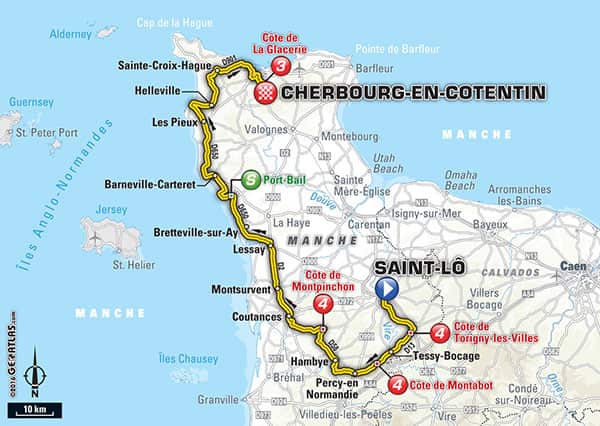
Saint-Lô, a city never used before as a start or finish at the Tour; Cherbourg-en-Cotentin, the harbour city of the Manche department, to be visited for the eighteenth occasion. This second leg is one for the puncheurs but history has told us that no less than five former Tour winners have won in Cherbourg-en-Cotentin, meaning escapees and GC favourites alike must be on their pedals as the day reaches its denouement on the Côte de La Glacerie.
Mountain passes & hills
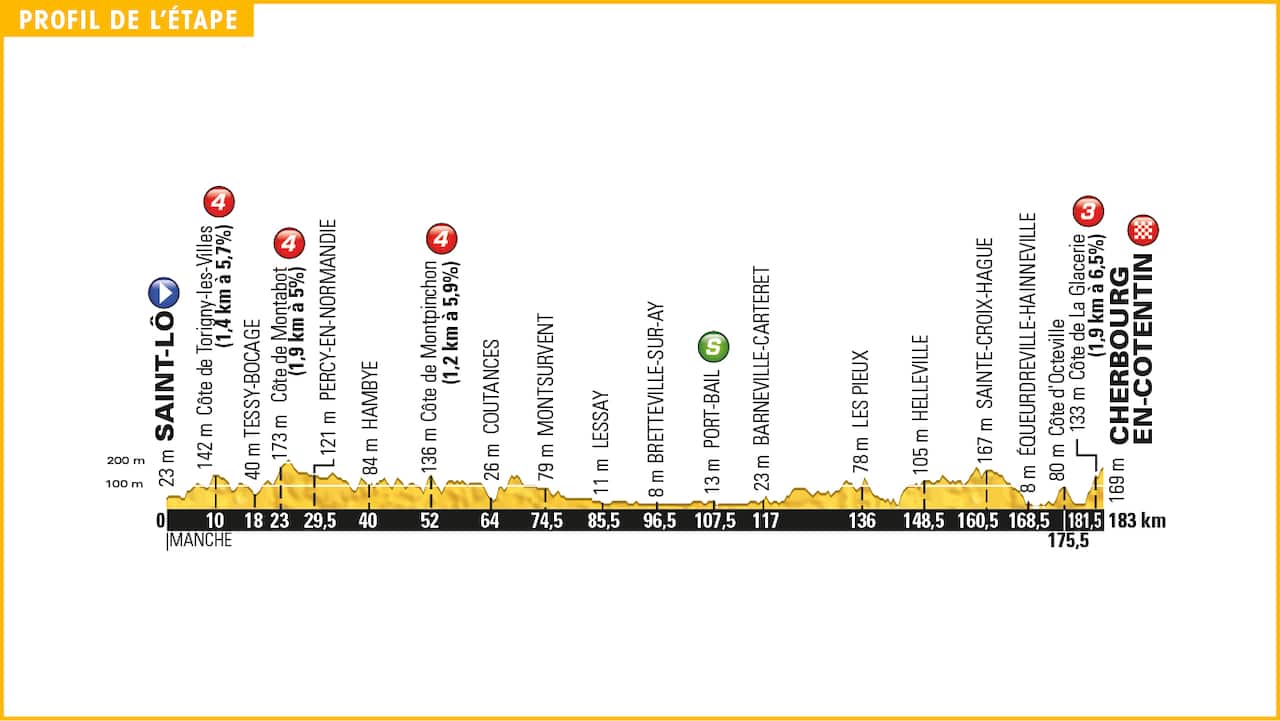
Km 10.0 - Côte de Torigny-les-Villes: 1.4 kilometre-long climb at 5.7% - category 4
Km 23.0 - Côte de Montabot (D28-D98): 1.9 kilometre-long climb at 5% - category 4
Km 52.0 - Côte de Montpinchon: 1.2 kilometre-long climb at 5.9% - category 4
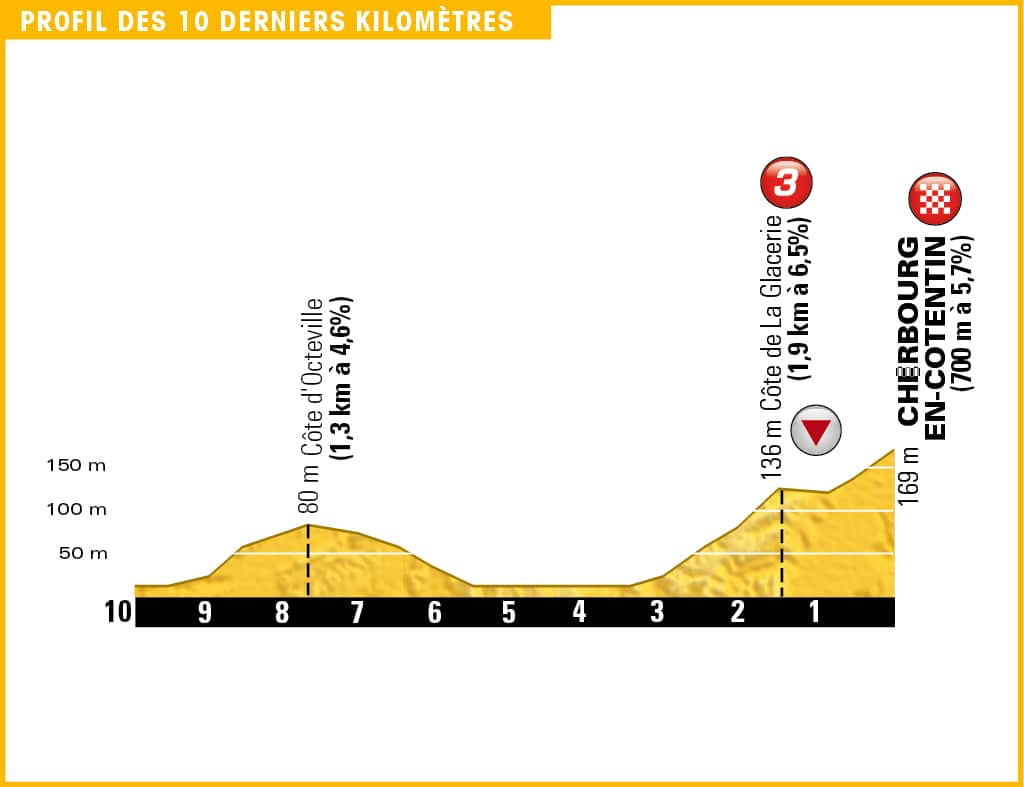
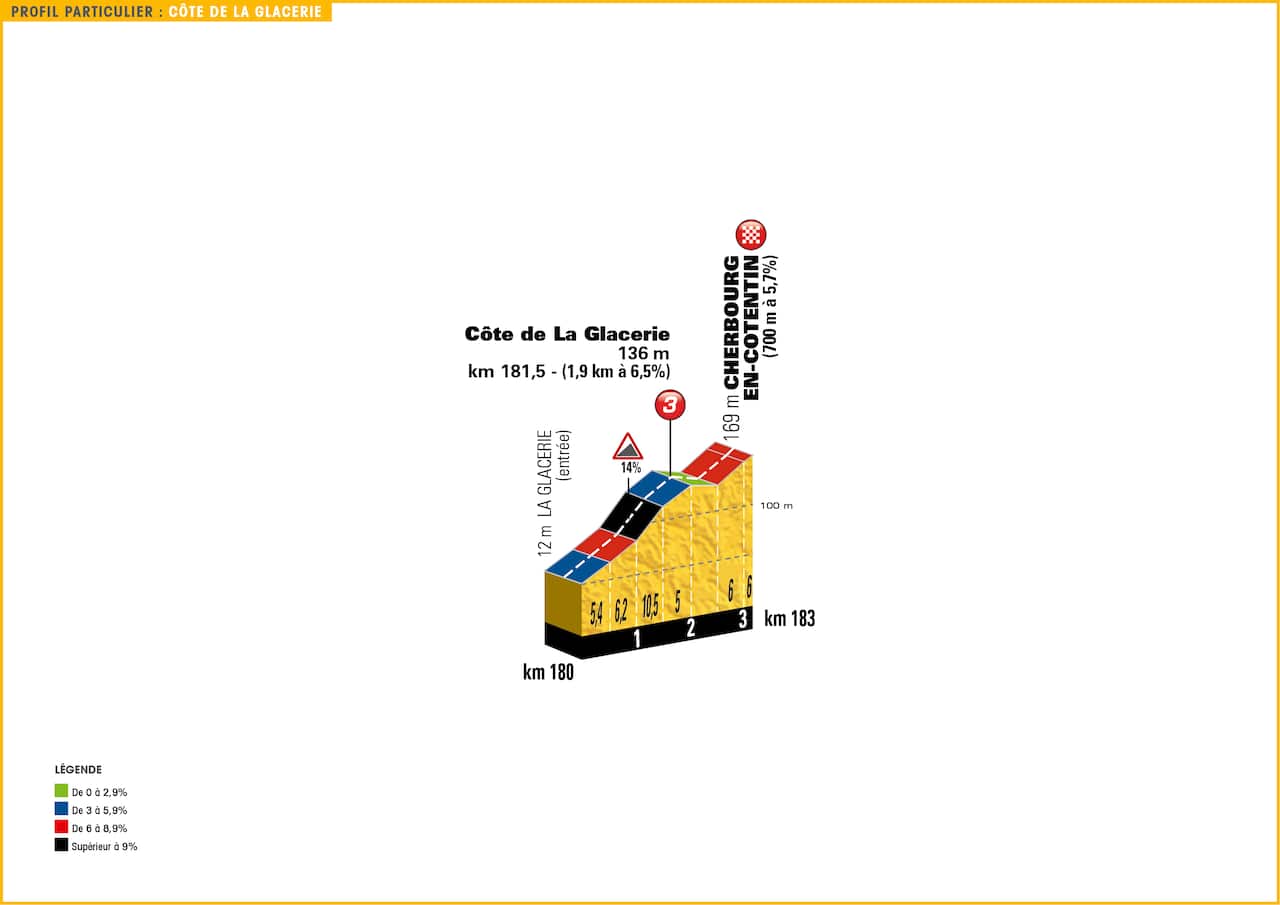
Km 181.5 - Côte de La Glacerie: 1.9 kilometre-long climb at 6.5% - category 3
The roadbook tells us the Côte de La Glacerie is 1.9 kilometres in length but the finish in Cherbourg-en-Cotentin is a further one-and-a-half kilometres from the top, thus making it a 3.4km effort. Should one attack on the 14 percent gradient at around 2km to go, or wait for the dip after cresting La Glacerie, when many will try and catch their breath before the final 700 metre, 5.7% ramp to the line?
Let’s not forget the run-in to La Glacerie, either. “The approach to the final climb will hurt everyone,” says La Manche local Anthony Delaplace of the Fortuneo-Vital Concept team, along with Alex Howes of Cannondale-Drapac the longest-surviving protagonist in yesterday’s escape, “especially if there’s a side wind on the coast. But we’re more likely to see splits and a whittling down of the peloton rather than echelons.”
Translation: If you want to win the Tour you need to be at the front today.
Since taking the helm in 2007, race director Christian Prudhomme, along with course director Jean-François Pescheux and since 2013 his successor Thierry Gouvenou, have designed Grandes Boucles that keep Tour contenders on their toes from the opening week. This year is no exception, and this stage, which will likely see a race for the win and a minor though not insignificant tussle between the overall contenders, is typical of that. “We will see a change of leader at the finish in Cherbourg-en-Cotentin,” Gouvenou says in the official Tour guide, meaning race leader Mark Cavendish will be making the most of his short-lived spell in yellow. “To animate the start of the Tour we’re looking for fast-finishing puncheurs, among whom Sagan, Valverde, Matthews and Vuillermoz are the archetypes.”
It is an irrefutable fact that the Tour is won in the third week but three weeks from today when the fat lady sings on L'Avenue des Champs-Élysées, those on - or off - the podium may be quietly celebrating (or rueing) the seconds gained or lost on days like this. Also, do not forget that time trials aside, bonuses of 10, 6 and 4 seconds await the first three place-getters on each and every stage.
A trick up his sleeve...
12 years and 10 days ago, on the morning of Stage 7 of the 2002 Tour de France, an Australian upstart from Sydney's western suburbs boldly described not just how he would ride the finale located in this department of Normandy they call La Manche (literally, 'the sleeve'), but how he would win - on SBS Television, of course!
Bradley McGee may have revealed his 'surprise' attack with a kilometre to go from the finish in Avranches but nothing could stop him overtaking Pedro Horrillo in the final uphill metres to claim his first win at Le Tour: "It was confidence and patience that got me this win today... I did a lot of training for this type of finish." That edition comprised a quartet of Australians - Baden Cooke, Robbie McEwen, Stuart O'Grady and McGee; this year there are nine. When all four finished in the top 10 that day in 2002, McGee was asked how come they all rode so well: "It goes without saying - an Aussie will have a go at anything. There's not many of us!"
Look how far we've come.
Christian Prudhomme, Tour de France race director, says...
“On the menu from Saint-Lô, the chef-lieu of the Manche area and a journey through the west coast all the way to Cherbourg-en-Cotentin. That's where the race will get harder with a fi rst ever fi nish at the summit of the Côte de La Glacerie. A 3km climb with a passage at 14%, therefore meaning seconds to be gained for the stage contenders and the favourites of the Tour.”

Watch the FIFA World Cup 2026™, Tour de France, Tour de France Femmes, Giro d’Italia, Vuelta a España, Dakar Rally, World Athletics / ISU Championships (and more) via SBS On Demand – your free live streaming and catch-up service. Read more about Sport

Have a story or comment? Contact Us