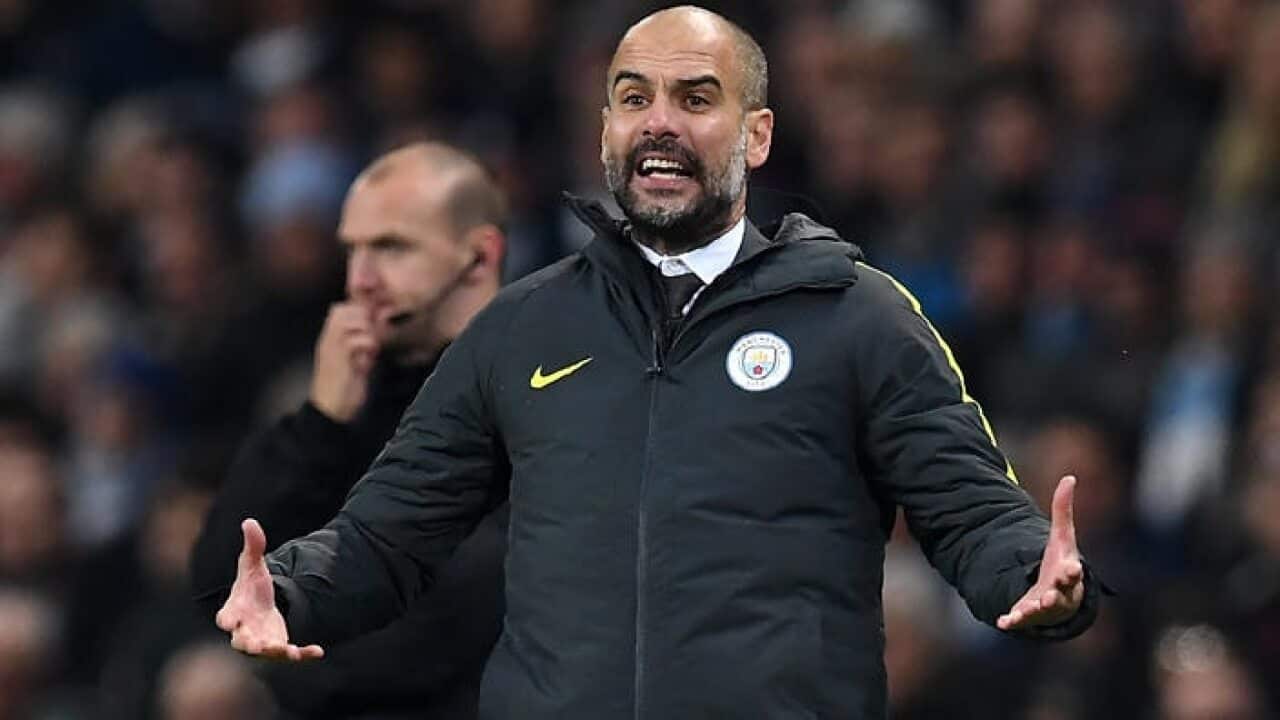
It was only a minute, but in that minute, he showed where his head is at right now. Unable to contain the frustration at the situation he finds himself in, the manager lost his cool. Curt, furious answers.
Great managers don’t need to play happy families with the press all of the time. Sir Alex Ferguson certainly didn’t. Brian Clough would taunt them for fun. Countless others have endured prickly relationships.
But Guardiola’s scorn wasn’t directly for the journalist involved. Moreover, he appeared seething at the entire English football industry: the refereeing, the interpretations, the fans, the press, the wider expectations. All at once, it appeared to boil over.
At half-time, the Catalan furiously gestured to the crowd to provide more noise. He urged them, then pointed to his ear – inferring he couldn’t hear them – before aggressively urging them again.
Earlier in the day, he told NBC that he was already thinking about the end of the line in his career.
“I will not be on the bench until I am 60 or 65 years old. I feel the process of my goodbye has already started,” he said. “I am arriving at the end of my coaching career, of this I am sure.”
To bring up such sentiments, unprompted, is disconcerting. Clearly, he is feeling totally isolated.
The culture of submission that exists towards big clubs in Spain and Germany is not replicated in England. In the Premier League there is not deference but deterrence. It’s a dogged and spiteful resistance. Hand-to-hand combat, not only between clubs, but stakeholders.
And for a period at the Etihad on Monday, with City reduced to 10 men after Fernandinho was sent off for the third time in six games, tiny Burnley looked like they might even force a shock result.
They didn’t, but the send-off so angered Guardiola that he couldn’t talk about it – instead answering a question about Fernandinho by talking about Burnely’s goal.
“All around the world, the Burnley goal on Claudio Bravo is a fault [foul]. Here, and all around the world, the rules say the goalkeeper in the six-yard box cannot be touched.” he said. “But, okay, so I have to adapt and I have to understand there are special rules here in England.”
The 2-1 win brought City to within seven points of Chelsea, but with Antonio Conte’s team holding a game in hand, and Liverpool stumbling at Sunderland, it’s all smiles at Stamford Bridge.
Guardiola appears to have evolved into a different version of the man who confidently and elegantly strode the touchline at Barcelona and Munich. Yes, he could manically flick his fingers, but it always seemed reasoned.
His critics will point out that he has had everything handed to him on a plate at two of the world’s biggest clubs, with little or no challenge put before him, and that England would find him out. They argue that the one year he was toppled – his last at Barcelona, when Real Madrid hit 100 points – he had to quit because of stress.
Unfortunately, because Guardiola is such a polarising figure, a reasoned analysis is likely to be clouded in emotion. In England, a shameful told-you-so mentality has emerged; Guardiola’s struggle is being taken as hard evidence that the Premier League is the best in the world.
It was during his pre-Christmas interview with Thierry Henry on Sky that Guardiola let slip how difficult it was to change his style.
“I try to play in one way all my career and here, for example with high pressing, when they have the ball we go to pick them up, it is not allowed, because it is not allowed,” he said. “Many times the ball is more in the air than the grass, and I have to adapt. I was in Munich and spoke with Xabi Alonso, and he said: 'You have to adapt, it's the second ball, the second ball!'”
“But really, you have to adapt to the second ball, and the third ball, and the fourth! I never before was focused on that, because in Barcelona or in Spain, more or less the players try to play for the culture. That's why they won World Cups, and they won the Euros, won the Champions Leagues, the Europa Leagues, all the time, all of the years, Spanish teams are in the latter stages, all of the teams.”
Unfortunately, the past two months mean this season is almost a write-off for City. Not quite, but almost. The bigger challenge isn’t about titles now but shaping this team for the future: working out the leaky defence, the ageing midfield and so on.
Can Guardiola adapt, as he promises to do? It's what all great managers must do eventually. If he’s going to succeed, he doesn’t have a choice.

Watch the FIFA World Cup 2026™, Tour de France, Tour de France Femmes, Giro d’Italia, Vuelta a España, Dakar Rally, World Athletics / ISU Championships (and more) via SBS On Demand – your free live streaming and catch-up service. Read more about Sport

Have a story or comment? Contact Us