When you see possibly less return and a lot of risk, the equation tilts away from cycling. The hoards of Melbournians that missed the christening of GreenEDGE last weekend wasn't the only surprise for me.
I also learned that the three-year commitment Gerry Ryan, the team's primary benefactor, has agreed to honour includes the year that we're in now – even though for the riders, racing won't commence till 1 January 2012, when GreenEDGE begin racing at the Jayco Bay Cycling Classic.
Doubtless, the financial investment Ryan has made over the past 18 months and particularly the last 12 has not been insignificant. However, it's probably more accurate to say Ryan will fund the team for two years rather than three, as until last Saturday, it led me to think GreenEDGE's future was secure till 2015.
It also explains why last Monday, when the team discovered its application for a WorldTour licence had been approved, GreenEDGE was awarded a two-year permit. "Gerry's put a lot of funding into this year, 2011," Bannan told me, "so in actual fact it is in fact a three-year commitment; the year to set up the structure, and then two years of the licence. So we asked for a two-year licence and that's what we got."
* * *
Bannan also said that "sustainability is one of our big objectives with this team".
In other words GreenEDGE is hunting not just results at WorldTour level, but a co-title sponsor who can bring a level of investment equivalent to or exceeding $6-8 million per annum - roughly one-third of the commonly accepted minimum outlay required to run an outfit at this level.
There's been plenty of talk that GreenEDGE had already secured a co-title sponsor for 2012. Bannan told me this was not the case, unequivocally saying the probability of his riders showing up to next year's Santos Tour Down Under wrapped in GreenEDGE livery, and only GreenEDGE livery, was "100 percent".
On 11 October, the day before the Herald Sun Tour kicked off in the Victorian town of Whittlesea, Ryan told me that "one or two companies in China" were interested in funding the project – a tacit acknowledgement that the team's search for an Australian partner had so far come to nought, and that his son Andrew, the team's commercial director, was now actively looking elsewhere.
Over the past two months, the forage for funds has gathered apace.
Ryan, Bannan et al know they must try and capitalise on Cadel Evans' history-making Tour de France victory and the magnified attention it has brought to Australian cycling, even if said winner has previously indicated he will likely end his career with his incumbent team, BMC Racing. Said Bannan: "Now we have a real opportunity to put something together quite special and unique. We are certainly talking and are in discussion – and still are in discussion – with several companies.
"But it was always going to be difficult selling a project," he said, "because we didn't actually get the licence till last week. But now, I think, we're really going to concentrate on the brand, GreenEDGE. And we believe in the next few months we will have successful discussions to have a partner come on board in 2013."
So, even if the hunt is successful, we may not discover the identity of the backer till the second half of next year.
* * *
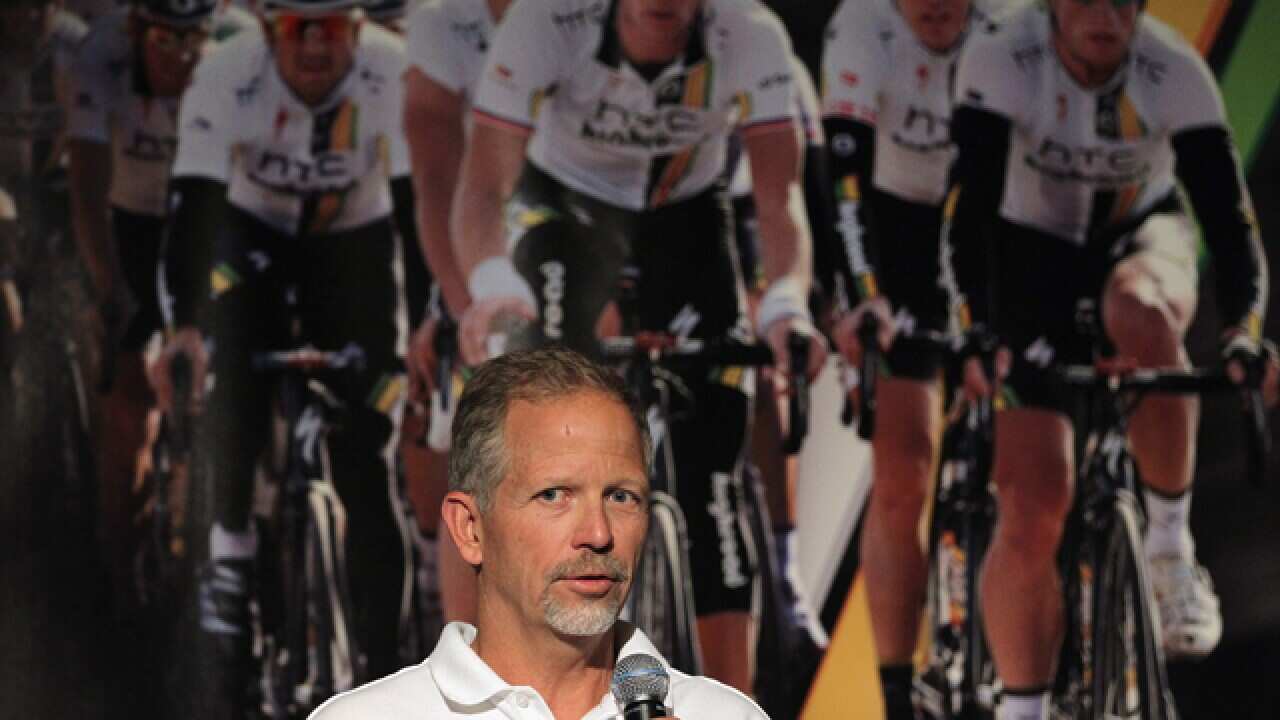
While many of you feel it should be a no-brainer for a potential suitor with a spare 10 mil in his trousers and a passion for cycling, consider what Bob Stapleton, owner of the outgoing HTC-High Road team, told VeloNews last week.
"Unfortunately, other sports have gotten to be better deals. Prices have come down, other than elite European football [soccer] clubs.
"All American sports' sponsorship rates have dropped," said Stapleton, "and second-tier European football, all the motor sports, they're all substantially down. And cycling's costs, if anything, are going up. So the historic cost advantage is even getting reduced. So when you see possibly less return and a lot of risk, the equation tilts away from cycling."
Before the Californian entrepreneur regrettably called an end to what has been the most successful men's and women's team the past three seasons, he considered merging with another team Рas Garmin and Cerv̩lo agreed to last year, and Omega Pharma and Quick Step, as well as RadioShack and Leopard-Trek, have settled upon at the end of this year. "But they were all really compromised," Stapleton said.
"We were all one team and all working toward the same goals, and I'm only interested in environments like that. Mergers or whatever, they are just compromised to start with."
Perhaps Stapleton should have reconsidered, because it'd be hard to argue that the Garmin-Cervélo partnership has been unsuccessful from either a sporting or business point of view. (Through no fault of their own, team owners Doug Ellis, Jonathan Vaughters and David Millar are still looking for a replacement partner after French building materials supplier, BigMat, chose to renege on their deal after initially agreeing to become a co-title sponsor.)
I also don't see the Omega Pharma-Quick Step and RadioShack-Leopard-Trek partnerships being deleterious, either.
In fact, the two best cases of internecine rivalry I can recall have occurred when riders have been on the same team by choice, rather than through any sort of merger or acquisition: the battle between La Vie Claire team-mates Greg LeMond and Bernard Hinault that reached its denouement at the 1986 Tour de France (and which LeMond won); and, more recently, the Lance Armstrong-Alberto Contador tête-Ã-tête in 2009 that again reached boiling point at La Grande Boucle, with Bertie coming out on top.
* * *
Though perhaps for Stapleton, he was less concerned with a merger than the thought of becoming the very thing he critically – and publicly – despised: a 'super-team'.
"These mergers are driving this kind of haves and have-nots," he said, sounding a tad aggrieved.
"So you really do have teams that have budgets north of 20 million Euro (A$26M), and then you're gonna have a bunch of teams that aren't close to that. And that consolidation is really destabilising the structure [of the sport] a little further.
"I got criticised by a senior cycling person about my statements about the super-teams before, but I did tell them I could count on my fingers and toes and get to 20 [million Euro] pretty quick on four or five teams  and I'm standing by that statement. We had chances to do stuff but we thought people were better off on their own than trying to cram organisations together and winding up with something that's adverse."
The upside to the end of HTC-High Road was that all 24 male riders found employment elsewhere, and on top teams (though five will no longer be on WorldTour squads next year), as did their sport directors.
Despite my run-ins with ol' Bob and members of his team – and I had quite a few – I'm going to miss the effervescent personality and his charges at the races next year, who had a certain chutzpah about them. Perhaps most importantly, they made you believe professional road cycling would find a better place and a happier face, at a time when the Operación Puerto investigation was in full flight and things couldn't get any worse.
So as far as I'm concerned, Bob, you're welcome back any time you want.
Twitter: @anthony_tan

Watch the FIFA World Cup 2026™, Tour de France, Tour de France Femmes, Giro d’Italia, Vuelta a España, Dakar Rally, World Athletics / ISU Championships (and more) via SBS On Demand – your free live streaming and catch-up service. Read more about Sport

Have a story or comment? Contact Us



