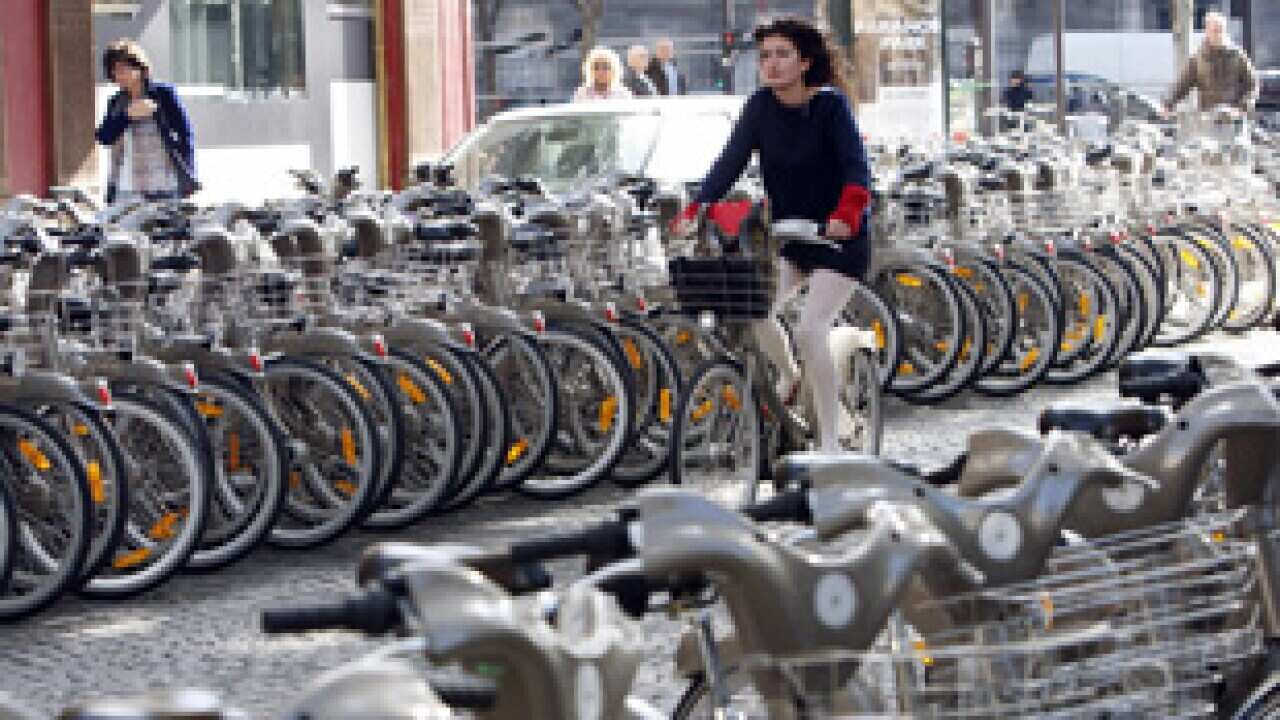
Around mid-2007, when the Vélib program began in the city that plays perennial host to the final stage of the Tour de France, I thought it was a great idea.
More people on bikes equals less cars equals a safer and greener city, were my initial musings.
However there was a spanner thrown into the spokes of this worthwhile program.
"The symbol of a fixed-up, economically friendly city has become a new source for criminality," mourned French newspaper Le Monde of the Vélib, Paris' bicycle rental system.
But in Rome for the final stage of the Centenary Giro d'Italia this May, I noticed the uber-cool Italians had also adopted their version of the Vélib program, which led me to think that it was only a matter of time before Lord Mayors of cities in Oz would follow suit.
With a Federal government pro-climate change, what better way to spruik our desire for a cheap, healthy, low-cost carbon alternative to the car or bus?
But in Paris, the bicycles are being vandalised by an anarchic youth. Others are being stolen and showing up on the black market in Eastern Europe and northern Africa.
80 percent of the initial 20,600 bikes – that cost $3,700 each – have so far been stolen or damaged.
And so, a program designed to create a utopian ideal has seemingly gone sour, where the V̩lib is seen as a trendy urban middle-class accessory Р"an accoutrement of the bourgeois-bohemes", Le Monde writes.
Sociologist Bruno Marzloff told the New York Times that social revolt is behind the vandalism – which in two years, has risen 54 percent; in particular, from those who live in Paris' less glamorous outer suburbs, many poor immigrants.
Despite this, I still feel such a system can work in Australia, and would in fact go some way to narrow the social divide between rich and poor.
Even the Parisians are undeterred, where over there, daily use averages 50,000-150,000 rentals a day (the variation based on the time of year), with more than 63 million rentals since the program's inception.
But with cycling-related accidents and fatalities also on the rise in countries like Australia and the US, we must first build the appropriate infrastructure to accommodate the Vélib or cycle-friendly pathways, particularly in Sydney. (In Kristina Keneally, at least NSW now has a premier who rides to work.)
Copenhagen, the city that will host this month's United Nations climate change conference, does not have a Vélib-style program, but 36 percent of the city's people rides to work or school each day.
Why? The city has over 300 kilometres of bike paths and more in the making, with many lanes "green" – the term given to thoroughfares for cyclists only. Plus they have a goal to be the world's first carbon-neutral city by 2025.
Maybe not in Paris, but over time, disenfranchised youth may even find inspiration from the bike, while saving the planet at the same time. First, though, there are some of those "green" paths to build.

Watch the FIFA World Cup 2026™, Tour de France, Tour de France Femmes, Giro d’Italia, Vuelta a España, Dakar Rally, World Athletics / ISU Championships (and more) via SBS On Demand – your free live streaming and catch-up service. Read more about Sport

Have a story or comment? Contact Us