

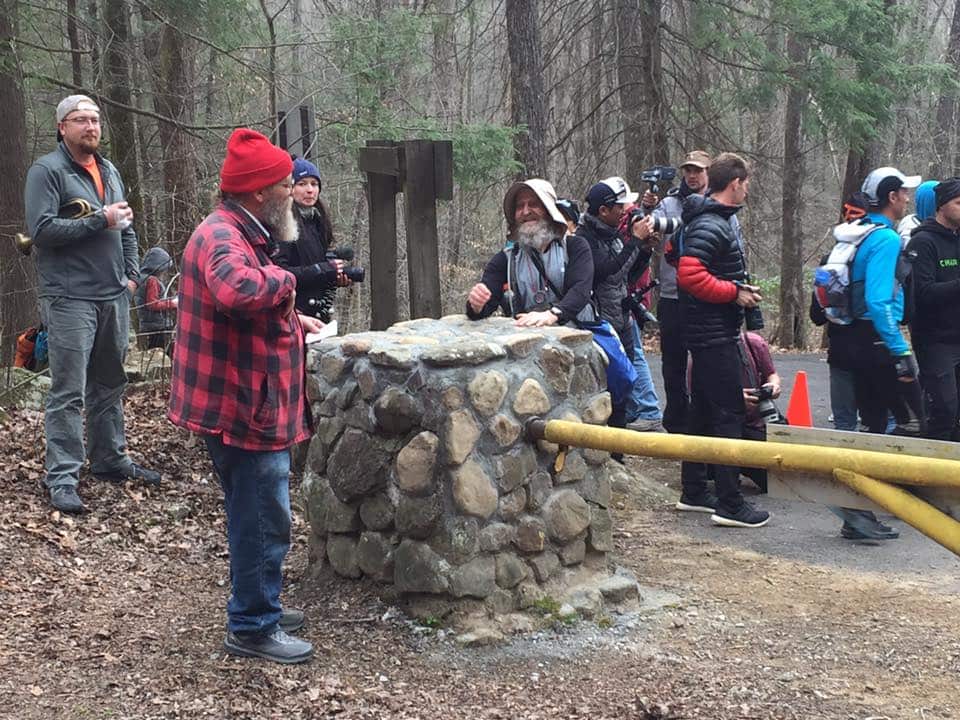
8.23am, 30 March 2019 Frozen Head State Park, Tennessee. The heavily bearded Lazarus "Laz" Lake blows a conch. An hour later, he lights a cigarette.
For those unfamiliar with the Barkley Marathons, it's a strange scene - some 'dude' blowing a shell and smoking a cigarette in the woods as a small crowd grows around him. But for the 40 runners gathered at the yellow gate, this ritual signals the start of the race and for most, hours of physical pain and emotional suffering.
The conch's toll elicited just one major response in Australian ultra runner Isobel Ross who took to the Barkley Marathons start line for the first time two weekends ago.
"I got goosebumps because that was something I'd dreamed about for so long," she said.
Lake can blow the shell at any time and has often done so in the middle of the night. But being prepared for an impromptu start is just one of the Barkley Marathons' many challenges.
Himself an ultra runner in the 1970s and last year walked across America, Lake (formally Gary Cantrell) somehow and for some reason dreamt up the Barkley Marathons, first held at the 100 mile distance in 1989.
He was inspired by James Earl Ray's 1977 escape from nearby Brushy Mountain State Penitentiary. Authorities found Martin Luther King Jr's assassin in the woods 54 hours later, soaked in sweat and mud, physically OK but he only covered around eight miles. The legend goes, Lake mocked Earl Ray's efforts saying to himself he could at least do 100.
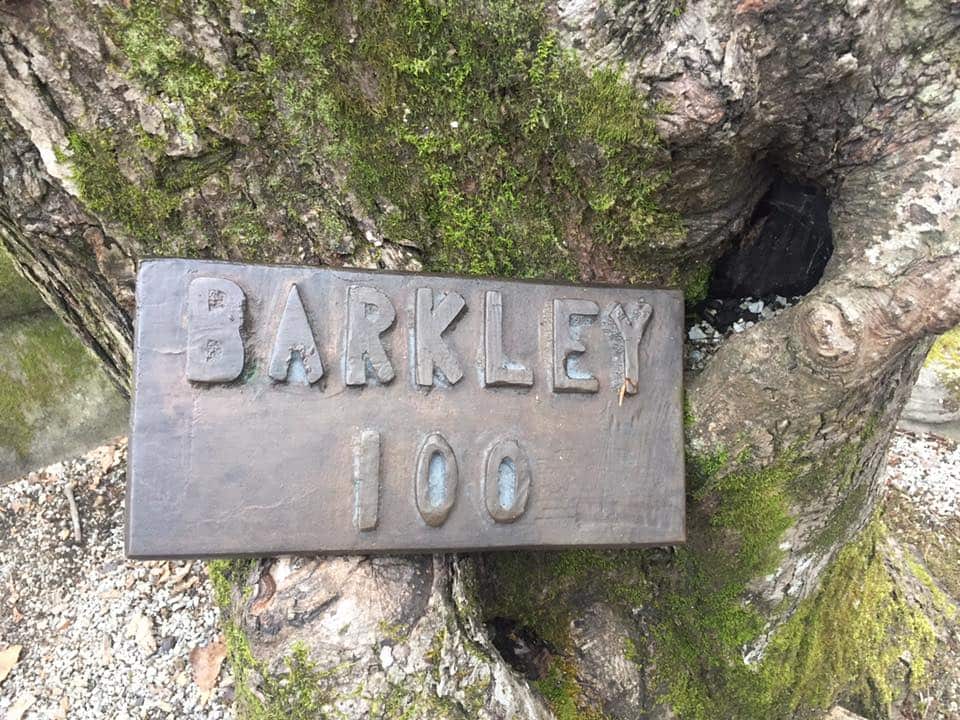
But this is not some simple 100-mile ultra race in the woods comprising five, 20-mile loops. It's "where dreams go to die," a 2018 documentary quipped, or as the 2014 Netflix documentary dubbed it, "the race that eats its young."
For starters, a loop is closer to 26 miles than the inexact 20. While some features stay the same, the course changes every year, the final map unveiled only a day before the conch sounds.
Runners must copy the map and the only navigational equipment allowed is a compass. No GPS devices, smart watches, or even go-pros. Lake does issue lo-fi wrist timekeepers to racers, but each displays only race-time elapsed.
No official event website exists and information about the race is widely unavailable, passing purely via word of mouth. Yet hundreds submit applications each year. Lake picks just 40, a mix of veterans and 'virgins', and confirms their selection with an official 'condolence' letter.
Ross applied for the first time this year and was somewhat surprised at her selection.
"Yeah, that’s pretty amazing, I’m pretty lucky you know, I obviously applied at the right time and all the planets aligned for me or something."
Add 10,000+ feet of climbing per loop (50,000+ feet in total, Mt Everest is 29,029) - mostly OFF trail through brambles, creeks and mud - to another quirk: runners must find 14 books hidden out on course, ripping out the page corresponding to their bib number, and handing the collection back to Lake at the start/finish gate.
The Barkley Marathons course wins again
Since 1989, only 15 men have 'finished' the full five loops within the 60 hour time limit. No one finished this year or last. Sue Johnston's 66 miles in 2001 is the best women's achievement.
A 'fun-run' (three loops within a 36 hour time limit) is the most competitors realistically hope for. It was Ross' goal anyway.
"I knew (it) would be a huge stretch - you’ve got to kind of go in to these things with stretched goals. Two loops would be like awesome and probably realistic was one loop and getting out on my second," she said.
Ross finished the first loop in 16 hours and 50 minutes, several hours outside the time cut off.
"I’m pretty disappointed that it ended up I didn’t even complete, well I completed the loop but not in the time."
Disappointment, maybe. But not failure. It's the Barkleys; where failure is not even a construct, even as the bugle plays 'Taps' for for each competitor bowing out.
"I actually really enjoyed that," Ross said. "I know it meant I tapped out but it was still a really good experience because I knew I’d done, under the circumstances and everything, the best I could."
Ross is no stranger to painful ultras, tackling some hard races since taking up the sport 12 years ago. Like the 2016 100km CCC in Switzerland and in 2017, nearly breaking down as she completed 198km in 24 hours on a Brisbane athletics track. Sounds like hell, but it's why she lines up again and again.
"The 24 hour track race...I realised how hard I could push my body to the point where I could barely run or even move in a straight line. Each race teaches me there is so much more we are capable of than we realise.
"You really grind yourself down to the point where it's just you and your rawness. Your basicness. And how much you can keep going when EVERY single part of you is telling you to stop. And I just like to see what I can do. How far I can go."
"Each race teaches me there is so much more we are capable of than we realise."
Ross didn't get the chance to feel much of the Barkley Marathons emotional and physical burn. And she knows why.
Those damn books.
"This (other) 'virgin' and I...got lost looking for a book for like an hour, an hour and a half. We were in the right spot. But by that time it was dark, it was raining."
But far from feeling like suffering, the camaraderie was too much fun.
"Normally if you were on your own you’d get pretty upset. We ended up just sitting down because we’d been looking for an hour and 'let’s just have a break' and we sat down and we chatted...had a few laughs and then we got up and found the book five minutes later.
"I’d never met her before that day but we got on so well and we were having so much fun – it really added to the race and when we came into the yellow gate we were just laughing and couldn’t believe how awesome it was.
"So even though it was wet and cold and miserable you know in theory it actually wasn’t because it was such a surreal, awesome experience."
The rest of the race she experienced mostly alone despite wanting to find a veteran or two to help her out on course. She did find one mid way through but it wasn't enough. As a result, Ross knows exactly what she needs to do differently next time.
"I’ve got to spend a lot more time working on my navigation, doing rogains and orienteering events and all that sort of stuff.
"Most Australian ultras aren’t overly marked but generally you have a pretty good idea where you’re going. This is completely different. Like you’ve really got to rely on your map and your compass and reading the land. Like 'am I on a ridge, am I going into a gully? Where are the creeks and rivers' and all that sort of thing.
"So being able to read the land comes from experience more than anything which I had been working on but I think I could improve."
To Ross, it is this mental game which makes the Barkleys so hard.
"Each race you do you feel like that’s the hardest one you’ve done but I think the Barkleys is harder because you’re having to use your mental skills so much. And that’s actually really draining as well.
"In a normal race you just follow the course and the track you don’t think about anything you just run whereas Barkley you have to do a lot of thinking as well it’s amazing how tiring it is just using your brain."
"Everybody knows it. You could be at work and sitting at a desk and if you have to do lots of thinking you’re exhausted at the end of the day. Combine that with also moving and then cold and I was slipping and sliding and falling everywhere. But you know, I ended up, just laughing.
"We were less than a kilometre from the finish line and I slipped crossing a creek and fell full body into a creek. This is like 1.30 in the morning."
Ross said she also needs to add more strength work to any future Barkley Marathons prep which this time round included midnight runs and training at the Melbourne Altitude centre.
"I need to get stronger legs because the hills are so steep. So a lot more strength work. I’ve just got to try and find the steepest climbs...where you’re really on your toes pushing and your calves are working because I found my calves were cramping."
Ross is a teacher when she's not ultra running and knows what's harder.
"Teaching. Way, way harder. I'm serious here!"
As Ross eyes the Great Southern Endurance Run in November but more immediately holiday ambling in New Orleans and Utah, for now, the Barkley Marathons has left her with another memento she must deal with.
"I’m actually covered in some sort of allergic reaction to the plants in the Frozen Head State Park. So it’s like over all my skin, itchy and I’m just putting cortisone cream on, slathering myself.
"There’s obviously something in the park. Because you’re navigating, you’re off trail you’re right there in it. But that’s just all part of the challenge."
The Barkley Marathons course wins again.
For the gear geeks:
Isobel Ross used sponsor La Sportiva's Helios shoes "because I like low drops and I like they're not too cushioned. I like to be able to feel the ground under my feet." She wore general clothes like capris but started the race in shorts and a singlet at the start, with a long sleeve top and a rain jacket for later. She wore Moxy (not a sponsor) shin guards and gators which also helped with the cold and protected her legs.
"And definitely poles!"
Want more running? Catch up on the Paris Marathon on SBS VICELAND and SBS On Demand, 21 April from 1330 AEST.

Watch the FIFA World Cup 2026™, Tour de France, Tour de France Femmes, Giro d’Italia, Vuelta a España, Dakar Rally, World Athletics / ISU Championships (and more) via SBS On Demand – your free live streaming and catch-up service. Read more about Sport

Have a story or comment? Contact Us