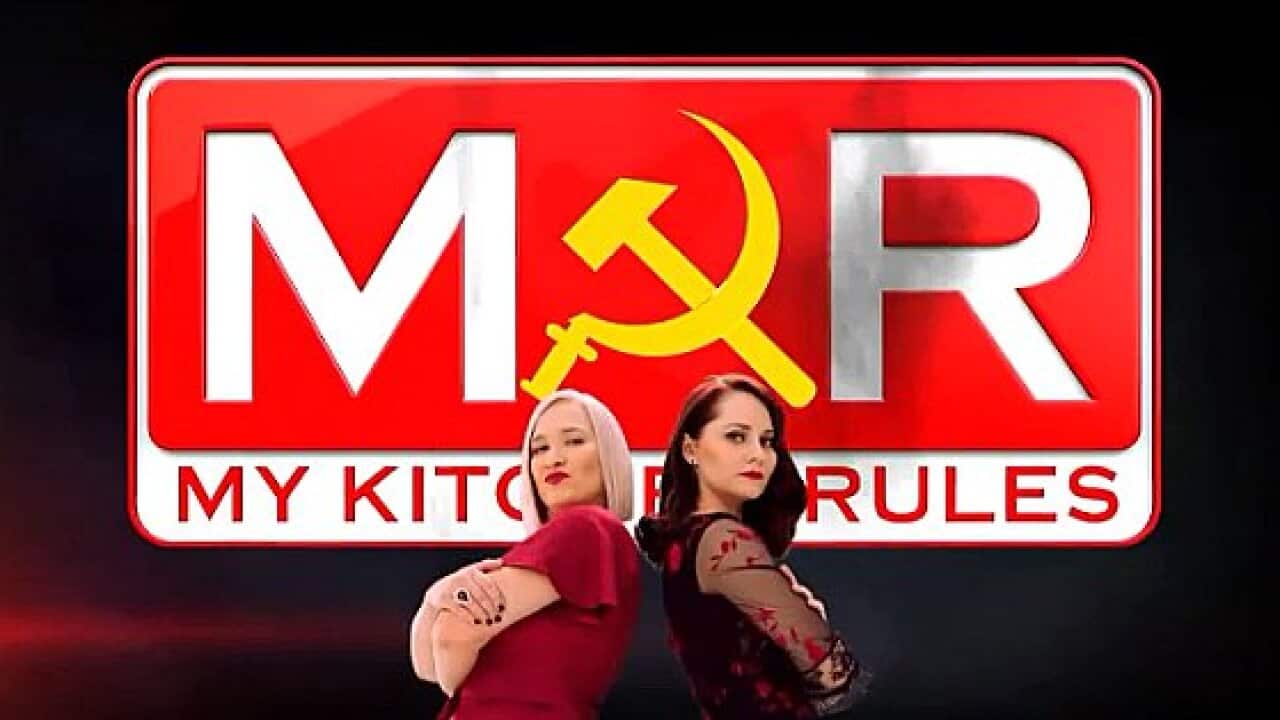
The 2018 season of My Kitchen Rules featured Olga and Valeria, labelled ‘cooking comrades’ by the show’s producers and cast as the trademark villains of the reality show. Rather than develop these characters as individuals, the producers instead created simplistic caricatures with the kind of subtlety and nuance usually reserved for a Trump tweet.
There was barely a scene which didn’t include the heavy-handed use of red, countless babushka dolls, or a soundtrack of Russian folk songs. In case that wasn’t obvious enough, Channel 7 threw in an enormous hammer and sickle in the promotion of the show.
Though the ad caused a minor stir online, the show continued to serve up a narrow, clichéd, and highly contrived portrayal of two Russian Australians, with a side of offensive narration featuring lines like: “The red army arrives”, “world domination is on the menu” and “will the Kremlin crumble?”
The message was clear - Russian Australians are a confusing, and occasionally menacing 'other'. Through their food, culture and attitude, the Russian pair’s foreignness became a source of tension and threat for competing teams, and for viewers.
It’s not the first time I’ve had my identity reduced to a two-dimensional cultural trope. I’ve been to more events than I can count where I’ve been introduced as “The Russian”, including by a former boyfriend who thought this would be an appropriate opener when meeting his friends for the first time. This cultural shorthand assumes everything there is to know about me based on my ethnicity alone. And people do - leaning on an overarching narrative that’s heavily rooted to Cold War caricatures.
My family migrated to Australia when I was five, so I’ve lost my accent, and the only way that you might guess that I’m from Eastern Europe is if you see my surname, or I tell you. While my whiteness and my Australian accent afford me considerable privilege, the discussion of my cultural background seems to attract a plethora of bizarre comments that illustrate a comfortable prejudice, masked among jokes.
If my background comes up at the at a party or at the pub, the conversation typically nosedives into a series of vodka jokes and questions about Putin’s penchant for shirtless photoshoots.
This takes place in a country with a deep-rooted race problem, and many Australians fail to understand the deep hurt caused by racial prejudice in our country. As a white Australian, I’m spared from much of this. However, as a Russian Australian, I have experienced a prejudice that comes from being part of a culture that is still perceived as unusual, unfamiliar, exotic, and at times - a threat. '
If my background comes up at the at a party or at the pub, the conversation typically nosedives into a series of vodka jokes and questions about Putin’s penchant for shirtless photoshoots. Somewhere in between communism and Crimea, I’ll be asked to “say something.” That’s always made me cringe.
Sometimes, the authenticity of my heritage gets called into question - “are you really, really Russian?” I feel like this question is an attempt to suss out which camp I’m in - whether I’m ‘Australian enough’ to laugh along to the story about bear-wrestling in the Russian wilderness, or ‘Russian enough’ to take offence.
The villains are the crazy ones, the evil women, the femme fatales, assassins, Russian mafia - the authoritarian Russian characters who intimidate, dominate, manipulate, and use their sexuality as a weapon.
Russian identity is particularly difficult to navigate as a woman. There are a few common reference points for Russian women in popular culture, and they’re often narrowed down to the villains, or the victims. This absurd binary continues to underlie the shallow cultural tropes we see in shows like My Kitchen Rules, many of which emerged from the Cold War days, and continue to position Russia as a sophisticated and capable threat. The villains are the crazy ones, the evil women, the femme fatales, assassins, Russian mafia - the authoritarian Russian characters who intimidate, dominate, manipulate, and use their sexuality as a weapon.
Jennifer Lawrence’s latest box office hit Red Sparrow doubles down on this fetishistic portrayal of Russianness - following a strong tradition of highly sexualised female Russian villains across genres, from Cate Blanchett’s Irina Spalko in Indiana Jones and the Kingdom of the Crystal Skull, Barbara Bach’s Anya Amasova in The Spy Who Loved Me and Mila Jovich as Zoolander’s Katinka.
Naturally, Lawrence’s character is cold and authoritarian. She wears a lot of red, kills people in service of the state, spies on CIA agents, and poses a major threat to the US. Oh, and she’s a ballet dancer too, because all good Russian women practice ballet.
On the other side, there are exoticised, sexualised, submissive women - often floating around in banner ads advertising sex and romance in neighbouring suburbs. Beautiful, doting Russian brides who marry wealthy Western men for the promise of a better future, or young, beautiful rags-to-riches girls from rural Russia who make it big on Western catwalks. These portrayals are all too common in film and fiction, but when you lift the veil, you see that they’re still empty archetypes with little emotional depth who are ultimately an accessory in men’s stories.
These stereotypes oversimplify identity, and prevent a deeper understanding and empathy of another’s culture. While it's tantalisingly easy to reach for cultural clichés and simple stock symbolism to understand Russian culture, they cannot and should not be used to define it. We need to realise that two or three symbols served up on a plate, don’t capture the nuance of migrant identities. While Australia’s dialogue around race, culture and identity continues to evolve, there’s still a long way to go. Why is it still okay for Channel Seven to promote their ‘cooking comrades’ with a hammer and sickle? That’s food for thought.