Ah, the age-old question, one hotly debated between two rival camps.
The first is the nature group, who believe prodigies possess innate genetic brilliance.
The second group – the nurture camp – lean towards family environment, hard work, practice and social background as being bigger factors in producing these precociously beautiful minds.
How do the 19 children on SBS’s Child Genius do it? Is their startling intelligence inherited or just a quirk of nature?
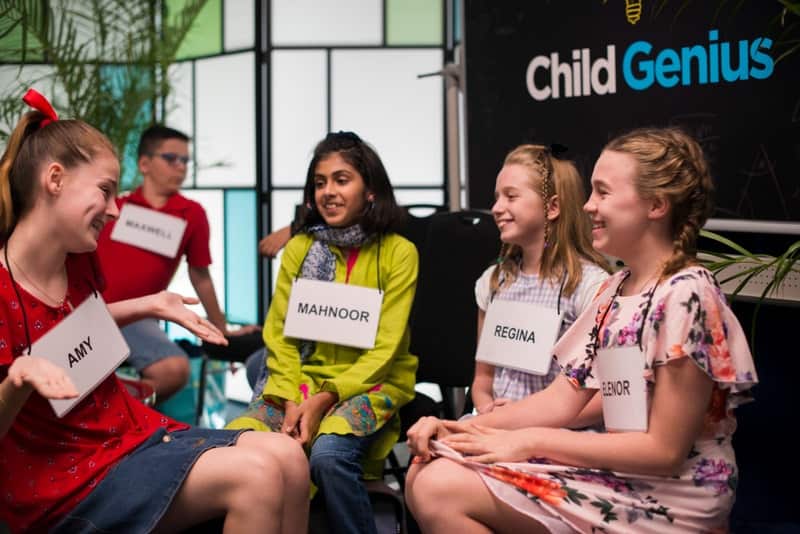
It’s tricky to pinpoint. Take Peter – the chubby-faced boy wonder from Darwin who skipped three grades in school, and is now in Year 9 at age 11. He not only spells pipistrelle right but sesquipedalian, achieving a perfect five out of five in the spelling test.
He runs riot through the mind-bendingly difficult anagram challenge that fells others.
His father Henri is a chemical engineer and has encouraged and exposed his son to all kinds of enriching academic experiences from young.
Another series contestant, Nathan, achieves instant fame for being able to spell not just otolaryngology but untangling binturong [a bearcat native to South and Southeast Asia, for all those in the dark; most of us probably] from an anagram.
So, nature or nurture?
Increasingly, researchers are taking a more fluid, less binary approach to the question of intelligence.
Researchers David Henry Feldman and Lynn Goldsmith concluded that the prodigy phenomenon is the result of a lucky “coincidence” of factors: a complex soup made up of everything from healthy social/emotional development, birth order and gender, education and cultural support, to access to training resources and family support.
Class and socio-economic background also play a part, as research from Stanford University on the “lost Einsteins” of the US education system has shown.
Hard work and practice – Einstein’s famous maxim of “99 per cent perspiration and 1 per cent inspiration” – comes up as a particularly potent variable, backed by everyone from Malcolm Gladwell to psychologist Angela Duckworth who says old-fashioned grit and perseverance often counts for just as much as natural intelligence when it comes to success in life.
As Larry Vandervelt has written, “whether they are child prodigies or not, gymnasts must practice, pianists must practice, stone-tool makers (in anthropology classes) must practice. Everybody must practice to get good at anything, and the cerebellum is the key.”
Still, this more organic model of intelligence has been disputed in recent studies, including twin studies that have suggested that between 40 and 80 percent of the variance in IQ is linked to genetics.
It suggests that genetics may play a larger role than environmental factors in determining individual IQ.
In the longest-running study of gifted children ever, scientists followed 5,000 children who tested in the top one percent of intelligence for over four decades and found that that intelligence plays a huge role in achieving success later in life.
These findings contradict two long-held theories, according to the science journal Nature: the idea that high performance comes mainly from practice and that that "anyone can get to the top with enough focused effort of the right kind."
Making the nurture versus nature debate even more complex, research has found that IQ is not fixed; instead it goes up and down during a person’s lifetime.
While most of us are too old to become child prodigies, we can still improve our working memories through brain training. Studies have shown they can improve working memory performance permanently and significantly.
There is hope for us dunces of the world, after all.
Four-part series Child Genius Australia will air weekly from Wednesday, 20 November at 8.30pm on SBS. Catch up anywhere, anytime after broadcast on SBS On Demand.