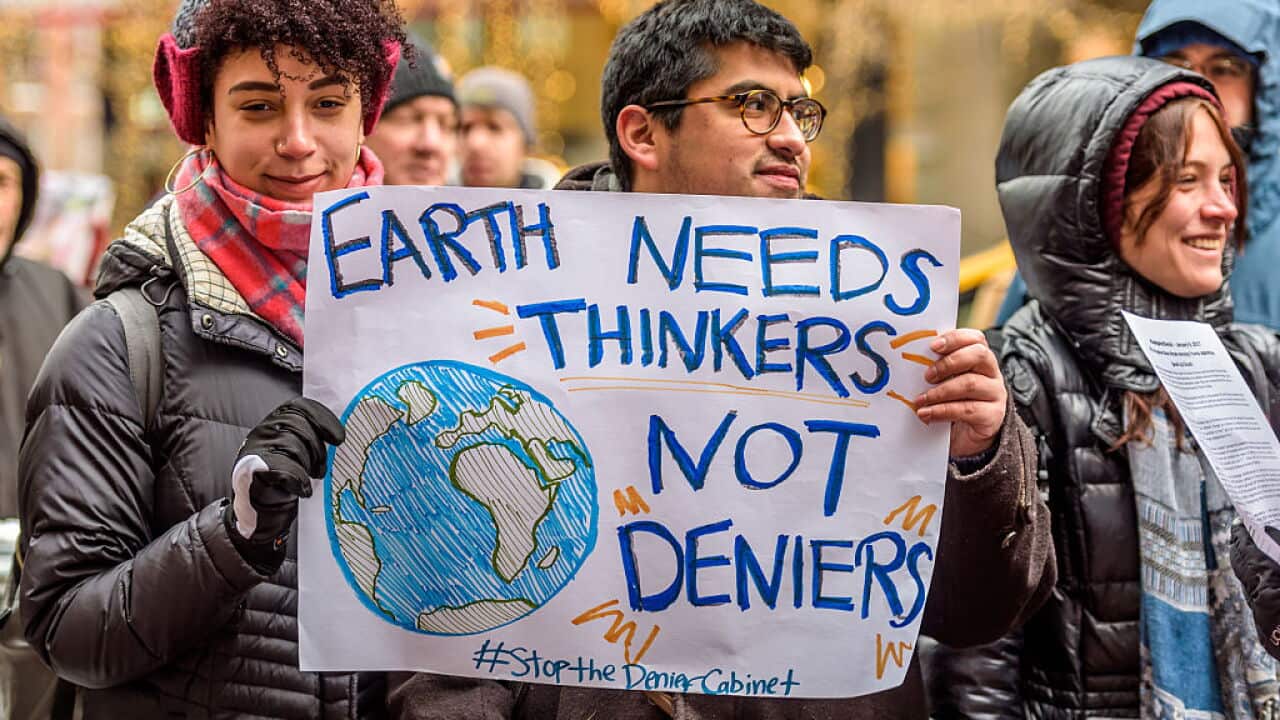
On Saturday April 22, scientists and their supporters will take part in about 500 marches in 40 countries around the world.
The march was conceived online in the wake of US President Donald Trump's inauguration and his administration's handling of science issues.
"People who value science have remained silent for far too long in the face of policies that ignore scientific evidence and endanger both human life and the future of our world," organisers have written on the March for Science website.
"We face a possible future where people not only ignore scientific evidence, but seek to eliminate it entirely. Staying silent is a luxury we can no longer afford. We must stand together and support science."
Around one million people have registered to march at events throughout the US, which are also being attended by staff from some of the country's biggest scientific bodies.
The main march will be held in Washington DC, where scientists and educators will discuss their work, effective science communication strategies and training in public advocacy, before marching through the streets of the city. It will also be live streamed as a virtual march, for those who are unable to attend.
In Australia, marches will be held around the country, in Brisbane, Canberra, Melbourne, Sydney, Cairns, Hobart, Perth, Townsville and Launceston.
Australian of the Year, biomedical scientist Alan Mackay-Sim, will take part in the Sydney march, as will environmental engineer Stuart Khan.
"I have long been concerned about the alarmingly low levels of appreciation for science exhibited by politicians in Australia as well as in other countries," he tells ScienceMag.org.
"I firmly believe that an improved appreciation for science holds the key to all of the great challenges we currently face."
Tammie Smith is a data analyst at the University of Sydney and a member of the Australian March for Science organising committee.
"I am a proud Australian Aboriginal woman, of the Dunghutti and Bundjalung peoples. I see [the march] as an opportunity to bridge the science and Aboriginal Australian communities," she tells ScienceMag.
"We need to be more inclusive in science. We should promote awareness of Aboriginal Australians’ views and encourage all Aboriginal peoples interested in a science career to study and go for it."
Around the world, people are getting their signs, banners and accessories ready.