
Supriya Benjamin “accidently stumbled” upon learning Mongolian as a summer course at the Australian National University (ANU).
“I had no holidays planned and thought I might as well get some credit units,’’ she says.
It was no ordinary classroom. The course was offered in a ger, a traditional Mongolian yurt set up on campus, with a visiting professor from the National University of Mongolia.
Supriya was immediately intrigued.
“It was the best experience I’ve had,’’ she says.
“We learnt about the nomadic Mongolian way of living, how a big part is still herding and living in ger on the steppes.
“The country has a grand history that I didn’t know about, with leaders such as Genghis Khan,’’ she says, referring to the vast Mongolian empire of the 13th century which stretched from Europe to China.
“I thought: ‘I must go to there and see it for myself’,’’ she says.
“The best way to learn a language is to immerse yourself.”
Supriya enroled to study Mongolian at the School of Culture, History and Language at ANU, the only university in the Southern Hemisphere offering the language. In June 2017, she travelled to Mongolia on a DFAT New Colombo Plan scholarship.
The trip involved meeting with government and media officials, NGOs and mining company executives in the capital Ulaanbaatar to deepen her understanding of the political and economic framework of the country.
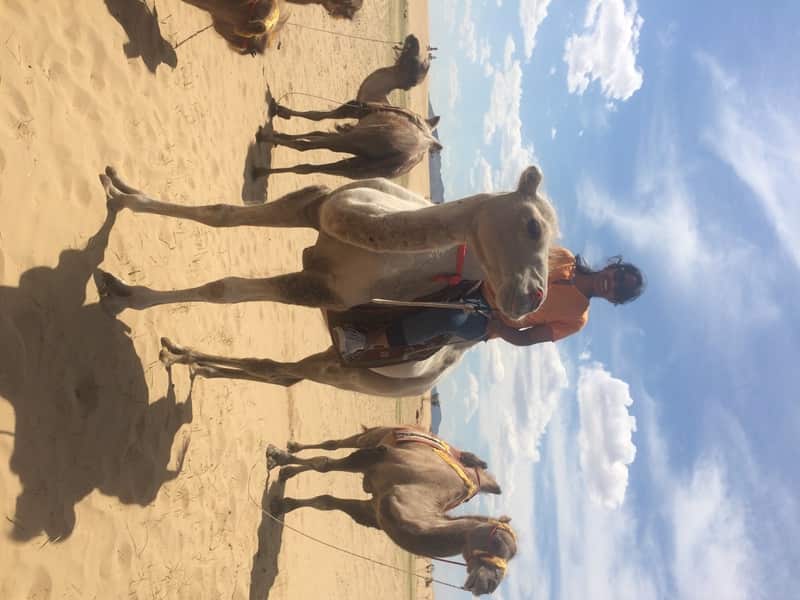
Rich in mineral deposits with a booming mining industry, Mongolia is a hub for a growing number of multinational giants including Rio Tinto, which operates copper and gold mines.
Supriya saw the challenges for the agricultural industry in a country that lives with drought and temperature extremes, where the mercury can drop to minus 40 degrees Celsius at night.
But what interested her most was visiting rural communities to meet families still keeping up nomadic traditions.
Horses are greatly revered and Mongolian herders are expert riders; young boys learn to ride from as young as age three. The horse population outnumbers people, and horse racing is a key part of the ancient Naadam festival.
Supriya tasted local dishes such as mutton roasted over a fireplace as well as cheese or dried curds made from the milk of yak and cattle. She even tried the national beverage airag, or fermented mare’s milk.
“In the ger at night, we would sit in a circle and the oldest would pour a shot of vodka. You would drink and share your story or problems. It’s an open conversation about a whole range of things.”
“It’s something I’ll never forget.”
Supriya was impressed to meet so many women in senior positions. Women in Mongolia are more educated than men and have lower unemployment, known as the ‘reverse gender gap’.
“Women don’t take their husband’s surname and the way they are addressed is full of respect, so that was another myth busted – the stereotype of gender inequality,” Supriya says.
The language fascinated her as well. Mongolian has its own traditional script read from top to bottom that is gradually making a comeback in society, though the Cyrillic alphabet is most commonly used – a legacy of Russian colonisation.
“Mongolian is completely different from Chinese (Mandarin), so a lot of misconceptions I had were debunked,” she says.
Supriya found the Cyrillic alphabet made it easier to learn than Japanese, which she is also studying. The grammar was relatively simple to grasp, with quite a few loanwords from English.
She has been studying Mongolian as an undergraduate subject online. From 2019 it will be formally added to ANU’s online Asian languages program through its partnership with Open Universities Australia. Supriya found the course “surprisingly easy’’ to adapt to after her experience of the summer course in the ger.
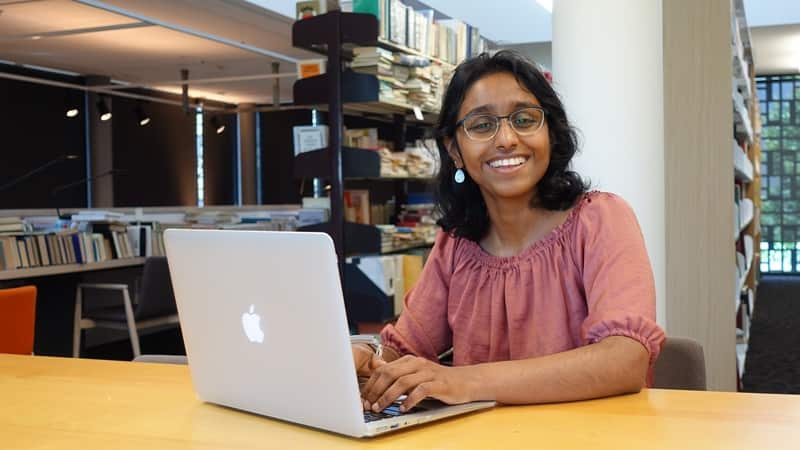
The course provides weekly video tutorials and online learning modules, combined with six hours of independent study. Lessons include discussions about contemporary topics in addition to the traditional pillars of language learning such as vocabulary and comprehension exercises.
“I thought I would struggle with online learning but I have not felt I’ve lacked any knowledge. I’ve got the lecturer checking up on the class once a week and they’ve been very reachable on email and always happy to Skype,’’ she says.
Supriya has found technology has made course assignments easy, even those which involve speaking.
“You can record yourself talking and send it through,’’ she says.
“The way they’ve done the course is really shaped for an online environment.
“I haven’t found any difficulties.”
Supriya has had peers and even her parents question why she is learning Mongolian. “The reaction from other people definitely makes for a good conversation starter,’’ she laughs.
But she can see the career advantages to having a niche language, and is determined to return to the country to work after finishing her double degree in International Relations and Asian Studies in 2019.
Mongolia interests her because “not a lot is known about it”, despite it being a huge landmass with potential for trade with Australia. Asian Studies at ANU had opened her eyes to the importance of the region, and hidden perspectives often not shown in the Australian media.
“I realised there was a lot happening in the [Asia-Pacific] region that a lot of us are ignorant about. There’s so much scope to work within the region to better the relationship with these countries,” she says.
Her long-term career goal is to help improve Australia’s trade relationship with its Asian counterparts.
She sees potential for agricultural trade with Mongolia; its increasingly urbanised population is moving away from its traditional meat and dairy diet, which could deliver a boon for Australian exports of fresh produce.
“To boost trade there needs to be a deeper level of understanding,’’ she says.
“Australia is in the region geographically, but mentally it’s still looking towards the US. It’s about time we shifted our focus to the Asia Pacific, not just for economic purposes but for political reasons, too.’’
ANU is the only university in the Southern Hemisphere offering Mongolian, and from 2019 will offer it online through its partnership with Open Universities Australia.
ANU offers 16 Asian and Pacific language programs that give students the skills and knowledge to succeed in the Asian Century. Nine of these languages – Burmese, Hindi, Mongolian, Sanskrit, Tetum, Thai, Tibetan, Tok Pisin and Vietnamese – can be studied entirely online via Open Universities Australia. Enrol now to start studying in 2020: open.edu.au/online-courses/australian-national-university