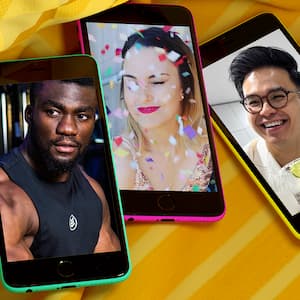
Getting a hookup on Grindr is a challenge in Cuba.
First there’s the difficulty of logging in. Communications infrastructure - after almost 60 years of communist rule - is desperately lagging behind.
The internet is only available at government-run wifi hotspots - often in public parks and squares - where Cubans and tourists crowd together, eyes glued to their smartphones.
Getting online requires a hotspot card, which can take an hour to queue for. You’ll then be met with achingly slow speeds and slim pickings on the app. There are so few users on the island that you’re also likely to end up chatting with holiday-makers sunning themselves in Florida, less than 170 km from Havana.
‘Planet Romeo’ is much more popular in Cuba, where being openly LGBT+ is a relatively new phenomena.
In many ways, visiting Cuba is like going back in time. The shops sell a limited range of basic products, the cars are colourful and vintage, and there’s not a skyscraper in sight.
Cuba’s development has been stunted by the country’s restrictive socialist economic policies, which have been in place since Fidel Castro’s revolutionaries overthrew the government in 1959. Strict and enduring sanctions from the United States, who would otherwise be the country’s largest trading partner, have also helped to cripple the country’s economy.
But while Cuba’s economic development has been held back under the Castros, advancement for LGBT+ rights has been rather dramatic.
The dark days in the early revolution
In the 60s and 70s, the early decades of the revolution, LGBT+ Cubans were branded enemies of the revolution and sent to military and agricultural work camps.
Some who were outed were expelled from government jobs, and many were among the tens of thousands fleeing the country in the initial decades of the Castro regime.
In the late 80s, when the AIDS crisis hit the island, HIV positive citizens were forced into quarantine together. They lived in ‘sanatoriums’ and were interrogated about previous sexual partners so they could also be tested. The conditions inside were “pleasant” but “frightening” according to one member of a visiting US delegation.
Combined with a Latin American culture which lauded ‘machismo’ masculinity and bible-based gender roles, it was a dark time to identify as LGBT+ in Cuba. Fidel Castro acknowledged this himself in 2010, when he offered a surprising mea culpa for the country’s poor record on LGBT+ rights.
“Personally, I do not have that kind of prejudice,” he told Mexican newspaper La Jornada. “But if one person is responsible, it's me, I’m not going to blame others.”
Since the early decades of the revolution, however, the government’s approach to LGBT+ citizens has evolved rather dramatically.
A second revolution
If Fidel was responsible for Cuba’s regressive approach to LGBT+ rights, then it is the women in his family who have been responsible the reversal.
The ‘revolution’ began in 1989, when the Federation of Cuban Women, founded by Fidel’s sister-in-law, Vilma Espín, established the National Center for Sex Education, ‘CENESEX’.
A year earlier, anti-homosexuality laws were repealed, with Fidel Castro publicly endorsing more ‘flexible’ attitudes towards sexuality. The sanatorium system was phased out, with the country’s sexual health program pivoting towards sex education and safe sex.
Espín had married into the Castro family through Fidel’s brother, Raul Castro, the current president of Cuba. Their daughter, Mariela Castro, would eventually become the country’s most high-profile campaigner for LGBT+ rights.
As the long-serving head of CENESEX, the president’s daughter has been vocal on LGBT+ rights and sought to promote equality within the police force and government authorities.
Mariela Castro, who also serves in the country’s ‘rubber stamp’ parliament, has been a key backer of legal reform as well.
In 2008, gender-reassignment surgery became a part of Cuba’s government-run healthcare system. In 2014, the government banned discrimination based on sexuality. Castro has said she is currently working on reforms to the country’s family law system for 2018.
Cultural homophobia, however, remains an issue on the island. Catholicism and Latin American ideals of masculinity remain influential.
Several Cubans tell SBS Sexuality they would risk estrangement from their families if they were to come out, mentioning friends who have been met with hostility and anger.
Mariela Castro is also not without her critics.
“The great changes that you are referring to are crumbs of bread that the state is giving us so that we do not complain and ask for more things than we have,” an LGBT+ journalist in the country tells SBS Sexuality.
To a large extent, Mariela’s ability to advocate in Cuba is a privilege bestowed on her by birth. Government critics in Cuba are often subject to arrest for dissenting against the Castro government. Independent LGBT+ groups say they’ve faced harassment and detention from security forces for their work, with two same-sex marriage activists seeking asylum in the Netherlandsin early 2018.
“It tells you everything you need to know about contemporary Cuba that the country’s most visible LGBT activist is the straight daughter of Raul Castro,”writes columnist James Kirchick, who accuses the Castros of “pinkwashing” the country’s other human rights abuses.
Still, it’s undeniable that Cuba is ahead of many of its Caribbean neighbours. In Havana there are now several LGBT+ tourist agencies, while in Jamaica and Trinidad and Tabago, homosexuality is still illegal.
The gold star in the region goes to Puerto Rico, however, a United States territory which has had same-sex marriage since the 2015 Supreme Court decision.