SPANISH FILM FESTIVAL: On screen violence presents a major dilemma for any filmmaker using a child as their central protagonist. How much – even make-believe exposure – should a child actor have? Is it possible that trauma would not just be replicated, but actually experienced, by the child actor in the midst of a gory scene?
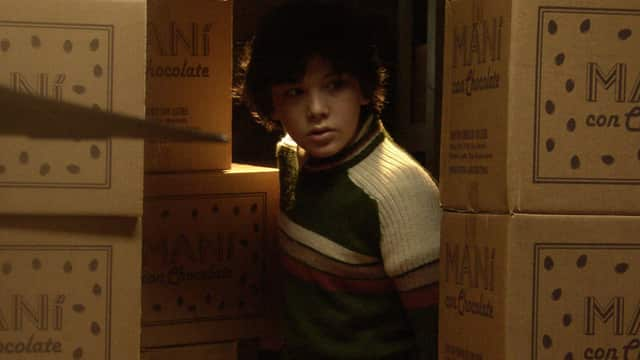
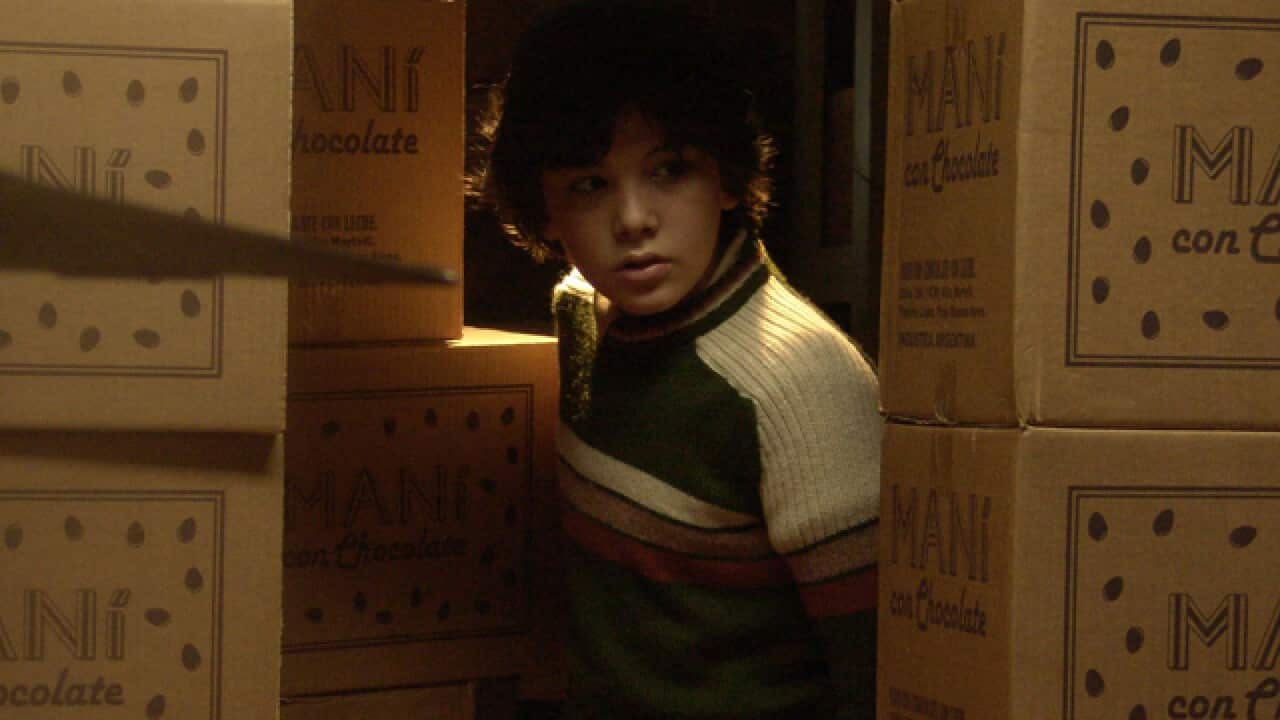
Teo Gutiérrez Moreno gives an authentic and sympathetic performance
The Argentinean film, Clandestine Childhood opens with six-year-old Juan coming home late one night with his parents only to become victims of a drive-by shooting. The attack is not entirely unanticipated by his parents – as active Peronists in the late 1960s they are aware that they are regarded as enemies of Argentina’s then military state and are always on guard.
Director Benjamin Ávilla sidesteps the problem of depicting a brutal attack, by taking a leaf out of the Kill Bill playbook. Ávilla jumps to an animated sequence which captures the screeching wheels of a car armed with gunmen, the blast of multiple gunshots and the inflicted (though non-fatal) bullet wounds with savage graphics, rather than the graphic savagery that might have been required if the scene had been depicted in a live action format. The technique works well and is employed twice more before the time the film reaches its conclusion.
Embellishing his own life story, writer/director Benjamin Ávilla with the assistance of scriptwriter, Marcelo Müller, uses a newsreel montage as an extended prologue to demonstrate that Juan’s family had managed to hide out in Cuba for several years. As the story properly begins, the family is returning to 1979’s Argentina. The parents undertake false identities to resume their political fight as part of an underground Peron movement and Juan – who is now Ernesto – goes to high school.
Juan plays his Ernesto role well, getting on with the business of doing his homework and responding to the first ripples of adolescent desire. However, a day in which 'Ernesto’ refuses to raise the Argentinean flag beloved by the military, reveals that though the boy adheres to the Peronist values of his parents, he hasn’t fully grasped the importance of 'playing the game’ for the greater gain of advancing their political struggle.
Even as the family all try to simulate an ordinary life, Juan’s teenage years are filled with foreboding and Avilla keeps the atmosphere taut in even the most innocuous of circumstances. All the actors play their duplicitous parts well, catching both the passion and the paranoia of the times. Centre stage for most of the film and playing the director’s younger self, Teo Gutiérrez Moreno gives an authentic and sympathetic performance.
The film’s post-credit finale is pointed and drives home Avilla’s political stance. Some viewers may baulk at such blatant partisanship in their cinema (when was the last time you saw an Australian feature with an unabashed political bias let alone a political message?), but the energy of Avilla’s politics supercharges the drama even if you don’t happen to agree with his views.
Watch 'Clandestine Childhood'
Thursday 13 April, 9:30pm on SBS World Movies / Now streaming at SBS On Demand
M
Argentina, 2011
Genre: Drama, History
Language: Spanish, Portuguese
Director: Benjamín Ávila
Starring: Ernesto Alterio, Natalia Oreiro, César Troncoso