A French comedy about a quadriplegic aristocrat and his black, socially awkward servant has become an enormous hit on home turf and is being widely perceived as a metaphor for a paralysed country.
Launched on November 2, Intouchable/Untouchables has sold more than 12 million tickets in France, raking in an estimated €74 million ($A96.8 million).
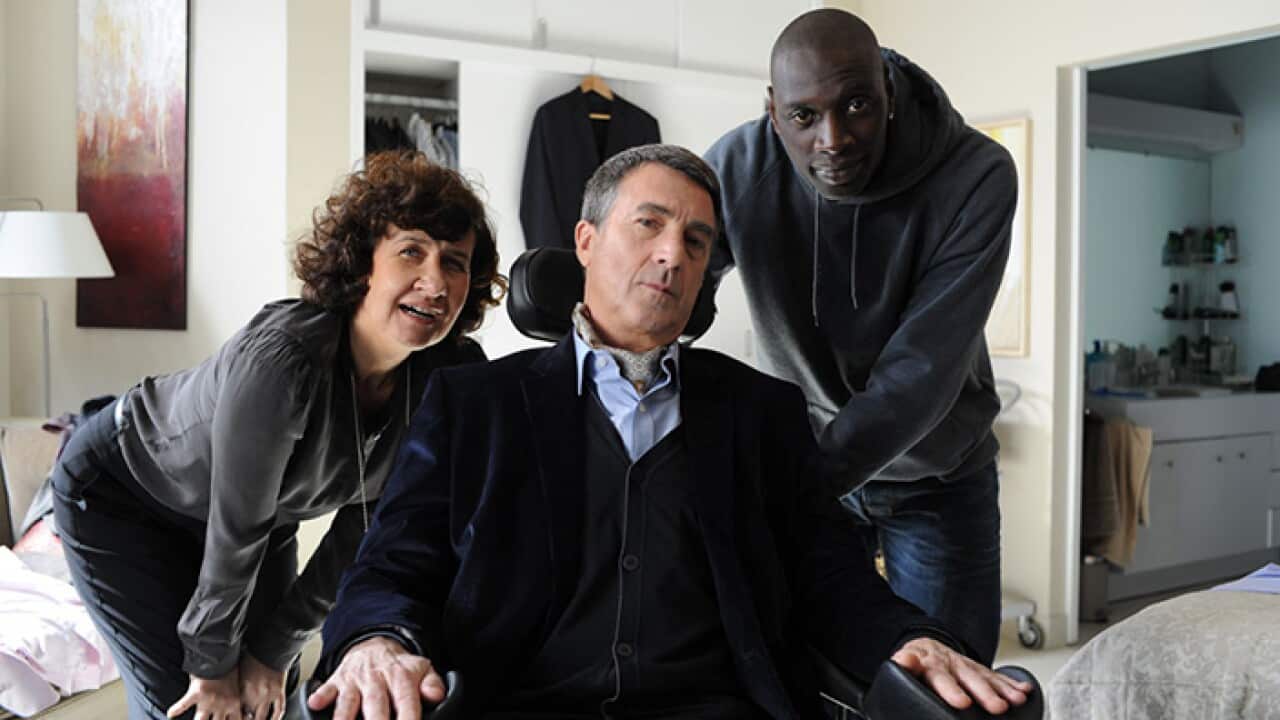
Inspired by a true story, the movie stars François Cluzet as Philippe, a wealthy widower who's paralysed from the neck down after a paragliding accident. He hires as his home help Driss (Omar Sly), an ex-convict from a high rise ghetto who takes the job purely so he won't lose his welfare payments.
The blockbuster already ranks as the sixth highest-earning French title in history and looks set to match Don't Look Now: We're Being Shot At (17.27 million admissions) and perhaps Welcome to the Sticks (20.49 million), according to Cineuropa.
It's the fourth film from directors Olivier Nakache and Eric Toledano following Just Friends (2005), Those Happy Days (2006) and So Happy Together (2009).
After its premiere at the San Sebastian festival in July, the Weinstein Company presciently snapped up the distribution rights for the US, Australia/New Zealand, the UK and several other markets; as part of the deal the Weinsteins also got the rights for an English remake.
The feel good buddy movie from Quad Productions clearly struck a chord with French cinemagoers. “France is like Philippe, the quadriplegic in the film: immobile, impotent, ageing. And hanging on to the improbable dream that somebody or something will come and, without brutality, wake her up," opined the website Rue89.
Marianne magazine hailed the film as perfect dose of escapism that people need in hard times, noting, “France, for a little more than an hour and a half, adores a black man, a disabled man and the humanity that unites them. It is sweet and false like a dream, a miracle."
The Hollywood Reporter's review described the movie as “The King's Speech meets Driving Miss Daisy” and said the “two strong central performances elevate a shamelessly manipulative French crowd pleaser.”
The film was inspired by Philippe Pozzo di Borgo, the boss of the Pommery champagne house who was paralysed after a paragliding accident. He recruited a poor man of North African origin, Abdel Sellou, to help look after him and, against all odds, an unshakeable friendship was formed.
Pozzo di Borgo was delighted with the film, telling Le Figaro that its directors "had achieved a state of grace.”
The left-leaning daily Liberation declared the “paralysis of one of the two main characters (is) not only a movie paralysis but the paralysis of an immobilised country and of impotent citizens."
But Liberation wasn't entirely complimentary, decrying that it perceived as “the dictatorship of emotion used to conceal the total absence of thought".
The film's huge success caps a buoyant period for Gallic cinema with Robert Guédiguian's The Snows of Kilimanjaro, a saga of class consciousness, poverty and generational conflict in Marseilles, and Olivier Marchal's gangster drama A Gang Story drawing sizable audiences.