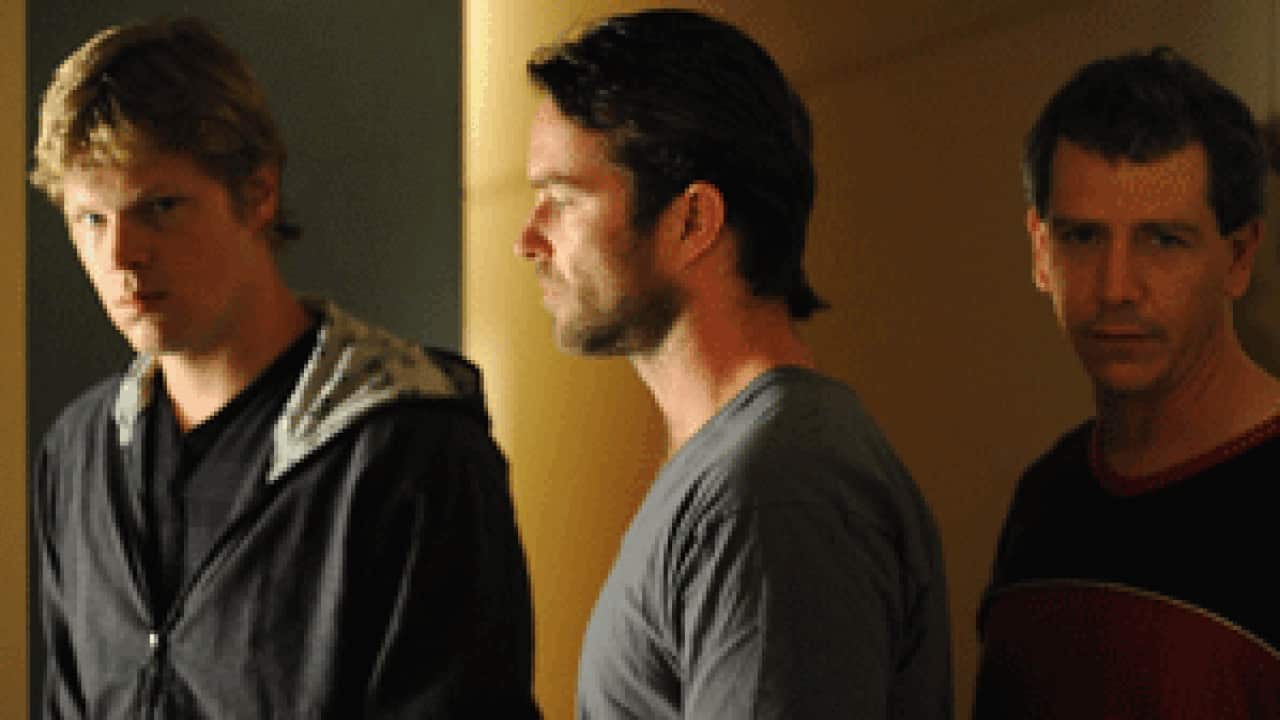
The beasts of prey in writer/director David Michôd's excellent debut feature Animal Kingdom are the Cody's, a Melbourne family of crooks. They're murderous, volatile and angry. When the cops murder one of their number they plot revenge, and when that goes bad they're ready to turn on anyone, even blood. Orphaned, after his mother's OD, 17-year-old Joshua 'J' Cody (James Frecheville) is the outsider here. Looking for a home, he comes to stay and finds a household fraught with suspicion. When J enters this 'jungle' he quickly has to learn what he has to about survival.
Animal Kingdom, which won the drama prize in Sundance in February, boasts a screenplay of tremendous depth and scope, qualities Michôd says were hard won. He wrote the first version, which he dismisses now as "naïve", ten years ago, producing it through the now defunct Tropnest writer's program. Michôd stuck with it, because readers, industry players and colleagues kept telling him it was worth it; and besides the criminal universe held a compelling fascination for him: “The movie is about these marginal people leading incredibly high stakes lives and I always wanted to make a gangster/crime movie, which is ripe and rich material for storytelling.” Melbourne was another key; Animal Kingdom plays out, not in 'classic crime settings' like bars, nightclubs and opulent homes, but in family restaurants, supermarkets and suburban streets. It was an irony that held a deep allure for the filmmaker: “There is a peculiar fascination Melbourne has with its own underworld,” he says. “Unlike other urban centre's where crime is ghettoised, it's all around them, like when someone gets shot in a suburban driveway, it might be the first time the neighbour's actually realised that there was a criminal living in their street. That's what's scary.”
Practically, what helped Michôd through the long development process, which included the Aurora writing workshop, was the fact he was always working, writing; other scripts, making shorts, like Crossbow and co-editing industry mag, Inside Film. (During this time he co-wrote the US indie feature, Hesher, with director Spencer Susser, which also bowed at Sundance in February).
The script was ultimately picked up by Porchlight Fims (Prime Mover, Little Fish) and producer Liz Watts. The industry buzz was so strong that Michôd was able to secure a stellar cast: Jacki Weaver plays the sweet and sour matriarch of the crooks, Smurf, Sullivan Stapleton, Craig, the family nut-case, and Luke Ford, Darren, 'the weak sister'. The supporting cast is great too; Joel Edgerton is terrific in a short but powerful role as Cody family friend, Baz, a knockabout bank robber with a teddy-bear grin, and Guy Pearce is fine too as the cop who tries to use J to nail the Cody's. But it's Ben Mendelsohn's Pope, a hard-case armed-robber who dominates the narrative and the screen. Australia has never been short of memorable psychopaths, but Mendelsohn and Michôd have set a new bench mark here. Where some actors would bounce off the walls in a role like this, Mendelsohn uses stillness and a gaze in the eye so cold, so heartless, it's enough to freeze the soul. It's a particularly inspired piece of casting; flying in the face of Mendelsohn's 'nice guy' public image.
“I don't think I was deliberately casting 'against type',” explains Michôd, who always had Mendelsohn pegged for the part. “I was simply placing the actors into characters that embodied their natural qualities.” He says Pope is a 'confusing' kind of character, very contradictory, capable of charm, but also cunning. “And Ben is like that too, very sharp.” It's the tension between Pope and J that gives the movie its' slow-burn sense of danger that is superbly attenuated by Michôd.
Frecheville's 'innocent amongst the wolves' is a brilliant re-imaging of a classic crime movie genre trope. For much of the films running time, J affects a zombie-like mask that is almost but not quite inscrutable. “A lot of reader's felt that J had to be a bit more active, but I knew that just wasn't authentic to the situation,” explains Michôd. Frecheville, a total newcomer to film, says Michôd was one of 500 young men he looked at for the part.
An admirer of Michael Mann, whose influence could be seen, arguably, in Animal Kingdom's serious high-drama tone, Michôd does not share that director's reliance on documentary research. For instance, it's well-known amongst industry players that Michôd's fiction derives in part from a notorious Melbourne double-murder, where two young cops were ambushed and killed by members of a local crime family. “I read journalist Tom Noble's books about Melbourne crime,” he says, “but I don't like to get bogged down in research and I don't like to bog the actors down in research, either… from the start what I was doing was a fiction.” Still, he says Noble was on hand to advise cast and key crew about the specifics of Melbourne's criminal milieu. “There were tapes and video so that the actors could get the cadences of speech, but in the end I just wanted them to do whatever they could to make it true to the story.”
Indeed, Michôd's conversation returns over and over again to the poetics of drama; not social commentary. But, he says, he is not a cerebral filmmaker. His method is intuitive and craft based, a style, he says that's worked up out of the material. “I kept telling James that he had to imagine what it would be like to be trapped in a cage for of lions… you wouldn't make any sudden moves or make any loud noises.”
Debut features are often flashy affairs. But Michôd has found a style here that's severe and subdued, but alive with nuance and texture. Even the violence, usually a strong trigger for dramatic impact is used here sparingly; though when it comes its shocking, short and ugly. Cinematographer Adam Arkapaw shoots the action in widescreen, often in long takes in autumnal tones; the effect is a bit like sitting in the dark and knowing that there is something or someone out there, just waiting for a chance to pounce. The closest thing Michôd has to an obvious flourish of technique is the use of slow-motion; not for the action scenes, but moments of reflection: “There's something very beautiful about slow-mo,” he says. “It's used in moments that become like out of body experiences for J.”
Shot on location in Melbourne over seven weeks, Animal Kingdom is a tough vision (some would call it cynical) where everyone seems out for themselves; even Nicky (Laura Wheelwright), J's girlfriend, exploits events to satisfy selfish needs. “I wanted to make something substantial and truthful to human behaviour… but I was a little afraid it might appear grandiose, or even operatic.”
As a one-time commentator on the Australian scene Michôd is understandably reluctant to make any sweeping statements about the “state of the industry”. “I think Australian filmmakers have a fear of appearing pretentious, and I felt it,” he says. “Humility is a great virtue and it's a trait in the Australian character that I love… but I'm not sure whether that's what audiences want in a filmmaker – but if people are going to spend money on a movie, I think they want to see something brave and bold.” He says the rave Sundance reviews – which praised Animal Kingdom as ambitious, re-assured him. “I was afraid that had we not have the resources, and time and budget, this imagined world would seem over-blown.”