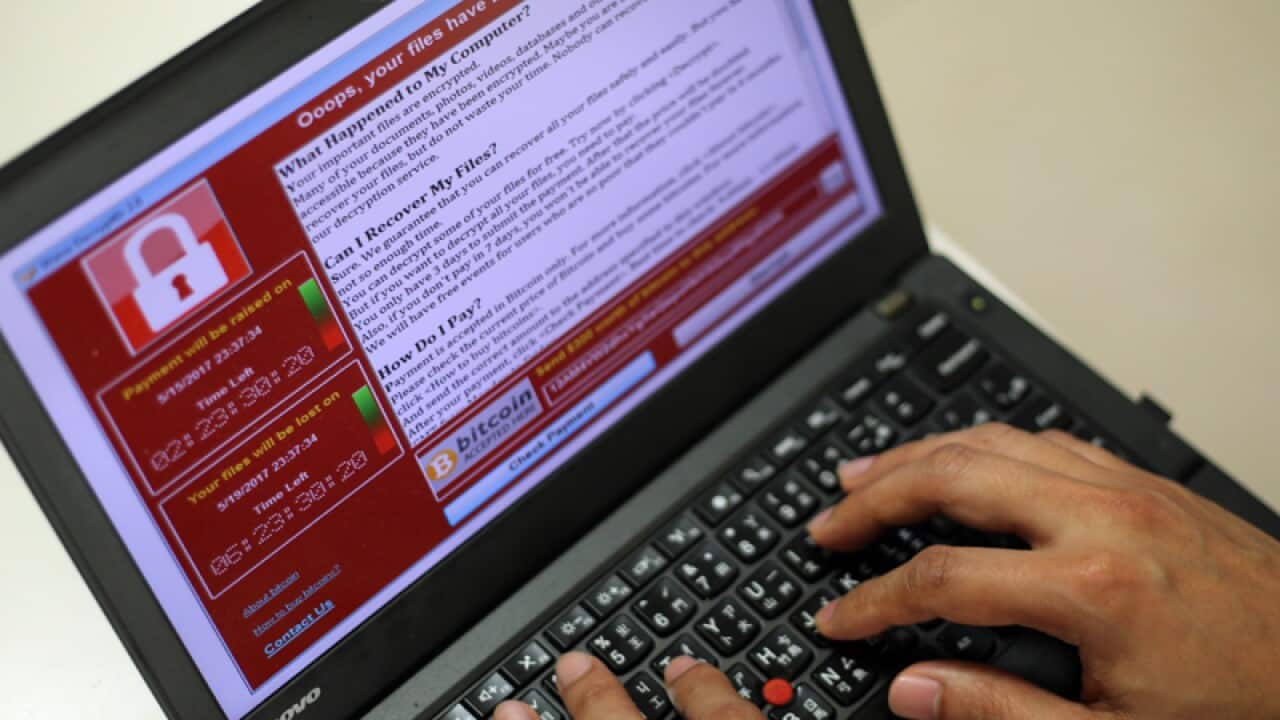
Tens of thousands of computers in some 150 countries are estimated to have been infected by malicious software that locked users' information and demanded payment for access to be restored.
The ransomware has not affected Australia's critical infrastructure or government agencies.
The Prime Minister's adviser on cyber security, Alastair Macgibbon, has this advice.
"If they have back-ups, go to back-ups. At home or in a business. Now, some of those businesses aren't going to have back-ups. They should report it at ACSC.gov.au or ring 1300 CYBER One report it to the Australian Cyber Security Centre. Don't give up hope, because there are researchers working all the time looking at how to decrypt these products. We have seen that happen with previous ransomware variants. There is a possibility that de-cryption could occur. We clearly don't advocate paying criminals, because we don't do it offline and we shouldn't be doing it online."
Britain's public health system was forced to send patients away, after at least 16 hospital networks reported their systems were infected.
The mother of one of those patients, Emma Simpson, says people were distressed upon hearing the news.
"They (hospital staff) said 'we've got terrible news, unfortunately you're going to have to be sent away, because all of the computer systems are down due to a virus and we can't access any of his files'. So they sent us away and said they would call us with a new appointment. So lots of people were very disappointed. There was big chaos, you know, people asking to see a doctor anyhow and then and announcement came that all the computers would be down until at least Monday."
Researchers from security software maker Avast recorded 57,000 infections in 99 countries -- with Russia, Ukraine and Taiwan the top targets.
The Russian interior ministry says about 1,000 computers in its network were hit.
In Spain, telecommunications firm Telefonica say computers on their internal network were infected -- although the impact had not affected clients or services.
And international shipper FedEx Corp says some of its computers were also infected.
Cyber security experts say the malicious software, known as ransomware, entered organisations when employees clicked on email attachments.
It then spread internally when employees shared files.
Victims were told to pay between $300 to $600 to restore access, or have their data destroyed.
The chief executive of cyber security firm RedLock, (mr)Varun Badhwar, says we may never find out who is behind the attacks.
"It may take us weeks or months or we may never even find out who's behind this. But I think ultimately the biggest cause for concern is the fact that these days malware kits like this are available on the wide Internet for everyone from a script kitty -- you know, a high school or college students who is interested in attacking people -- all the way down to organized crime units."
Cyber security experts say hackers appear to have stolen the software from the U-S National Security Agency (NSA) , who used it to exploit a weakness in Microsoft systems for its own intelligence-gathering purposes.
The tool was then leaked to the internet by a group of hackers known as The Shadow Brokers several weeks ago.
At the time, Microsoft released software updates for the vulnerabilities, but not everyone installed the fixes, or they continued using the older, unprotected versions of Windows.
Prime Minister Malcolm Turnbull's special advisor on cyber-security, (mr)Alastair MacGibbon, says no Australian organisations appear to be affected so far, but the risk remains.
"Why hasn't it impacted Australia? It could well be that the criminals were very specific in their targeting. I suspect they started in the U-K, and that has then leeched into Europe. And given the fact that we are a highly connected country, it is probably only a matter of time before we see this occurring in Australia. But what I would say, and this is very important for people to know, this is not just targeting health networks. This targets any network. And what you need to do to protect yourself against it, is to patch your operating system. If you're running Microsoft Windows, patch it now."
Treasurer Scott Morrison says Australian authorities are working with overseas authorities to address the cyber threat.
"The government takes cyber security very, very seriously. We have a minister who is specifically tasked with these responsibilities. And Australians, I think, can be confident that the government is taking every action that it can. It is a very unpredictable area. And it means staying ahead of the game. And when you see these events, you can be assured that we would be in contact, and liaising with our partners in other countries to ensure that we're all protected."
Opposition Leader Bill Shorten says more needs to be done in Australia to ward against the risks of cyber crime.
"The reality is that there are criminals out there constantly testing and trying to use the 'cyber world' to steal and rob and commit crime. We've been relatively good at protecting 'hard targets' - perhaps banks and the military - but there's a lot of 'soft targets' out there, and we need to do more to help them prepare. I'm talking about small-to-medium-business. I'm talking about hospitals. I'm talking about universities."
Package by Biwa Kwan and Kristina Kukolja