
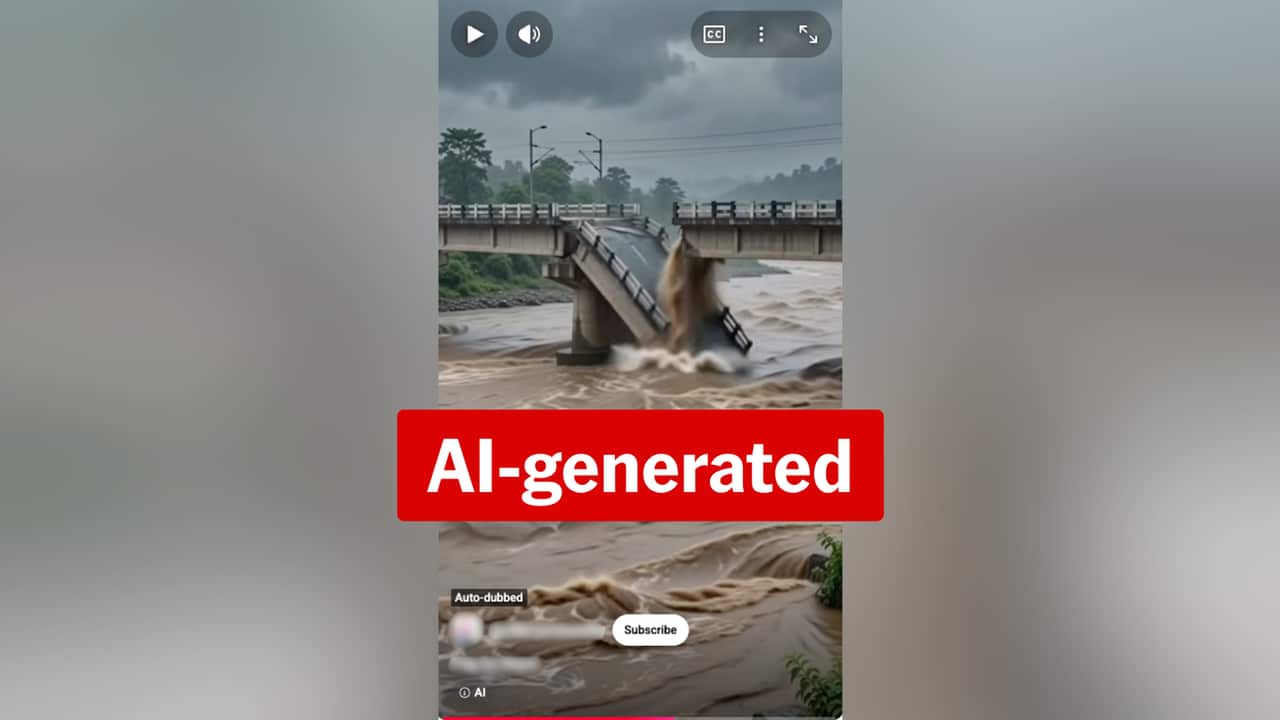
A bomb dropping on a dam, glitchy flood waters destroying an entire village street, and an elephant rescuing a man are some of the fake images circulating online.
The cause of the floods was a glacier collapse triggered by a vast flow of icy debris, according to the US Geological Survey (USGS). But if you're scrolling on social media, you might've instead seen the narrative that it was caused by a bomb being dropped on a dam.
The fake AI-generated clip was actually published in May 2026, with early copies of the video labelled with an AI watermark.
Associate Professor at the Queensland University of Technology Paula Dootson told SBS Examines AI labels can easily be missed, causing people to share posts before they realise it's fake.
"For any more obvious visual content labels, it's quite possible it's AI accounts or bots that are sharing these rather than human accounts. And we know there's a lot of those."
Dootson said mislabeled content is the most common type of problematic visual that response agencies deal with.
"How that visual gets there is not always clear," she told SBS Examines.
"Sometimes it could be because maybe you and I, we search 'landslide' or 'flood' and an old video pops up, and we don't check the metadata and we just share it. And then of course it gets momentum. The algorithm picks it up as being the first search response.
"But it could also be because the synthetic content is labelled, but content from a past event isn't. So it's harder to distinguish what you are sharing," Dootson added.
Implications for understanding disaster
Fake and mislabeled content can impact how people understand the scale of an event, such as the damage to infrastructure and how many people and communities are affected.
Dootson said misleading visuals can be used to push political or organisational agendas and to shift public conversations, by "aiming to really confuse the public and create uncertainty."
She added that financial incentives could be driving the spread of such content.
Following the devastating floods, many social media posts have prompted users to scan a QR code to donate to relief efforts. But it can be difficult to tell where the donations are actually going.
Independent cyber security expert Nittesh Bhatta told SBS Examines there's been a rise in scams.
"Not so much organised groups ... but more lone actors looking for easy money and fame in the name of donations and support."
The Nepal government has a 'one-door policy' to streamline donations and distribution, via the Prime Minister's Disaster Relief Fund.
The Nepali Police have warned people to beware of fake QR codes and links to donate to Nepal flood relief efforts.
Police said scammers could be exploiting the disaster by using social media and other platforms to divert relief donations or obtain people's banking information, as reported by The Kathmandu Post.
Bhatta said scammers are also exploiting photos of missing people to get payments through private messaging apps
"Friends who were searching for a 22-year-old missing person were targeted by an individual on a Whatsapp chat, who had used photographs of the missing person to impersonate them and requested money."
Ask questions to verify content
Dootson encourages viewers to ask themselves questions in order to verify the content they see online.
"Where was it posted? Who was it posted by? Can we look for any inconsistencies and what's out there? And can we just ask ourselves more broadly, has this been used before? And we can use tools like reverse image lookup for that," she said.
"So if we're both consciously looking at what content's being spread and making sure we're not part of the problem, then we can hopefully have a situation where only the real verified visuals are being shared about an event."