
Gather and celebrate: Inviting friends | Beach safety

Sydneysiders Enjoy Warmer Than Average August Weather

Sydneysiders Enjoy Warmer Than Average August Weather Source: Getty / Getty Images/James D. Morgan

Learn casual ways to invite your friends to go to the beach. Plus, find out the number one danger on Australian beaches and how to stay safe when swimming in the sea.


Note: This episode was originally published in Dec 2021.

SBS Learn English will help you speak, understand and connect in Australia -  view all episodes.

This lesson is suitable for intermediate-level learners. After listening, test your knowledge with our quiz.

Learning notes

How to invite a friend to go somewhere 
Ways to ask a friend to go to the beach (or somewhere else):
  • Do you wanna hit the beach?
  • Hey, how about we hit the beach?
  • Let’s hit the beach.
  • Shall we head to the beach?
  • How about we spend the day at the beach?
  • Shall we hit the beach?

Colloquial expressions:
  • Hit the ground running - starting a new activity with lots of energy and enthusiasm
  • It’s gonna be a scorcher! – It’s going to be a really hot day
  • Sizzling – very hot
  • It is packed! – full of people

Beach vocabulary:
  • Esky – a box that keeps food and drink cold
  • Lifeguard – a person paid to people safe at the beach
  • Lifesaver –a volunteer (unpaid person) who helps keep people safe at the beach
  • Rip – an area of water that moves out to sea very quickly
  • Patrolled –watched over
  • Hazard – a danger

Cultural information: Beach safety 
Australian beaches often have dangerous rips. A rip current or ‘rip’ is an area of water that moves very quickly, much more quickly than the water around it. It’s usually on a part of the beach which is deeper and where the water rushes out to sea.

If you go into one, it can take you out to sea away from the beach very quickly. On average, rips cause at least 21 deaths in Australia each year.  

The best way to avoid rips is go to a patrolled beach and swim between the yellow and red flags. 

5 beach safety tips:
  1. Always swim between the red and yellow flags.
  2. Ask a lifesaver or lifeguard for advice
  3. Read the beach safety signs at the beach entrance
  4. Always swim with a friend or adult
  5. If you need help in the water, stay calm and attract attention by raising your arm
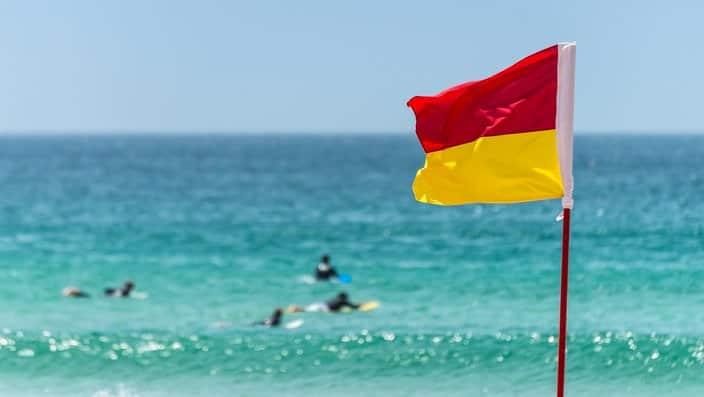
Red And Yellow Warning Sign Flag at the Beach
Red and yellow flag marking the limit of the safe swimming area on a beach under a blue summer sky Source: iStockphoto

Transcript

Hello, and welcome to the first episode of Learn English.

My name is Josipa, and like you, I’m still learning the English language.

It’s not an easy language to learn, is it? People seem to speak really fast, and they use all kinds of phrases that I’ve never heard before.

For us, learners, that can be so confusing. For example phrases like 'hit the ground running'. No, nobody is asking you to start hitting the ground while you run on it.

'Hit the ground running' is a phrase people use to mean ‘start something new’ with lots of energy and enthusiasm. 

And that’s exactly what we are going to do. So, let’s hit the ground running.

Today, in our first episode, we will go to a place where many of us love to spend long, hot summer days. Yes – the beach! We’re going to learn how people invite each other to go to the beach, or somewhere else.

Also, we are going to hear about beach safety and the number one danger on our beaches – any idea what that is?  

Yes, you got it, rips! But if you don’t know what rips are, listen on…

But first, let’s get there!


Anne:Did you see the weather forecast today? It’s gonna be a scorcher! Do you wanna hit the beach
Mark:It’ll be packed! There won’t be any room to sit down!
Anne:If we get there early, it shouldn’t be too bad. Mark:OK. Let’s hurry then.
Anne:Great. Oh, how about we ask Ben and Sonya, too. It’s a hot day. They might want to come along, too. You ask Ben, and I’ll ask Sonya.
Mark:Ok
Ben:Hello. 
Mark:Hey, Ben, It’s Mark. How’s things? Look, It’s boiling hot today. How about we spend the day at the beach? Anne is coming. Ben:OK, great. See you there! 
Mark:Ben can come. How about Sonya?
Sonya:Hi Anne, how you going?
Anne:Hey Sonya, it’s gonna be a scorcher today. Do you wanna check out the beach?
Sonya:That sounds lovely! I'll meet you there. 
Anne:Ok. Let’s go!


I don't know about you but I need a little break from this conversation—so many expressions that are difficult to understand!

That’s because my friends, Anne and Mark, are native speakers. They love to chat, and they can speak really fast using a lot of phrases I’ve never heard before.

But when we go more slowly, we can understand and learn these expressions.

Let’s start with Anne,
It’s gonna be a scorcher! Do you wanna hit the beach?
Anne said: it’s gonna be a scorcher. To scorch something is to burn it, so Anne means is that it’s going to be a really hot day, a scorcher, a day that will really burn you if you are not careful.

There are so many other ways to describe a hot day, and Australians love talking about the weather! You may also hear people say: It's boiling hot! It's stinking hot! It's a hot one!

But enough about the weather – let’s talk about how Anne asked Mark if he wants to go to the beach with her.
Do you wanna hit the beach?
Just like 'hitting the ground running', 'hitting the beach' does not mean you actually hit the sand on the beach. ‘Hit’ is just an informal way of saying 'go', so hitting the beach means going to the beach.

And 'do you wanna hit the beach' means 'do you want to go to the beach'. People use ‘hit’ when they are talking with friends, informally,  rather than with people they don’t know very well. So, don’t say it to your boss!

Instead of ‘do you wanna’ you can also say ‘how about’, so you can ask them to go to the beach by saying ‘Hey, how about we hit the beach?’ You can also say ‘Let’s hit the beach’. You can also use these expressions to invite people to go with you to other places. 

Friends also invite each other to do things using other informal phrases like: ‘Shall we head to the beach?’ ‘Do you wanna check out the beach?’ ‘How about we spend the day at the beach?’

Listen to the different ways Anne and Mark invite Sonya and Ben to go with them to the beach.

Anne: Hey Sonya, it’s gonna be a scorcher today. Do you wanna check out the beach?

Mark: Hey, Ben, It’s Mark. Look, it’s boiling hot today. How about we spend the day at the beach?

Do you remember how Mark answers Anne when she asks him to the beach? Let’s hear him again.

Mark:It’ll be packed! There won’t be any room to sit down!

It will be packed.

Mark thinks that there will be so many people that they will have to sit very close to each other, that is, that the beach will be very full or ‘packed’. And he is probably right that the beaches near the city will be packed, full of children building sandcastles and running around playing with a ball; a lot of families sitting in deckchairs eating and drinking the food and drinks they have brought in their eskies.

Esky, that’s an Australian word you should know about. An ‘esky’ is a cool box that keeps our food and drinks cold even on a scorcher!

Mark said,
There won’t be any room to sit down!

He means that the beach will be so packed that there will not be enough space to sit down. ‘Room’ here doesn’t mean a room in a house, but it means ‘space’, so that it will be difficult for them to find enough space to put their things down.

By the way, did you know that we have over 10,000 beaches in Australia?  That means that if we decided to visit a different beach every day, it would still take us…

Oh, it would take us about 30 years to visit them all. That’s a lot!

Ok, so now we are all on the beach.

Lifeguard:Attention please! Attention please! You need to swim between the flags!

In summer, when there are a lot of people on the beach, there are lifeguards to watch people very carefully to keep them safe in the water.

They put red and yellow flags on the beach to show people where it is safe to swim. Then they watch the area very carefully so that they can help anyone who has difficulty in the water. This is called a patrolled beach.

If you don’t see flags on the beach, it means there are no lifeguards watching the sea, and swimming is not recommended. 

That’s because our beaches can be very dangerous places, and people who were not born here, like me, don’t always understand the hazards like dangerous rips.

By the way, 'hazard' is just another word for danger, and the biggest hazard on Australian beaches is a rip current or a rip. R-I-P.

Australian beaches often have dangerous rips. A rip current or ‘rip’ is an area of water that moves very quickly, much more quickly than the water around it and it can take you out to sea away from the beach very quickly. On average, rips cause at least 21 deaths in Australia each year.

The best way to avoid rips is go to a patrolled beach and swim between the yellow and red flags.

But even the strongest swimmers can sometimes get caught in the rip current.

So, we asked surf scientist and surf lifesaver Rob Brander from the University of New South Wales to tell us what to do if we are caught in a rip.

Rob:The main thing is not to panic. Don’t panic because the rip will not pull you under the water. All the rip will do, it will take you further out to sea, and it’ll sometimes also bring you back.  Remember that you've got air in your lungs, you float, you are very buoyant. So, don’t panic.

"The second thing to do if you are not a particularly good swimmer, put your hand up, straight up like that, it signals for the lifeguards and lifesavers to come and get you."

"What you could also do is, if you are a good swimmer, you could look around. And if you could see the size of the rip, which is usually the shallower water where the waves are breaking, lot of white water, swim towards that area. White water is good because it means that is shallow. You can maybe stand up, and also white water brings you back to the beach."

"What you should never do is swim against the rip. These things move pretty fast and you’ll just find yourself going backwards, swimming faster, getting tired and then you'll start to get scared. So just go with the flow, signal for the  lifeguard, and let the rip take you around and get out of it yourself."

Thanks Rob.

So, did you catch the main points?

The main thing is not to panic because you will float as you have got air in you. The second thing is to signal for help to a lifeguard by raising your arm, and thirdly, remember, don’t try to swim against the current.

To stay safe on the beach, I always follow these five easy tips from the kids at Surf Life Saving NSW.
  1. Look for the yellow and red flags, and always, always, always swim between them
  2. Ask a lifesaver or lifeguard for advice
  3. Read the safety signs
  4. Always swim with a friend or adult
  5. If you need help, stay calm and attract attention by raising your arm. If no one can see you, no one can save you.
Thanks to our educational consultant Professor Lynda Yates, surf scientist and surf lifesaver Rob Brander from the University of New South Wales and kids at Surf Life Saving NSW. 

For more beach safety tips, or to find out which beach is patrolled by lifeguards and lifesavers in your state or territory, visit beachsafe.org.au or download the Beachsafe app. 

spk_0

Welcome to our Summer Special collection: Gather and celebrate.

spk_0

It's a mix of fun, simple, and feel-good episodes to keep you company throughout the festive season. We are kicking off with our very first ever episode, making it extra special if you ask me. Join us as we talk about inviting friends, enjoying a day at the beach, and staying safe while swimming. And of course, you'll hear our classic line, it's a scorcher.

spk_1

Ease into the English language and Australian life with SBS Learn English.

spk_0

Hello and welcome to the first episode of Learn English. My name is Josipa and like you, I'm still learning the English language. It's not an easy language to learn, is it? People seem to speak really fast and they use all kinds of phrases that I've never heard before. For us, learners, that can be so confusing. For example, phrases like hit the ground running.

spk_0

No, nobody's asking you to start hitting the ground while you run on it. Hit the ground running is a phrase people use to describe starting something new with lots of energy and enthusiasm, and that's exactly what we are going to do.

spk_0

So let's hit the ground running. Today, in our first episode, we will go to a place where many of us love to spend long, hot summer days. Yes, the beach. We are going to learn how people invite each other to go to the beach or somewhere else. Also, we are going to hear about beach safety and the number one danger on our beaches. Any idea what that is?

spk_0

Yes, yes, you got it, ribs. If you don't know what ribs are, listen on. But first, let's get there.

spk_2

Did you see the weather forecast today? It's gonna be a scorcher. Do you want to hit the beach? It'll

spk_3

be packed. There won't be any room to sit

spk_2

down. If we get there early, it shouldn't be too bad. OK,

spk_4

let's hurry then.

spk_2

Oh, how about we ask Ben and Sonia too? It's a hot day. They might want to come along too. You ask Ben and I'll ask Sonia. OK.

spk_4

Hello. Hey Ben, it's Mark. Look, it's boiling hot today. How about we spend the day at the beach? Ann's coming. OK, great, see you there. Ben can come, how about Sonya?

spk_4

Hi Anne, how

spk_2

you going? Hey Sonia, it's gonna be a scorcher today. Do you wanna check out the beach? That sounds

spk_4

lovely. I'll

spk_2

meet you there. OK, let's go.

spk_0

OK, I don't know about you, but I need a little break from this conversation. So many expressions that are difficult to understand. That's because my friends Anne and Mark are native speakers. They love to chat and they can speak really fast using a lot of phrases I've never heard before. But when we go more slowly, we can understand and learn these expressions. Let's start with Anne.

spk_2

It's gonna be a scorcher. Do you want to hit the beach?

spk_0

Anne said it's gonna be a scorcher. To scorch something is to burn it. So Anne means that it's going to be a really hot day, a scorcher, a day that will really burn you if you are not that careful. There are so many other ways to describe a hot day, and Australians love talking about the weather. You may also hear people say it's boiling hot, it's stinking hot, it's a hot one.

spk_0

But enough about the weather. Let's hear how Ann asks Mark if he wants to go to the beach with her.

spk_0

Do you want to hit the beach? Just like hitting the ground running. Hitting the beach does not mean you actually hit the sand on the beach. Hit is just an informal way of saying go. So hitting the beach means going to the beach. And do you want to hit the beach means do you want to go to the beach. People use hit when they're talking with friends, informally, rather than with people they don't know well. So, don't say it to your boss.

spk_0

Instead of do you want, you can also say, how about so you can ask them to go to the beach by saying, hey, how about we hit the beach? You can also say, let's hit the beach. You can also use these expressions to invite people to go with you to other places.

spk_0

Friends also invite each other to do things using other informal phrases like, shall we head to the beach? Do you want to check out the beach? How about we spend the day at the beach? Listen to the different ways Anne and Mark invite Sonya and Ben to go with them to the beach.

spk_2

Hey Sonia, it's gonna be a scorcher today. Do you wanna check out the beach?

spk_4

Hey Ben, it's Mark. Look, it's boiling hot today. How about we spend the day at the

spk_0

beach? Do you remember how Mark answers Anne when she asks him to go to the beach? Let's hear him again.

spk_3

It'll be packed. There won't be any room to sit down.

spk_0

It will be packed. Mark thinks that there will be so many people that they will have to sit very close to each other. That is, that the beach will be very full or packed, and he's probably right that the beaches near the city will be packed, full of children building sand castles and running around playing with a ball. A lot of families sitting in deck chairs, eating and drinking the food and drinks they have brought in their eskies.

spk_0

Esky, that's an Australian word you should know about. An esky's a cool box that keeps our food and drinks cold, even on a scorcher. Mark said.

spk_3

There won't be any room to sit down.

spk_0

He means that the beach will be so packed that there will not be enough space to sit down.

spk_0

Room here doesn't mean a room in a house, but it means space, so that it will be difficult for them to find enough space to put their things down. By the way, did you know that we have over 10,000 beaches in Australia? That means that if we decided to visit a different beach every day, it would take us, um, 10,000 to 960.

spk_0

Oh, it would take us about 30 years to visit them all. That is a lot.

spk_0

OK, so now we are all on the beach.

spk_5

Attention please. Attention please. You need to swim between

spk_0

the flags.

spk_0

In summer when there are a lot of people on the beach, there are lifeguards to watch people very carefully to keep them safe in the water. They put red and yellow flags on the beach to show people where it is safe to swim. Then they watch the area very carefully so that they can help anyone who has difficulty in the water.

spk_0

This is called a patrolled beach. If you don't see flags on the beach, it means there are no lifeguards watching the sea, and swimming is not recommended. That's because our beaches can be very dangerous places and people who were not born here.

spk_0

Like me, don't always understand the hazards like dangerous rips. By the way, hazard is just another word for danger, and the biggest hazard on Australian beaches is a rip current or a rip, RIP.

spk_0

Australian beaches often have dangerous rips.

spk_0

A rip current or rip is an area of water that moves very quickly, much more quickly than the water around it, and it can take you out of the sea away from the beach very quickly. On average, rips cause at least 21 deaths in Australia each year. The best way to avoid rips is to go to a patrolled beach and swim between the yellow and red flags.

spk_0

But even the strongest swimmers can sometimes get caught in a rip current. So we asked surf scientist and surf lifesaver, Rob Brander from the University of New South Wales to tell us what to do if we are caught in a rip.

spk_6

The main thing is not to panic. Don't panic because the rip will not pull you under the water. All the rip will do will take you further out to sea and it'll sometimes bring you back. Remember that you've got air in your lungs, you float, you're very buoyant, so don't panic.

spk_6

The second thing to do is if you're not a particularly good swimmer, put your hand up, straight up like that, signals to the lifeguards and the lifesavers to come and get you. What you could also do if you're a good swimmer, is you could look around and if you can see the sizes of the rip, which is usually the shallower water where the waves are breaking, a lot of white water, swim towards that area. White water is good because it means it's shallow, you can maybe stand up, and also white water brings you back.

spk_6

To the beach. What you should never do is swim against the rip. These things flow pretty fast, and you'll just find yourselves going backwards, swimming faster, getting tired, and then you'll start to get scared. So just go with the flow, signal for the lifeguard, or let the rip take you around and get out of it yourself.

spk_0

Thanks, Rob. So did you catch the main point? The main thing is not to panic because you will float as you have got air in you. The second thing is to signal for help to a lifeguard by raising your arm.

spk_0

And thirdly, remember, don't try to swim against the current.

spk_0

To stay safe on the beach, I always follow these five easy tips from the kids at Surf Life Saving New South Wales. Number 1,

spk_7

look for the red and yellow flags and always, always, always swim between them. Number 2, ask a lifesaver or lifeguard for advice. Number 3, read the safety signs. Number.

spk_7

Always swim with a friend and adult. Number 5. If you need help, stay calm and attract attention by raising your arms. If no one can see you, no one can save you.

spk_0

For more beach safety tips or to find out which beaches are patrolled near you, visit beachsafe.org.au or download the Beachsafe app.

spk_0

We have used a lot of language about the beach today. Let's quickly revisit the important words. See if you can remember the meaning before I say it. Hit the ground running is too.

spk_2

Hit the ground running means to start a new activity with lots of energy and enthusiasm. A

spk_0

scorcher is.

spk_2

A scorcher is a hot day, taken from the word scorch, which means to burn. For example, tomorrow is gonna be a scorcher.

spk_0

When a place is packed, it is.

spk_2

Packed means very full, like, the bus was packed this morning.

spk_0

Esky, and esky is.

spk_2

A box that keeps food and drink cold, so when you go to the beach, don't forget the

spk_0

esky. Do you remember what is the rip current or rip?

spk_2

An area of water that moves very fast and can take you out to sea. Rips are the number one hazard on Australian beaches.

spk_0

Talking about hazards, a hazard is another word for.

spk_2

Yes, that's right, a hazard is another word for danger.

spk_0

We also heard a few different ways of inviting a friend to go to the beach. Let's hear them

spk_3

again. Do you want to hit the beach? Hey, how about we hit the beach? Let's hit the beach. Shall we head to the beach? How about we spend the day at the beach?

spk_0

To help you remember these words, try inviting someone you know out to wherever you want to go next, using expressions that you learned today.

spk_0

That's all we have for our first episode. I hope you enjoyed it. Listen to see how people invite you to do different things. What different ways do they use. To read all the words we have used today, go to SBS.com.au/learnEnglish. You can also find learning notes and transcripts there. Or you can listen to this episode again because the more we practice our listening and speaking skills, the faster we learn. Thank you for listening.

spk_1

SBS Learn English.

END OF TRANSCRIPT

Share