
Learn English useful for going to a wedding. Practise asking about the ceremony and reception, talking about gifts and gift registries, and inviting someone as your plus-one.
SBS Learn English will help you speak, understand and connect in Australia - view all episodes.
This lesson is suitable for intermediate-level learners. After listening, test your knowledge with our quiz.
Learning notes:
Learn everyday English for going to the wedding, talking about gifts and gift registries, and inviting someone as your plus-one.
Examples of phrases you can use when talking about the wedding:
- Where is the wedding being held?
- Do you know where the meeting is being held?
- Where is the wedding?
- Are you coming to the ceremony?
- The ceremony is at the botanical gardens.
- The reception is at the restaurant nearby.
- The venue looks beautiful.
- Have you seen the wedding venue yet?
- Have you chosen an outfit yet?
- Have you replied to the invitation yet?
Examples of phrases you can use when talking about gifts:
- Have you bought them a gift yet?
- What are you getting the couple?
- Have you sent the happy couple a card?
- They’ve set up a gift registry.
- Have they got a gift registry?
- I found a nice set of glasses on their wedding registry.
Examples of phrases you can use when inviting someone and replying:
- Would you like to come as my plus-one?
- Can I bring a plus-one to the wedding?
- My sister is coming as my plus-one.
- I’d love to. Thanks for asking.
- Thanks for inviting me, but I can’t make it.
Colloquial expressions:
I’d love to is a warm and friendly way to accept an invitation.
I can’t make it means you cannot attend or get to an event.
Come on is something you can say to encourage someone to do something with you.
Vocabulary:
A ceremony is a formal celebration of something. It can be an award or a graduation. In this case it is the part of a wedding where the couple actually get married.
A reception is a formal party. In this case it is the celebration held after the wedding ceremony.
A venue is the place where an event happens.
A gift registry is a list of gifts that people would like to receive for a special celebration. Guests can look at the list and choose a gift to buy.
A wedding registry is the name for a gift registry for a wedding.
A plus-one is a person you invite to come with you to an event.
A dance floor is the area where people dance at a party, wedding or club.
To get on the dance floor means to start dancing.
To be held means to take place or happen. You can use this phrase when talking about organised events, meetings and concerts.
Learning notes:
Accepting and refusing invitations is something we have to do very carefully so that we don’t upset anyone, so we tend to show that we are enthusiastic when we accept and sorry when we don’t:
- Claire: I’d love to. Thanks for asking.
And when Allan says he has to leave early, he is careful to show he is thankful for the invitation and he implies that he wishes he could stay longer but really can’t. It is polite to give specific reasons why we can’t stay.
- Allan: I’d love to come to the wedding, but, sorry, I’ll have to leave early because I must be on the last train home.
And in the following example Allan stresses that he is refusing the invitation because it is impossible for him to attend (by saying that he is ‘not able to’), and he uses the future ‘I won’t be able to’ to stress that he has thought about it carefully.
- Allan: Thanks for inviting me, but I’m sorry, I won’t be able to make it.
Transcript:
(Note: This is not a word-for-word transcript)
SBS acknowledges the Traditional Custodians of Country and their connections and continuous care for the skies, lands, and waterways throughout Australia.
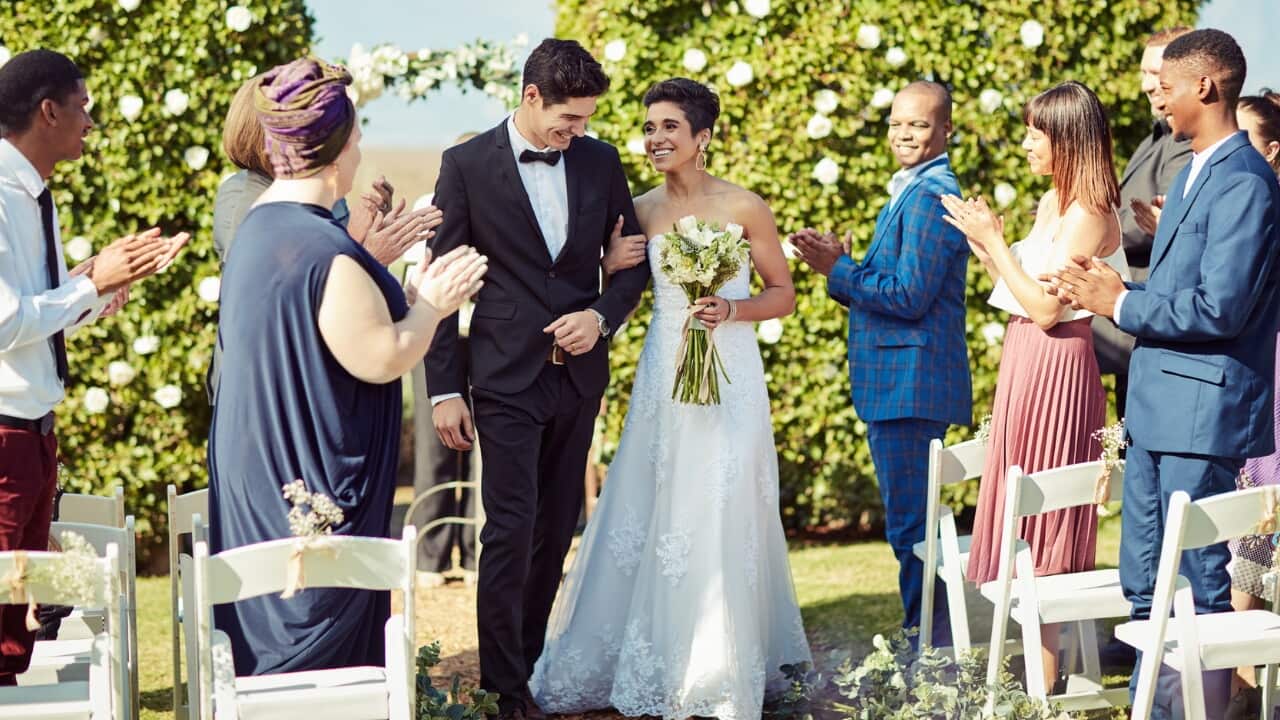
A wedding in the gardens. A dinner nearby. Speeches, music, and maybe a little dancing. Allan has received an invitation to his friend's wedding, but there's one more thing he needs to organise.
Allan: So...do you want to come as my plus-one?
Being invited to a wedding is exciting, but if you’re new to Australia, some of the language and customs might be unfamiliar. What’s the difference between a ceremony and a reception? What is a gift registry? And who can you bring as your plus-one?
Hi, I’m Kate. If some of those questions are new to you, don’t worry. In this episode, we’ll practise everyday English you can use when you’re going to a wedding.
So, let’s start....
Allan: So... I've been invited to a wedding and was wondering ...would you like to come as my plus-one?
Claire: Really? Me? Sounds great! I’d love to. Where is the wedding being held?
Allan: The ceremony is at the botanical gardens, and the reception is at the restaurant nearby.
Claire: Oh...the gardens are beautiful this time of year. Have you bought them a gift yet?
Allan: Not yet. They’ve set up a gift registry, so I’ll choose something from that.
Weddings can look very different. They may be large celebrations with a lot of guests, or small gatherings with only close family and friends. They can also reflect the couple’s culture, faith and their personal choices. But wherever the wedding is held, these phrases can help you talk about the day.
So, let’s start with the question Allan had Claire:
Would you like to come as my plus-one?
A plus-one is a person you invite to come with you to an event. Your invitation may say that you can bring a guest, or it may include the words “plus-one”. For example:
Can I bring a plus-one to the wedding?
Or:
My sister is coming as my plus-one.
Claire then asked:
Where is the wedding being held?
When you ask where an event is being held, you’re asking where it is happening. You can use this phrase for a lot of different events, meetings and concerts. For example:
Do you know where the meeting is being held?
You could also ask a simpler question:
Where is the wedding?
Both questions are useful. But ‘Where is the wedding being held?’ sounds a little more formal and is especially useful when you are talking about an organised event.
Allan then said:
The ceremony is at the botanical garden.
The ceremony is the formal part of the wedding. It is where the couple stand together and say, in their own way, “We choose each other.” There may be promises, rings, prayers, readings, cultural traditions or marriage documents to sign.
You might hear someone say:
Are you coming to the ceremony?
Allan also said:
The reception is at the restaurant nearby.
The reception is the celebration after the ceremony. This is when everybody relaxes, shares a meal, listens to speeches and eventually says:
Come on, let’s dance!
Sometimes the ceremony and reception are held at the same place. But they can also be at different venues, like in Allan’s example.
A venue is the place where an event happens. You could say:
The venue looks beautiful.
Or:
Have you seen the wedding venue yet?
Claire then asked:
Have you bought them a gift yet?
When a couple gets married, guests often bring or send a wedding gift. If you are talking about the two people getting married, you can call them the couple.
For example:
What are you getting the couple?
Or:
Have you sent the happy couple a card?
“Have you bought them a gift yet?” is a useful question because it asks whether someone has already done something. The word yet is often used in questions like this.
For example:
Have you replied to the invitation yet?
Or:
Have you chosen an outfit yet?
Allan said:
Not yet. They’ve set up a gift registry, so I’ll choose something from that.
Here, the gift registry is a list of gifts that the couple would like to receive. Guests can look at the list and choose a gift to buy. It can make choosing a present a little easier.
You might also hear people call it a wedding registry.
Here are few examples:
- Have they got a gift registry?
- I found a nice set of glasses on their wedding registry.
Some couples don’t have a registry. Instead, they might prefer money, gift cards or simply having their friends and family there to celebrate with them.
Now, let’s look at a few polite ways to accept or decline an invitation.
When someone invites you somewhere, it is common to show that you are pleased to be asked:
I’d love to. Thanks for asking.
Sometimes, you want to go, but you cannot stay for the whole event. You could say:
I’d love to come to the wedding, but I’ll have to leave early. I need to catch the last train home.
Here, Allan says yes first, then explains his plan. Giving a short reason can sound polite, but you do not need to share every detail.
And if you cannot go at all, you can say:
Thanks for inviting me, but I’m sorry, I won’t be able to make it.
“I won’t be able to make it” means you cannot attend the event. It is a polite, clear way to decline an invitation.
To be able to make an event means you can get there, so if you can’t get to an even that you have been formally invited to you can say, “I won’t be able to make it”.
If you can’t get to a less formal event like a catch-up with friends, you could use the less formal version ‘sorry, I can’t make it’.
Sign up for previews, updates and to provide feedback.
Paul Nicholson and Lily O'Sullivan voiced the characters of Allan and Claire, and Professor Lynda Yates was our educational consultant.