Nowadays social media and online websites seem to be dominating most of millennials' attention, but, radio definitely continues to keep you company every day, with the most up-to-date information, entertainment and audience participation.
And radio's history began in 1894, when the Italian inventor Guglielmo Marconi built the first wireless telegraph system based on radio transmission. From then, the development of radio broadcasting has been huge.
Inception
In 1920, radio station KDKA in Pittsburgh, Pennsylvania, went on the air as the first US licensed commercial broadcasting station with the presidential election results as its inaugural show.
In 1933 FM broadcasting was invented by American engineer Edwin Armstrong and since then it has been used worldwide to provide high-fidelity sound.
In the past few years we have been enjoying listening to the radio on line, in streaming, via podcast and through app, tablets and mobile phones... The medium keeps changing with its listeners.
1938: Radio's impact is felt
The power of radio's impact was famously demonstrated in the US on October 30, 1938. American actor and future filmmaker Orson Welles aired, over the Columbia Broadcasting System radio network, an adaptation of the novel The War of the Worlds by Herbert George Wells.
The broadcast was presented as a series of simulated news bulletins, which suggested an alien invasion by Martians was actually in progress. It became famous for allegedly causing mass panic because for those who missed the introduction that the show was a drama, the illusion of realism was unmanageable.
Radio in the Philippines
In the Philippines, radio started in 1924 with the establishment of KZKZ (AM) in Manila by Henry Herman Sr., owner of the Electrical Supply Company in Manila. Henry Herman was an American and a former soldier who came to the Philippines to fight in the Philippine-American War. He stayed in the Philippines after he was discharged.
However, this was not the first test. Archives suggest that an American woman named Mrs. Redgrave used a five-watt transmitter for a test broadcast from Nichols Field (now Villamor Airbase). This test is possibly the first radio broadcast in Asia.
Henry Herman's station originally broadcast using a 5-watt transmitter. In 1924, it boosted its power to 100 watts. In 1924, Radio Corporation of the Philippines (RCP) bought KZKZ AM from Henry Hermann. Two year later, the company began to work on constructing two of the largest radio stations in Asia with the idea of maintaining direct Manila-San Francisco service. After the Philippine independence, it changed its callsign to DWKZ, but changed in 1960 to DZCA.
In 1929, RCP launched KZRC in Cebu broadcasting with a 100-watt transmitter, but was later sold to store owner Isaac Beck. It is now DYRC owned by the Manila Broadcasting Company.
Early on, all radio programs were in English as this was the American Colonial era in the country.
Radio was unregulated until 1931 when the Radio Control Board was established under the Insular Government.
Today, there can be over a hundred of radio stations in the Philippines these days as several cities, regional and community radio stations are operating in almost every region of the country. But, the current oldest radio station is DZRH.
Radio today
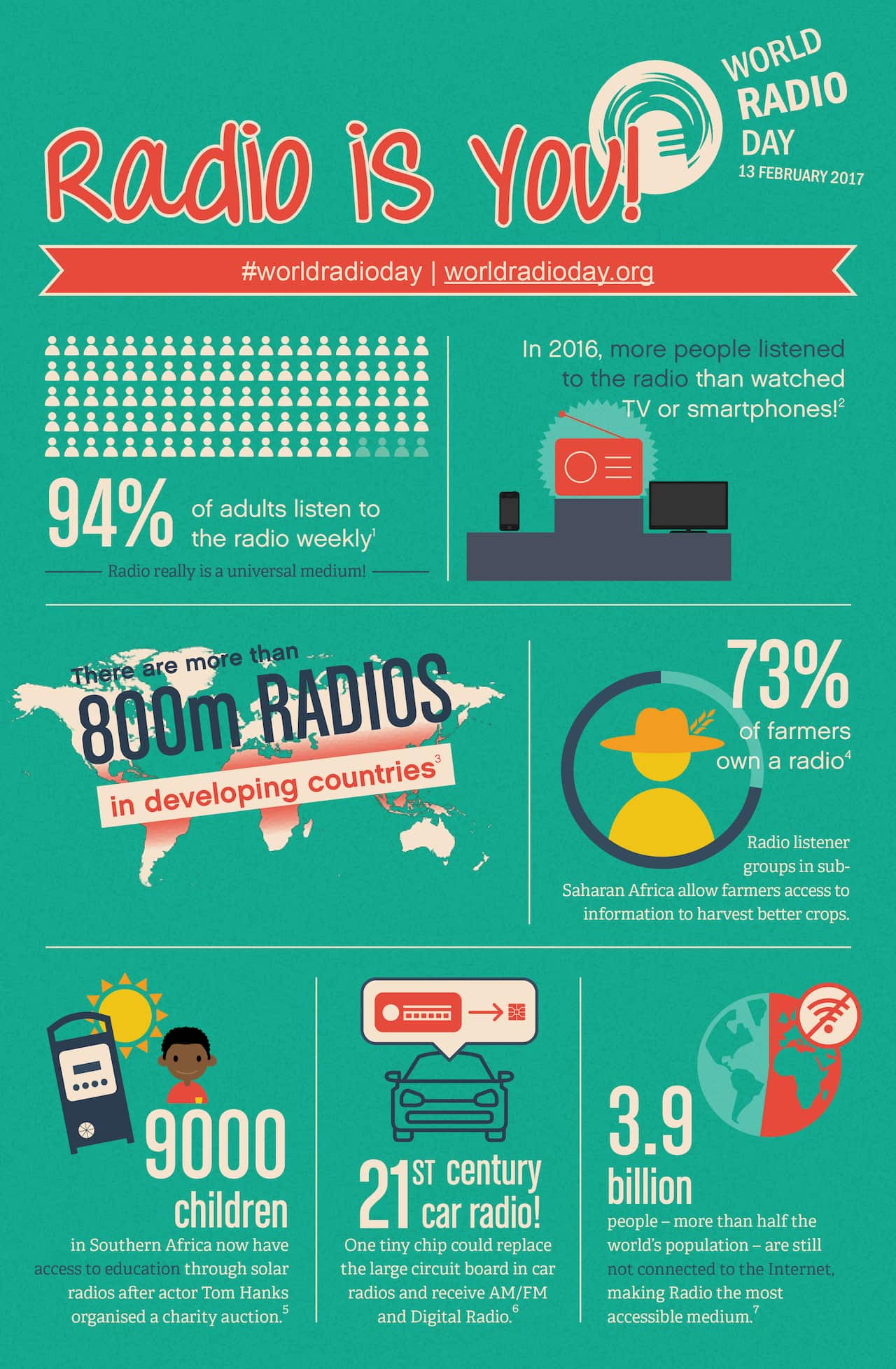
According to the World Radio Day official website, "Radio is still the most dynamic, reactive and engaging medium there is, adapting to 21st century changes and offering new ways to interact and participate."
"Where social media and audience fragmentation can put us in media bubbles of like-minded people, radio is uniquely positioned to bring communities together and foster positive dialogue for change. By listening to its audiences and responding to their needs, radio provides the diversity of views and voices needed to address the challenges we all face".
World Radio Day is held every 13 February of the year.

UNESCO’s Executive Board recommended to the General Conference the proclamation of World Radio Day, on the basis of a feasibility study undertaken further to a proposal from the Academia Española de la Radio. During its 67th Session, the UN General Assembly endorsed the resolution proclaiming 13 February as World Radio Day.
The date, 13 February, is the day the United Nations Radio, the international broadcasting service of the United Nations was established in 1946.
According to the organizers, "Radio is the mass media reaching the widest audience in the world. It is also recognized as a powerful communication tool and a low cost medium. Radio is specifically suited to reach remote communities and vulnerable people while offering a platform to intervene in the public debate, irrespective of people’s educational level. Furthermore, radio has a strong and specific role in emergency communication and disaster relief".However, it is said that up to a billion people still do not have access to radio today.
What are the objectives of the Day?
- Raise greater awareness among the public and the media of the importance of radio
- Encourage decision makers to establish and provide access to information through radio
- Enhance networking and international cooperation among broadcasters
World Radio at SBS
At SBS we celebrate World Radio Day every year.
SBS Radio started in Sydney and Melbourne in 1975 as two AM stations transmitting important information in 6 languages about new government services. Today, SBS Radio is a bridge linking to the 4+ million Australians who speak a language other than English. 74 language programs are broadcast each week, as well as four music channels - SBS PopAsia, SBS PopDesi, SBS PopAraby and SBS Chill. SBS Radio produces 334 unique hours of programming each week.
Here's the SBS Filipino team, working in radio...
How do you listen to SBS Radio? While you driving or riding a tram or a bus, while you are cooking or walking, through the app on your tablet or your smartphone? Or do you catch us through podcasts or in streaming?
Comment on the SBS Filipino Facebook page and send us a picture of you while listening to SBS Radio!
Happy World Radio Day to everybody! And don't forget "Radio is you!".