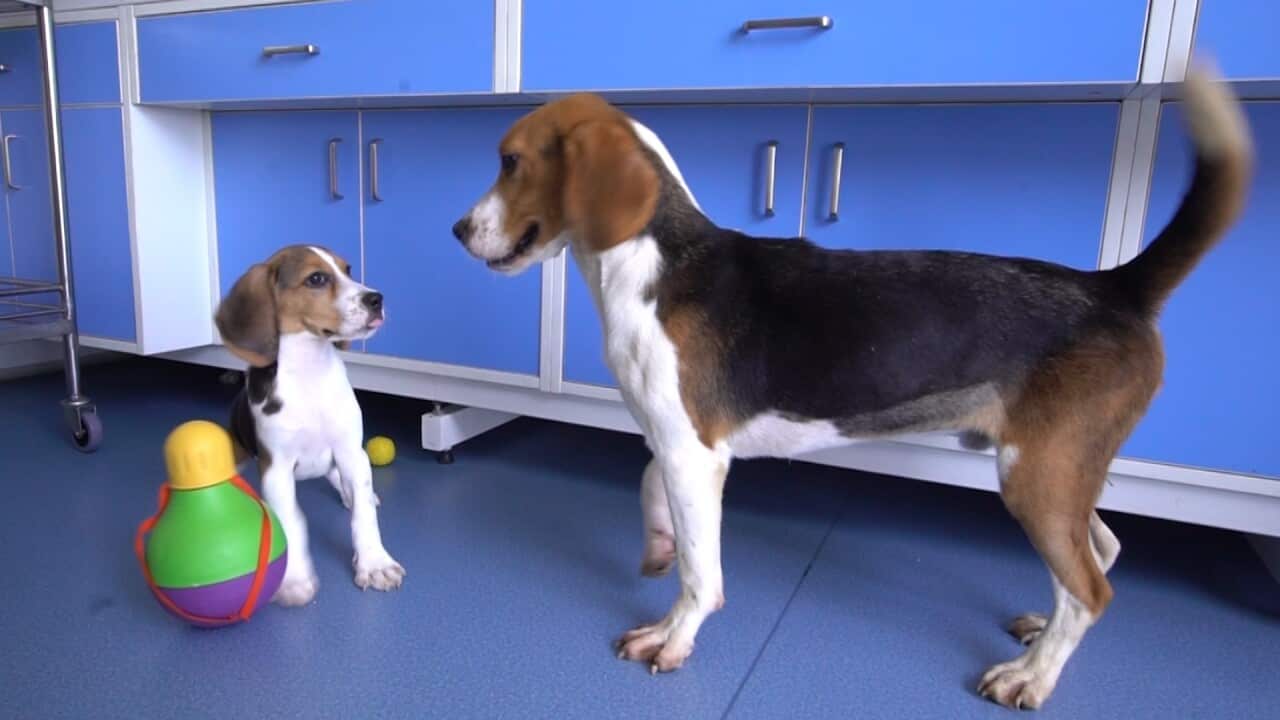
The puppy Longlong (pictured on the left) looks like the offspring of the older beagle Apple. But he's not. Longlong is Apple's clone.
"These two dogs, Longlong and Apple, are 99.9 per cent the same. Longlong's birth is a breakthrough in terms of genetic modification and cloning and its application to dogs."
Mi Jidong, General Manager of biotech company Sino Gene
Sino Gene, located just north of downtown Beijing, says the technology will be used to study gene-based diseases - such as heart disease and diabetes - and to create 'super dogs' for police search and rescue teams.
What next? Human clones?
Critics argue the breakthrough in China poses some serious ethical questions around cloning.
"If we see cloned animals as a testing object, I wonder how soon this work will be applied to humans."
Peter Li, China Policy expert at Humane Society International, United States of America
An Australian animal geneticist believes the breakthrough is impressive, but says the lack of transparency in Chinese labs is worrying.
"Doing it on animals doesn't mean it can translate with the same outcome in humans, but obviously once you've allowed this technology to do something it may well be more complicated to say no, you should not use it for something else."
Fabiene Delerue, University of NSW
What do YOU think? Tell us at www.facebook.com/sbsGerman



