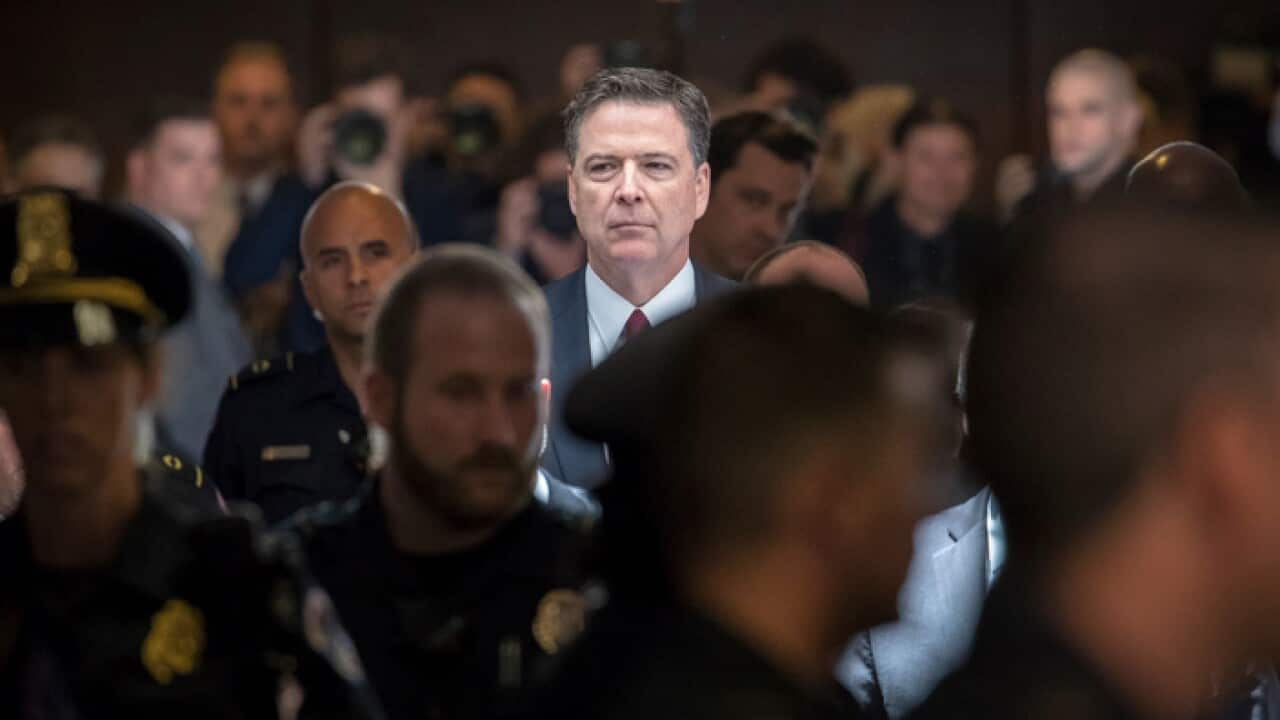
The day before, James Comey's written statement that President Donald Trump had asked him to stop his investigations against the recently released National Security Adviser Michael Flynn had hit hard in political Washington. In his statement, under oath in front of the Senate's secret services committee, Comey essentially repeated the accusations against the President and his administration.
Comey had written notes that also served as a basis for his opening statement because,
"I knew that there might come a day when I would need a record of what had happened — not just to defend myself — but to defend myself the FBI and our integrity as an institution".
Besides, it would have been very unusual that the conversations were conducted in private.
"A really significant fact to me is — why did he kick everybody out of the Oval Office?"
According to his notes, Trump wanted loyalty.
“He needed loyalty, he expected loyalty”,
Is how Comey described an unpleasant meeting at the White House in January. Then, at another meeting, Trump asked Comey to drop the investigation against the dismissed National Security Adviser Michael Flynn. According to Comey's notes, Trump said:
"I hope you can see your way clear to letting this go, to letting Flynn go. He is a good guy. I hope you can let this go,"
This "I hope" is now interpreted differently by the parties. The Republican Senator James Risch suggested that hope is something different than a legal arrangement. Democrats, on the other hand, condemn the allegation that Trump was guilty of influence on the judiciary. Comey interpreted the statement Trumps as an invitation, which he should pursue.
"My impression was, he wanted something from me for keeping my job,”
He also admitted that he himself had given information about a conversation with Trump about a friend to the media, so as to achieve the establishment of a special investigator.
Comey says he thinks that probe into General Michael Flynn probably helped seal his fate.
"There's no doubt that ... It's a fair judgment -- it's my judgment -- that I was fired because of the Russia investigation, I was fired in some way to change, or the endeavour was to change, the way the Russia investigation was being conducted. That is a very big deal, and not just because it involves me. The nature of the FBI and the nature of its work requires that it not be the subject of political consideration. And on top of that, you have the Russia investigation itself is vital, because of the threat."
Speculation over ties between Russia and the Trump administration has persisted since claims of Russian interference in the 2016 presidential campaign first surfaced.
Speaking after the testimony, President Trump's personal lawyer, Marc Kasowitz, says the revelation destroys Mr Comey's credibility. Trump never suggested that Comey should stop the investigations against anyone.
"Of course, the Office of the President is entitled to expect loyalty from those who are serving the administration. And from before this president took office to this day, it is overwhelmingly clear that there have been, and continue to be, those in government who are actively attempting to undermine this administration with selective and illegal leaks of classified information and privileged communications. Mr Comey has now admitted that he is one of these leakers."
So now one word stands against the other.
When Donald Trump was giving his own speech at a conference of evangelical supporters, he showed himself as self-confident as ever.
"And, as you know, we're under siege. You understand that. But we will come out bigger and better and stronger than ever. You watch. You fought hard for me, and now I'm fighting hard for all of you. I have one goal as president, to fight for the American people and to fight for America and America first. We are winners, and we are going to fight and win and have an unbelievable future, unbelievable future, and it's going to be together."
The US president does not seem to have to expect any direct criminal consequences due to the statements of the hearing. They could, however, foment the debate on a procedure for misuse of office. The accusation, that pressure on the judiciary was applied, also led to the overthrow of President Richard Nixon in 1974.
NOTE: German Language Version of this article is slightly different and contains more details.



