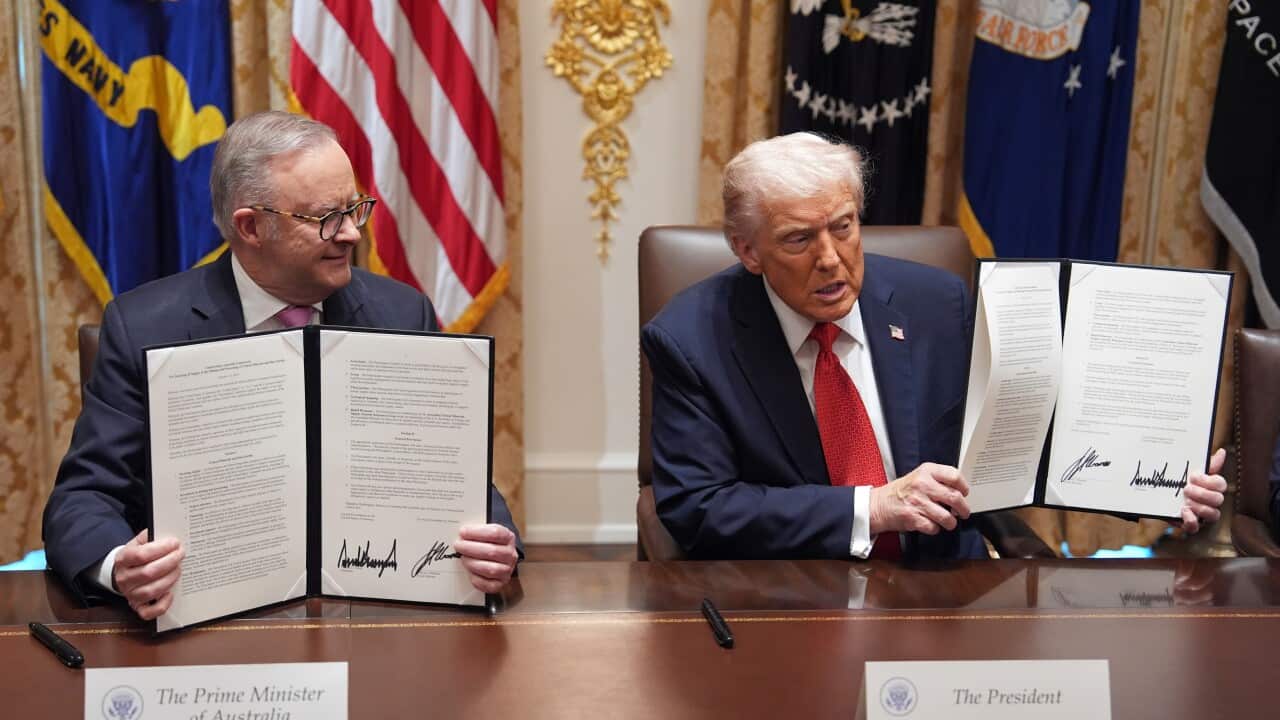
President Donald Trump, right, and Australian Prime Minister Anthony Albanese hold up signed agreements on on critical minerals and rare earths, in the Cabinet Room of the White House, Monday, October 20, 2025, in Washington. (AP Photo/Evan Vucci) Source: AP / Evan Vucci/AP/AAP
Australia holds some of the world’s largest deposits of critical minerals, resources that are mined locally but largely exported to China for processing. China currently controls about 90 per cent of global supply chains in this sector. However, a new US-Australia critical minerals and rare earths deal worth AU$13.5 billion (US$8.5 bln) aims to challenge China's dominance in the production of rare earths. In this podcast, we speak with Mohan Yellishetty, an expert from Monash University's Department of Civil and Environmental Engineering, who welcomes the move but says that China’s stronghold on critical minerals may take a few years to weaken.
Australia holds some of the world’s largest deposits of critical minerals, resources that are mined locally but largely exported to China for processing. China currently controls about 90 per cent of global supply chains in this sector. However, a new US-Australia critical minerals and rare earths deal worth AU$13.5 billion (US$8.5 bln) aims to challenge China's dominance in the production of rare earths. In this podcast, we speak with Mohan Yellishetty, an expert from Monash University's Department of Civil and Environmental Engineering, who welcomes the move but says that China’s stronghold on critical minerals may take a few years to weaken.