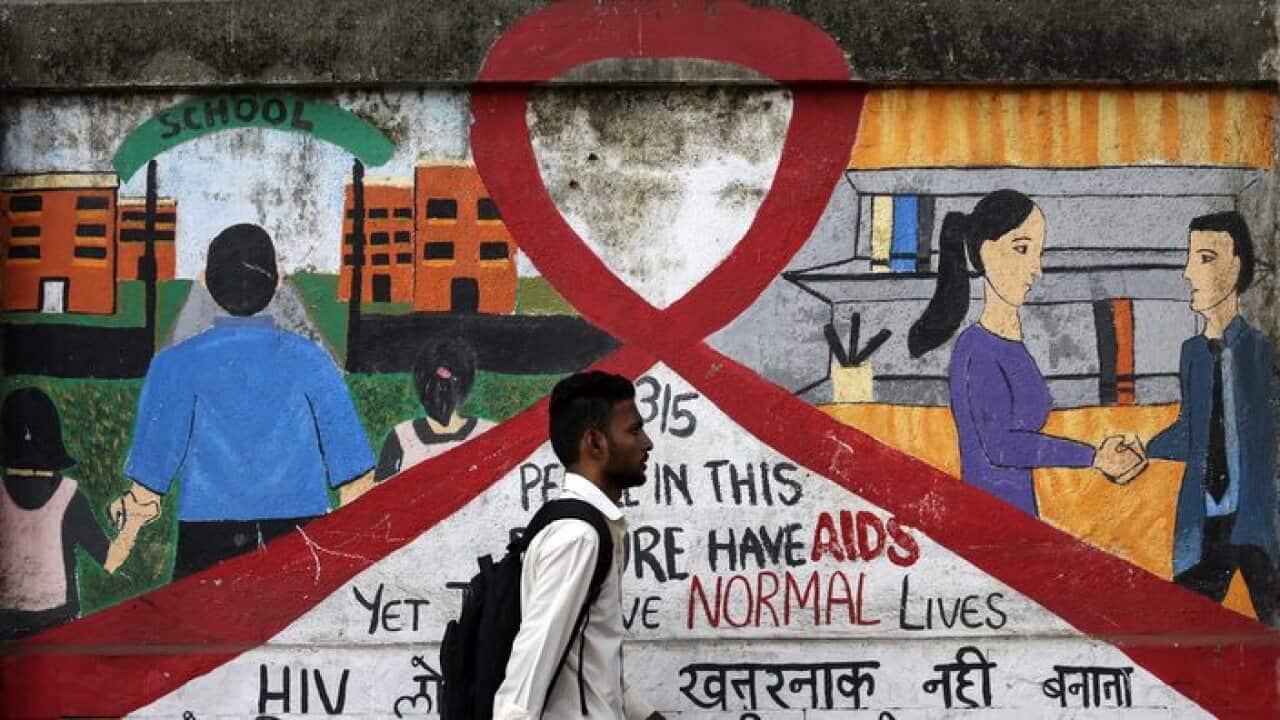

Annual World AIDS Day on December the 1st is an important day to educate people and break down the stigma around HIV and related illnesses.
While many view the virus as an epidemic of the 1980s and '90s, almost 37-million people still live with the condition around the world today.
Dai Aoki migrated from Japan to Australia just over 15 years ago.
Not long after he arrived in the country, he found out he was HIV-positive.
He says although he experienced discrimination back then as a result of his diagnosis, the perception around the virus has changed.
"When I (was) diagnosed, actually I couldn't understand the English very well just because I just migrated here (Australia). So my English wasn't good enough. But, now, I think there is not really discrimination anymore, but there's still a stigma around HIV."
If left untreated, HIV -- or the Human Immunodeficiency Virus -- attacks the body’s immune system and leaves the body vulnerable to infections and medical conditions it could normally control.
The disease may be transmitted when the bodily fluids of a person with HIV enter the body of a person without HIV.
In 2018, HIV-positive people can take daily treatments to prevent the virus from advancing into AIDS, or Acquired Immune Deficiency Syndrome.
AIDS refers to the illnesses or symptoms resulting from the severely damaged immune system.
The last stage of HIV, AIDS will lead to death if left untreated.
Australian Federation of AIDS Organisations spokesman James Gray says improvements in medicine have meant many who become HIV-positive can still live healthy lives.
"In the Australian context, we are seeing some really fantastic achievements in reducing HIV among gay men, particularly in the sort of inner-city areas. So it's really, really important that we're able to take those gains and ensure that no-one is left behind so other populations at risk of HIV also see the same decreases and, also, some of the gay men that are not yet seeing those decreases, they can also benefit from the successes we're seeing."
During the 1980s and early 1990s, HIV became a worldwide epidemic, with millions of people diagnosed and dying of the unknown virus.
The first cases reported were among gay men in the United States, and, for a while, doctors believed it was only a condition for gay males.
But cases soon emerged among women, children and heterosexual men.
Initial treatments for HIV became available to the public in 1987, although they had high rates of toxicity, causing unpleasant side effects.
It was not until 1995, when highly active anti-retroviral treatment became available, that HIV and AIDS-related deaths declined.
Mr Gray says interest around the virus waned around that time.
"After effective treatments came out in around the mid-1990s, there was a period of time which people often reflect on as a period of silence around HIV, where people weren't really talking about it anymore because people weren't dying -- which is obviously a fantastic outcome in terms of the treatments, but it did mean that, for a lot of people, the idea of HIV that they had from the 1980s and early '90s kept on going and they didn't sort of up to date for what it meant to have HIV now or what HIV prevention meant these days."
World Aids Day on December the 1st raises awareness about HIV and AIDS.
UNAIDS says almost 37 million people worldwide were living with HIV and/or AIDS in 2017.
About 53 per cent were from eastern and southern Africa, while 1.8 million were children.
Mr Gray says people's perceptions of HIV and AIDS need to be challenged.
"So when HIV had its biggest impact was around the same time that there was a lot of gay-rights campaigns, decriminalization, those sorts of things. So there has been a linkage between the two. But we also need to recognise, as you say, that other people are affected. In fact, around the world, about 50 per cent of people living with HIV are actually women, and predominantly heterosexual women as well. In Australia, while heterosexuals are less likely to get HIV than gay men, it is still an important part of the epidemic that we need to respond to."
Dai Aoki says, while it is great how far research and treatments have come, it remains important to remember those who have died -- and still die -- of the condition.
"World AIDS Day is not actually celebrating anything, but more of a remembrance. And being aware of what's happened through history and what we are now. To inform the Australian population.”
James Gray, with the Australian Federation of AIDS Organisations, says the fight to end HIV and AIDS is still not over.
"People with HIV achieved something really, really fantastic and changed the way that we do health and public health around the world by being leaders in responding to an issue that really affected them and driving the change. We need to continue to reflect on and listen to people with HIV and those communities that are affected by HIV. They've shown tremendous leadership, and, by listening to that leadership, that's how we'll finally end the epidemic for good."