Hello, you’re listening to SBS Hindi. I’m Swati Sharma.
The month of March is observed as Women’s History Month. It is a time to remember the women who have made history, and those who are shaping it today.
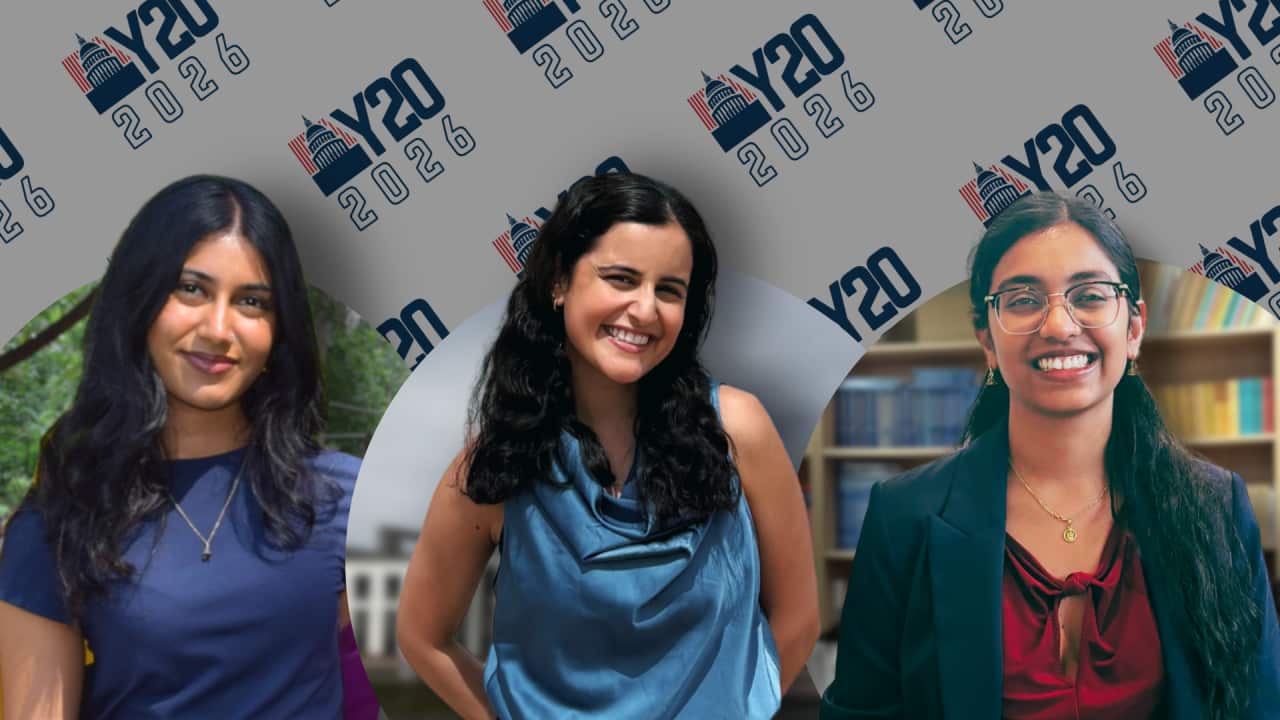
Today, we speak with three young women of Indian origin who will represent Australia this year in Washington, DC, at a global stage where youth representatives from the world’s largest economies come together.
This platform is the Y20, the official youth group of the G20. Each year, Y20 delegates collaborate to draft a communique, a formal policy document. This document is submitted directly to G20 world leaders. It is not merely symbolic; it has the potential to influence real policy decisions.
There is another aspect that makes this opportunity especially significant. Australia’s Y20 representatives are not directed by the government, nor by Global Voices, the organisation that recruits and trains them. Global Voices is a non-partisan body that equips young people with skills in policy and diplomacy, but the issues they choose to negotiate are entirely their own.
This means they do not follow any party line. They speak on behalf of all young people in Australia.
This year, three of Australia’s five Y20 fellows are young women of Indian origin. Coming from diverse backgrounds and working across different policy areas, they share a common opportunity.
Let’s meet them today.
Let’s begin with Isha Desai.
A graduate in Politics and International Relations from the University of Sydney, she works on sustainability policy at Penguin Random House. At the Y20, she is advocating for climate mobility governance, focusing on the rights of people who are being forced to leave their homes due to climate change.
Isha, thank you for joining us today. If someone listening to us has never heard the term climate mobility governance, can you explain in simple terms what we are actually talking about and why Australia needs to be having this conversation at G20 table?
So in very simple terms, climate mobility governance is the idea that if your home is impacted by climate disaster or climate change, um, particularly irreversible impacts, that there should be a pathway in international law and policy for you to relocate in a dignified manner. I think the reason why it's important for Australia to be talking about this is because we are situated within the Indo-Pacific region, and the Indo-Pacific region contains some of the world's most low-lying islands, which means that these islands are most likely to be impacted by climate change first. We know that Tuvalu, which is in the Indo-Pacific, is already predicted to be entirely 95% underwater by 2100. And so I do feel that Australia has a responsibility to act as an ally and a leader in this space.
So, um, you're not representing the government position, you're not even representing Global Voices position. You're negotiating on behalf of all young Australians. The communique your delegation produces will also feed into actual G20 negotiations between world leaders. That's a lot of responsibility. What does it feel like, and how do you decide what young Australians actually need?
It is a big responsibility, and the G20 Youth Summit, which is what I will be representing Australia at, they take five delegates every year because there are five different tracks at the Y20. So these tracks include global economy, global health, digital transformation, energy, and then fragility and conflict. So I'll be representing the global economy track. What that means is that it's my job to kind of look at what Australian young people feel about the global economy and what we want to see improve. What that looks like practically is doing some research on what young Australians are facing right now and what I think the international community can be doing to support them.
One last question I have for you is you're a young Indian woman in this space that's traditionally been very white and very male. Has this ever felt like a barrier, and how have you dealt with it?
It's a really interesting question, and I've been thinking a little bit about that. I think I have the privilege of being young, and I found my work so far in this space to be quite refreshing. As you know, there are five delegates this year, and three of us out of the five are South Asian women. When I first met them in Canberra, I felt a lot of camaraderie and recognition and belonging. And I think the more I am in this space, I do see a lot of young women, young Asian women, young brown women in this space. I do think that senior leadership in diplomacy still remains very male and white. But right now, I'm quite hopeful that there are young people coming up that are passionate and hardworking.
It's wonderful. Um, Isha, thank you so much for joining us on SBS Hindi today.
Now, we turn to Madura Katta.
Raised in India, educated in Canada, and now working with the Queensland Government on health policy for marginalised communities, she brings a perspective shaped across three countries, three systems, and lived experiences that extend beyond any one place.
Madura, thank you for joining us on SBS Hindi. You’ve lived in India, studied in Canada, and now work in policy in Australia. When you sit at the policy table, which of these three experiences speaks the loudest for you?
So I grew up in India. I lived there until I was twelve, and then moved to Canada, um, and then moved to Australia five years ago.
So I think that all three places have shaped me in different ways, but I would say my transition moving from India to Canada was the most educational. So growing up in India, inequality and adverse health outcomes were very visible in daily life.
Um, but moving to Canada and seeing a completely different system, meeting people from so many different backgrounds, um, and seeing how inequality could look different in different places really shaped my experience. And negotiating these different perspectives became a daily part of life, which is what brought me to policy.
Right. So you work at the intersection of research and policy, which you've described as bridging a gap. In your experience, why is that gap so hard to close? Why doesn't good research automatically become good policy?
So during my studies, I learned that in public health specifically, it takes nineteen years for research to be implemented as policy-
... which is a pretty scary statistic to think about. Uh, but I think particularly now working for the Queensland Government, I'm able to see that the machinery of government k- moves slowly, and that's... there's a reason for that. Um, and the reason is that it is one of the oldest organizations, and, um, change is incremental, and there are lots of good people who are pushing for change.
Uh, but I think there's less of that translation of research to policy. Um, so if we have people who work in the intersection who are able to bring new research to the table and try innovative approaches, uh, we'll be able to bridge that gap. So with my experience working in research and having that literacy and, uh, keeping myself up to date on, uh, the latest research in those fields, I hope to bring this evidence-based perspective to addressing policy.
Uh, Madura, your focus is health outcomes for marginalized community. What is the one thing you want to put, um, at Y20 on the table in Washington that you feel isn't being said loudly enough right now?
So the track that I'll be negotiating on is food security and global health. So the reason that food security is so interesting to me is that during my work as a research assistant, I realized the ubiquity of food insecurity in Australia. So as part of my research, I conducted twenty-eight street intercept interviews.
So this e-essentially entailed me walking on to the street and talking to people and asking them questions and their opinions about different food policy solutions. My focus was on remote Aboriginal and Torres Strait Islander communities in Australia. But what was really interesting to me was how many people mentioned that they themselves were struggling to eat healthy-
... and how they would actually really benefit from these policies that I was asking their opinions on. Uh, so I think one thing that I would really like to put forward is the importance of food security and how food insecurity doesn't just look like a lack of food, but it looks like a lack of access to healthy food-
... and, and overexposure to unhealthy food. So what I really wanna bring with me is how different communities, um, marginalized communities are more affected by this issue. There's a lack of access to culturally important foods that are still affordable. So I wanna bring the perspective of young Australians with me to the Y20 conference and talk about why food security is more important now than ever, especially with climate change and other factors.
That sounds really promising. And, um, lastly, I just want to ask you, for young people from the Indian Australian community who want to get into policy or public health, what does that path actually look like? Where do you even start?
I think that's a really good question. So I had, uh, the opportunity to take a global health policy course as part of my Master of Public Health, and I was really interested to see the systems perspective and the intersections. And then I was very fortunate to get into a graduate program with the Queensland Government.
And through this graduate program, I was able to work in multiple different departments. And so I think for me, that was an opportunity to see, uh, different departments and how policy can look different from small policy to big policy. And now, um, through the organization Global Voices, I'm doing this fellowship, which has afforded me the opportunity to attend this summit. So I, I'm able to look at policy and diplomacy from a multilateral and international perspective, which I think will add a lot of tools to my toolkit.
So I really encourage other young Australians to look for opportunities, whether you apply for the same Global Voices fellowship or you look at grad programs, uh, and just take opportunities that you can get, whether it is to volunteer for NGOs or other organizations that you feel passionate about, like the Public Health Association of Australia or any climate change networks. And I think there are lots of opportunities out there to find things that you're passionate about.
Right. Uh, Madura, thank you so much for listing this out for our audience, and we wish you all the best, uh, for the summit later this year. Thank you for joining us on SBS Hindi.
Thank you so much. And now, let's meet Riya Rao, a final year student of International Studies and Journalism at University of New South Wales, who has done fieldwork with Pacific communities and who believes that real policy is shaped by the stories of the people it applies to.
[outro jingle] Riya, thanks for joining us on SBS Hindi today. You went to Vanuatu and came back with a completely original research idea around storians and using it as a policy tool. What did you see on the ground that changed the way you think about development and policy?
So in Vanuatu, I was there for a Fixim Sola research project, which is funded by the Department of Foreign Affairs and Trade. And we went in there with kind of an agenda to enhance local forms of off-grid solar repair. So it was quite community driven from the get-go. However, when we went there, even the infrastructures that we chose to meet around when discussing anything with community members or the tools we use, we went in looking at the census, looking at things that from a Western point of view are the go-to modes of research when you enter any space. When we spoke to people on the ground in Vanuatu, no one had really heard of the census. There was maybe one building in an entire area council, and we realized that no matter how community driven a research agenda may be, it will still not fully reflect everyone's point of view and ends up being that
these systems are not entirely attentive to the local realities. And that's where this new idea came about, where it was about, of course, we've always discussed not extracting from local communities going in very informed, but even the most community driven solutions will not have longevity without any policy backing. So when I came back from Vanuatu, I had heard from a lot of people's stories, and when I spoke to people, they said to me as well, they would love to see their stories more recognized, but they didn't really have a means of doing that. They didn't have any formal contact. They didn't know who to contact, how to get their word out there. And that's where Storian came about. It was about spotlighting community voices into formal spaces in a way that makes sense to them.
So you're studying both international studies and journalism. How does journalism shape the way you approach policy work? Do you think policy world also needs more people who can actually tell stories?
Yes, a hundred percent. I think that so much of the policy world is the jargon, and that jargon gets lost to ordinary members of society who maybe haven't had the same level of education or even encountered a lot of these terms. They don't really know where to look for the resources. So that's really where I see my role in this entire process, is just translating the more formal structures, the more formal wording to a community level, and also just listening to communities and then bringing that back into the formal spaces in a way that would actually be heard in those formal policy settings as well.
Sure. Um, so at Y20, you will be in a room with young delegates from every G20 country. What is one thing that you want them to understand about the Pacific that they probably don't already know?
Well, Australia is unfortunately the only G20 nation in the South Pacific. Many of these G20 nations may not have even heard of a lot of these countries. Um, so what I really want them to understand is, I guess a big transferable insight from Vanuatu itself was how indigenous knowledge systems, which are very, very important in the Pacific as well as in Australia and many of the other G20 nations may not have as big of an indigenous focus, is just understanding how indigenous knowledge systems actually play such a big contribution to our policy frameworks. And while we're recognizing them at the lower levels, either at a community level, even at a somewhat state level, at the national level, there's just not the same level of recognition. So if I can bring a more indigenous centric approach to the other G20 nations perspectives, that would be the biggest success for me.
Uh, one last question that I want to ask you is that you're still a student and you're young and you're walking into one of the most high level youth policy forums in the world. What would you say to a young woman who would think she's not qualified enough to be in those spaces yet?
Well, I would say to any young woman who may be feeling like a bit of an imposter that, you know, don't let perfection stop you from trying, at least trying to make a change. When I applied for the Global Voices program, I definitely did not think I was qualified enough to be given a voice, and now here I am. So if you're interested in something, if you're passionate about something, even making that first step, it doesn't matter what your qualification is unless you try at least.
Yeah, like they say, if you don't ask, the answer is always going to be no.
Exactly. Yeah. So, um, Riya, this is amazing what you young women are doing. Um, thank you for your time today, Ria.
[outro jingle]And those were Isha Desai, Riya Rao and Madura Katta.
Three young women who will represent Australia in Washington, DC this year. Without a government script, without a party line, speaking on behalf of young people across Australia.
This Women’s History Month, they are shaping a new chapter of history.
For SBS Hindi, I’m Swati Sharma. Thank you.
[Outro jingle]
Thank you for downloading this podcast from SBS Radio. To find out how you can listen to our full range of programs, visit sbs.com.au/hindi.
END OF TRANSCRIPT