
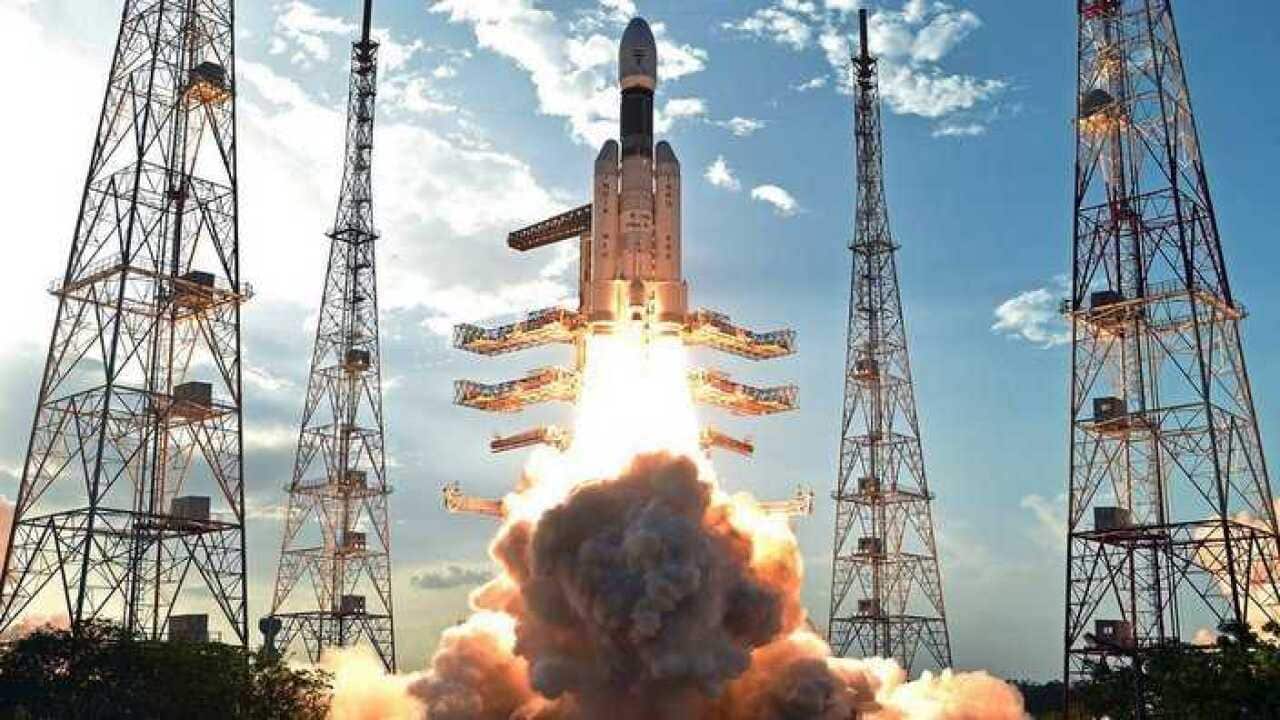

The Indian Prime Minister Narendra Modi recently announced that India will launch a manned mission to space by 2022.
The Indian Prime Minister Narendra Modi said in his Independence Day speech this year that India will launch its first manned mission to space by 2022.
The India Human Spaceflight programme is being developed by Indian Space Agency ISRO (India Space Research Organisation). A spacecraft called 'Gaganyaan' will carry the first crewed flight.
Astrophysicist and PhD student at ANU, Soniya Sharna tells SBS Hindi that India will only be the fourth country in the world to send a human to space.
"Only three countries Russia, US and China have sent a human to space. If we call this age the 'satellite age' it will not be wrong. Satellites are being used for navigation purposes, weather forecast, military, scientific research and a lot of other purposes. So given this manned missions will play an important role."
Soniya Sharma tells us that in this mission the ‘Gaganyaan’ spacecraft will be launched and will be stationed in an orbit at a distance of 400kms. There will be a crew of three people and they will perhaps spend a few days in orbit
She further emphasizes why manned missions are important even though humans have been sending space probes, orbiters, and rovers to study other planets.
"Unmanned missions have been sent to Mars like 'Curiosity' rover or 'Mangalyaan' orbiter and they have studied the topography and the chemical composition of that planet. Scientists feel that they may have seen some signatures of microbial life there and they want to confirm that. Something like that can only be confirmed by a manned mission."
Meanwhile, Australia got its own Space Agency in this year which commenced operation on 1st July 2018.
Chief Executive of the Australian Space Agency, Dr Megan Clark, believes Australia's joining the industry at just the right time.
“The industry’s completely transformed, it’s undergoing a transformation the like we haven’t seen since we walked on the moon. And this is a wonderful opportunity for Australia to really show what it can do on the international stage.”
But even though Australia did not have its own agency till this year it has been involved in several international space projects
Paolo Ferri, head of Mission Operations at the European Space Agency ((ESA)) in Germany says there ESA (European Space Agency has a long-term cooperation with Australia.
"There is already cooperation in Earth observation and there’s a lot to be done in that area; payloads, development of instrumentation but also exploitation of the data.”