
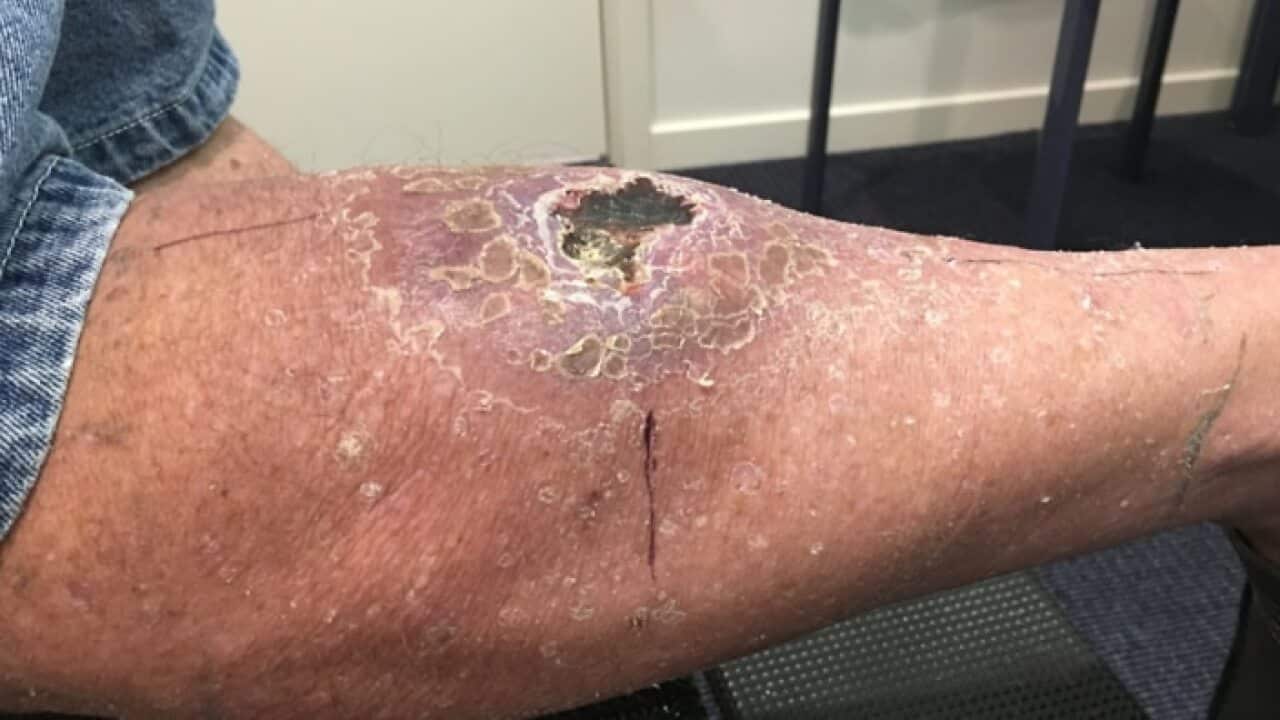

The rapid spread of a mysterious flesh-eating ulcer in Victoria has medicos calling for urgent research funding.
More than 200 patients presented with tissue-destroying Buruli Ulcer last year - and to date - 2-Australians have required amputations.
Melbourne schoolboy Gus Charles still wears the scar from a Buruli Ulcer, which formed after he cut his knee more than a year ago. He says initial swelling became infected and was mis-diagnosed before surgical intervention.
A few weeks before the sugeon cut it open it collapsed and sort of a small divet came through and blood came out and after the surgery that's when I realised it was something pretty serious.
His mother Sally Charles says the ordeal and intensive treatment has been draining.
It's extremely frustrating - and you're worried, any parent would be worried, because it's just awful knowing your child is in pain and knowing it's not getting fixed, in fact, it's getting worse and that no-one can diagnose it.
Dr Daniel O'Brien, from Barwon Health, specialises in the research and treatment of the condition.
It's a flesh eating infection and it starts to eat away at the skin and the tissue underneath the soft tissue we call it, and if it's not treated, it basically continues to spread and get larger and larger and in some circumstances, where it's very aggressive, it can very rapidly take over a whole arm or a part of a leg.
Buruli Ulcers are believed to have originated in Western Africa, before curiously presenting in various parts of Australia since the 1930's. Over the past few years, the overwhelming majority of diagnoses have been in Victoria - primarily on the Bellerine and Mornington Peninsulas. In total, 107 cases were recorded in 2015, 182 in 2016 and last year 275 people presented with the condition. Over the same period it's estimated there were just 10 cases diagnosed elsewhere in Australia.
Professor Paul Johnson, from Austin Health, says it's possible the bacteria which causes the condition exists in possum feaces and is spread to humans through mosquito bites.
There are big questions we don't know the answers to - particularly why it spreads, why it arrives in a possum population in the first place, and where it's going to turn up next.
Victorian health authorities have spent a million dollars researching the ulcers over the past 15-years - and have joined with researchers in applying for a futher 2-million dollars from a federal medical research fund.
It's not a thing we can wait around for - this is a rapidly worsening epdemic. We have critical information that we don't know and the funding is urgent so the sooner the better.