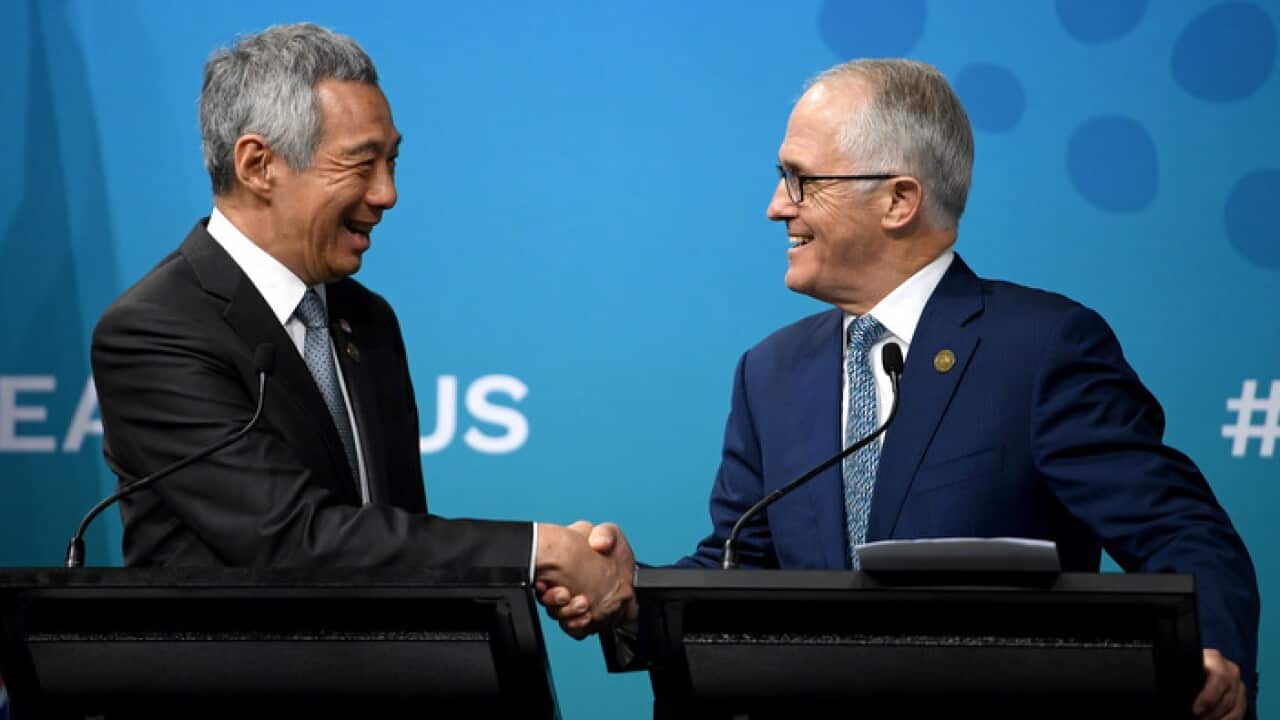

Prime Minister Malcolm Turnbull and Southeast Asian leaders from the 10-member ASEAN have agreed to intensify their response to regional challenges, including terrorism, the South China Sea, and trade.
The agreement came at the end of a three-day special summit in Sydney.
Prime Minister Malcolm Turnbull has reaffirmed Australia's commitment to an ASEAN alliance, saying the bloc has an "all-weather friend" in Australia.
"Today, nearly one million Australians claim southeast Ancestry, and more than 700,000 Australians speak one of the languages of ASEAN at home. The countries of ASEAN are among our closest neighbours. They are our friends, and our increasingly our family as well. Our shared geography and our shared interests mean we also share our future. The summit has helped shape and chart our future together. More security and stability. More prosperity and more opportunity."
Leaders attending the summit have announced an agreement to share intelligence on cyber security threats, as well as policing resources.
Mr Turnbull says the deal, outlined in the so-called Sydney Declaration, will be critical in thwarting potential terrorist attacks.
"What may appear to be an inconsequential piece of information in the hands of one police service or one security service, may be the piece that solves the jigsaw in another country. And so sharing is critically important. We have been able to disrupt very, very serious threats to security in Australia because of a piece of information that has come from overseas."
The ASEAN leaders have also re-emphasised to China the importance of freedom of navigation in the disputed South China Sea.
China has been building artificial reefs to use as defence bases in the busy waterway, which is also claimed by a number of other ASEAN members.
The leaders emphasised in a joint statement the importance of non-militarisation in the area, saying there is a need to avoid "actions that may complicate the situation".
Mr Turnbull says Australia is pushing to create a legally-binding Code of Conduct - a sentiment backed by Vietnam's Deputy Prime Minister Phạm Bình Minh.
"That is not enough. We need a legal binding COC (Code of Conduct). Because anything happen in the South China Sea it will affect not only the claimant state but also affects the stability and prosperity in the region.
ASEAN chair and Singapore's Prime Minister, Lee Hsien Loong says leaders are hoping to reach a speedy agreement, though a definitive resolution might yet be some way off.
"ASEAN countries all have broad and substantial relationships with China. For many of the ASEAN countries, China is in fact their biggest trading partner. This is an issue which we can manage, which we can prevent from escalating, but this is not an issue which can in a definitive way be solved in any short period of time."
Mr Turnbull says the ASEAN leaders also pledged to fight protectionism, by backing the proposed Regional Comprehensive Economic Partnership, or RCEP, trade deal.
It comes after Australia signed another trade deal, the Comprehensive and Progressive Agreement for Trans-Pacific Partnership, earlier this month.
Mr Turnbull says a sucessful RCEP deal would see the Asia-Pacific region remain at the forefront of international trade for years to come.
"There was very strong support around the table for a swift conclusion to the Regional Comprehensive Economic Partnership. It covers half the world population and a third of the world's trade. If we can secure a good agreement, it would ensure on the back of the TPP-11, tht the Indo-Pacific continues to be the fulcrum of open and free trade.
Meanwhile, Mr Turbull says Myanmar leader Aung San Suu Kyi has reached out to Australia and her fellow ASEAN leaders for help in dealing with the Rohingya refugee crisis.
Ms Suu Kyi has faced international condemnation over her muted response to atrocities against Rohingya people in Myanmar's troubled Rakhine state, from where 700,000 people have fled to neighbouring Bangladesh, following a military crackdown.
Last week, Mr Turnbull signalled an intention to raise the issue of human rights abuses with the Myanmar leader, and he says the matter has been discussed at length during the summit.
"We discussed the situation in Rakhine state at considerable length. And she seeks support from ASEAN and other nations to provide help from a humanitarian and capacity-building point of view. Everyone seeks to end the suffering."
Other outcomes from the summit included a $30 million investment to support the development of so-called "smart cities" scholarships to promote cross-border education, and the promotion of peacekeeping and gender equality.
Overall, Mr Lee says he is pleased with how the summit went.
"I'm very happy with the outcomes from this summit meeting. I think the purpose of the summit is to focus our minds, to give the civil servants impetus to complete specific projects, and at the same time, to have top-level exchange of views and the review of where we stand in the relationship - and that we have achieved."
Singapore will host the 32nd and 33rd ASEAN formal summits later this year in April and November.