
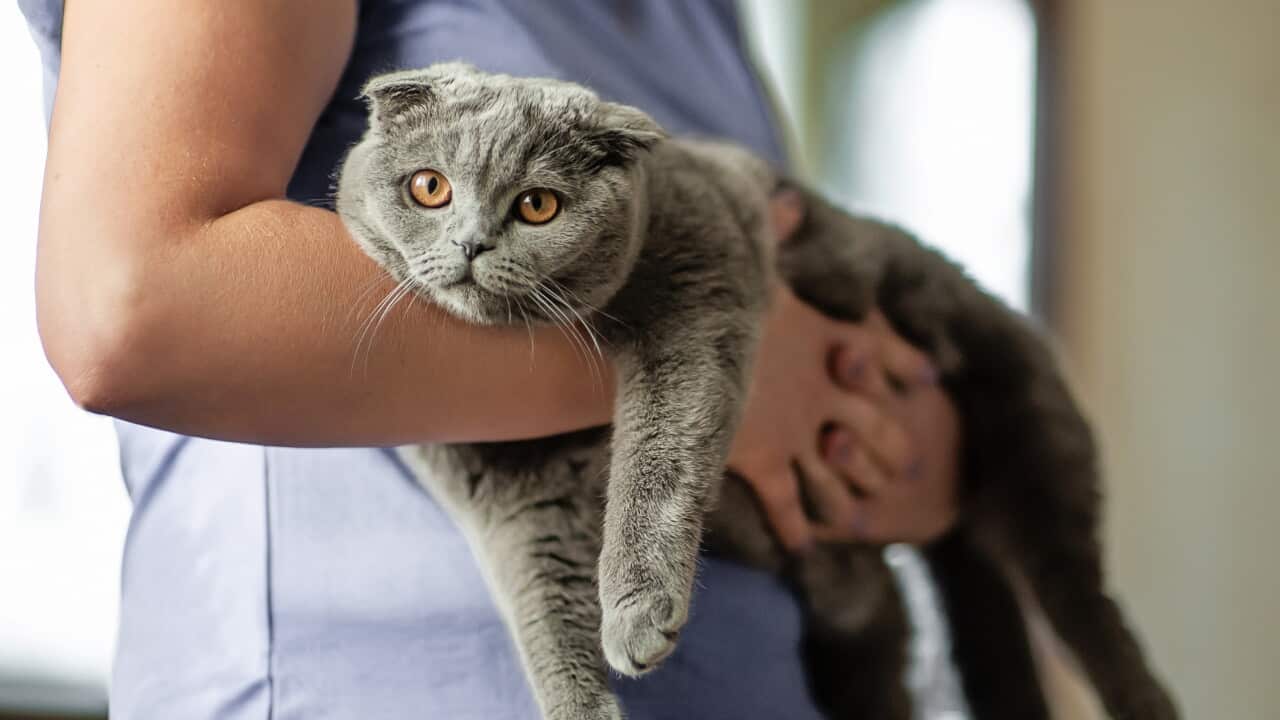

病気のペットについて伝える際に役立つ英語を学びましょう。ペットが食事や水分を摂らなかったり、普段と違う行動をとったりする場合に、それを説明するための日常的なフレーズを練習しましょう。
英語を理解し話すことは、オーストラリアでの生活を向上させるのにとても役立ちます。ポッドキャスト、SBS Learn Englishでは、日々のさまざまなシチュエーションで使えるとっさの英語や表現を、あらゆる例を取り入れて簡単に説明します。
このエピソードは、中級者に適しています。聴き終わったらクイズで学習成果を確認しましょう。
学習ノート:
食事や水飲みの様子の変化について話すときに使えるフレーズの例:
- My cat is off his food.
- What do you usually feed him?
- I usually feed him dry cat foot in the morning.
- Has she touched her food today? .
- He doesn’t have an appetite.
- She hasn’t drunk any water at all.
- He’s barely drinking.
- She’s barely touched her water bowl.
- I’m worried he might be dehydrated.
ペットの様子を説明する際に使えるフレーズの例:
- He seems really flat.
- She’s not herself today.
- He seems a bit out of sorts.
- Her coat looks a bit dull.
- He’s losing fur around his ears.
- He seems really unwell.
- She perked up after drinking some water.
- He’s still not perking up. We should get help.
嘔吐、排便、トイレのトラブルについて話す際に使えるフレーズの例:
- Has he vomited at all?
- He threw up this morning.
- She’s been sick since last night.
- His poo’s been runny.
- He’s had diarrhoea since yesterday.
- The puppy had a runny tummy.
獣医と話したり、アドバイスを求める際に使えるフレーズの例:
- We should get him checked.
- I’ll keep an eye on him tonight.
- The vet will check her for dehydration.
- I’ll take his temperature.
口語的な言い回し:
Let’s not muck around ー 「時間を無駄にするのはやめよう」、「真剣に受け止めて、今行動しよう」
To get someone checked ー 専門家に依頼して、適切に検査すること。ここでは、獣医がその専門家となります。
To keep an eye on someone ー ペットの様子が良くなるか悪くなるかを、注意して観察すること。
ボキャブラリ:
Vet: veterinarianの短縮形, 獣医。
Food: はペットの食べ物。 feed は通常、動物に食べ物を与える行為を指します。
Appetite: 食欲。
To be off their food: 食欲がないという意味です。この表現はペットについて話すときに使ったり、病気で食欲がない人について話すときに使うことができます。
An animal’s coat: その動物の体毛。
Fur: 多くの動物に生える柔らかい毛のことです。
To be flat: いつもより疲れているように見えたり、静かで、元気がないように見えることを意味します。
To be not himself / herself: いつもと様子が違うことを意味します。
To be out of sorts: 少し気分が悪い、疲れている、あるいはいつもと少し違うと感じることを意味します。
To vomit: 嘔吐すること。
To throw up: 嘔吐することの口語的な表現。
Barely: ほんの少し、ほぼ何もないに近い。
Poo: 糞便の口語的な表現。
Runny: 水様の。水のような。
Diarrhoea: 下痢
A litter tray: 猫砂と呼ばれる特殊な素材が入ったトレイで、猫が家の中でトイレとして使うものです。
At all: 疑問文や否定文で強調するために使えるフレーズです。通常は「anything or anyone at all」の短縮形です。
A funny tummy: お腹の調子が悪いことを表す、くだけた言い方で、子供やペットについて話すときに使うと、より柔らかく、医学的な響きが少ないので便利です。
Cat litter: 猫用トイレの中にある特殊な素材のことです。
Dehydration: 脱水状態。
Temperature: 体温。
A fever: 体温が通常よりも高い状態。
To perk up: 見た目や気分が良くなり、エネルギーが湧いてくることを意味します。
Symptoms: 症状。
学習のポイント:
どんな言語でも、友人や家族と話すときは、フォーマルな言葉よりもくだけた言葉を使うことがよくあります。特に、身体や不快な事柄について話すときはそうです。くだけた言葉は決して「悪い」ものではありません。単に、あまりフォーマルでない場面や、よく知っている人と話すときに使う言葉です。会話の中では、病気について話す際にフォーマルな言葉とくだけた言葉の両方が出てきます。話す相手や状況に応じて、どちらを使うかを選ぶことができます。
FORMAL | INFORMAL |
Has lost his/her appetite | Off his/her food |
Is tired and lacks energy | Is really flat |
To vomit | To throw up |
Has diarrhoea | Has runny poo |
Has lost her appetite | Hasn't touched her food |
Not behaving normally | Out of sorts |
To watch carefully | To keep an eye on |
To look and feel more lively | To perk up |
スクリプト:
(注:これは一字一句書き起こしたものではありません)
SBS acknowledges the Traditional Custodians of Country and their connections and continuous care for the skies, lands, and waterways throughout Australia.
Have you ever looked at your pet and thought, ‘Something’s not right’? Maybe they won’t eat. Maybe they’re sleeping more than usual. Or maybe they’re giving you that sad little look that makes you cancel all your plans and start typing on your phone, ‘is my dog okay?’
Hi, I’m Josipa, and in this episode, we’re practising everyday English you can use when talking about a sick pet. Our pets can’t tell the vet what’s wrong, so we need to describe their symptoms clearly.
Today, Allan is worried about his cat, Milo. Milo is usually the first one in the kitchen when he hears a food packet open. He normally rubs against Allan’s leg, meows loudly, and acts like he hasn’t been fed in three days, even if he only ate something an hour ago. But today, Milo is sitting very still in the corner, ignoring his food bowl. Allan takes him to see Claire, who is a vet, that’s short for a veterinarian, an animal doctor.
Allan
Milo’s off his food and he seems really flat.
Claire
Poor thing. How long has he been like this? Has he vomited at all?
Allan
Since yesterday. He hasn’t vomited, but he’s barely drinking and his poo’s been runny.
Claire
Right, let’s not muck around. I’ll check him for dehydration and take his temperature.
Poor Milo. When pets are sick, it can be hard to know what’s wrong with them, so we need simple, clear language to describe what we notice is not quite right.
First Allan said,
Milo’s off his food.
If a pet is off their food, it means they do not want to eat. You can use “off their food” for pets, and sometimes also for people who are sick and do not want to eat.
Here, food is the thing your pet eats, But feed is usually the actioon og giving food to an animal.
For example, Claire might ask,
What do you usually feed him?
That means, what food do you usually give him?
You could answer:
I usually feed him dry cat foot in the morning.
You could also ask,
Has she touched her food today?
This means the food is still there, and she hasn’t eaten it.
So, with pets, we might say cat food, dog food, wet food, or dry food. But we use feed when we talk about giving that food to the animal.
Allan also said,
He seems really flat.
If someone or an animal seems flat, they seem tired, quiet, low on energy, or not like themselves. You could also say,
She’s not herself today.
This is a very useful phrase you can use to describe animals and people when they’re behaving differently from usual.
You might also hear people say,
He seems a bit out of sorts.
If someone or an animal is out of sorts, they seem a little unwell, tired, or not quite normal.
With pets, you might also notice changes in how they look. For example:
Her coat looks a bit dull.
An animal’s coat means the fur or hair on its body. We usually say hair for people, but coat sounds more natural when we are talking about an animal’s whole body.
You could also say:
He’s losing fur around his ears.
Fur is the soft hair that grows on many animals.
Then Claire asked,
Has he vomited at all?
To vomit is when food or drink comes back up from your stomach and out of your mouth. Not fun, not pretty, but hey… it has happened to everyone, right?
You can also say throw up in everyday, informal English.
For example,
- He threw up this morning.
- She's been sick since last night.
In this context, been sick can mean vomited. But we can also use the word ‘sick’ when we mean generally unwell, so use the word ‘vomit’ or ’sick’ if you need to be clear that some someone has vomited.
Claire asked, “Has he vomited at all?” We often use ‘at all’ as short for ‘anything at all’ in questions and statements to for emphasis.
For example,
Has he eaten at all?
This means ‘has he eaten anything at all’ and it stresses that we are asking whether he has even eaten a little bit.
Or we can use it for emphasis when we are making a negative statement about something. For example:
- She hasn't drunk any water at all.
- I don’t like this weather at all.
Talking about drinking...Allan said,
He’s barely drinking.
If someone is barely drinking, it means they are drinking only a little, almost nothing. You can use barely in a lot of everyday situations. For example,
I barely slept last night.
That means I slept very little.
Or,
I barely know her.
That means I only know her a little.
If your pet has drunk very little, you might say,
She’s barely touched her water bowl.
Allan then said,
His poo’s been runny.
This is an informal way to say that the poo is soft or watery. A more formal word is diarrhoea. You could say,
He’s had diarrhoea since yesterday.
Diarrhoea is when a person or animal feels unwell, needs to poo more often than usual and their poo is runny. For a cat, you might notice this in the litter tray.
A litter tray is a tray filled with special material called cat litter that cats use as a toilet inside the house.
But let’s say you have a sick puppy, you might say,
The puppy had diarrhoea after eating something from the bin.
Or, more informally, you could say
The puppy had a funny tummy after eating something from the bin.
To have a funny tummy is an informal way of saying that you have problems with your tummy. We often use it when talking about children or pets because it sounds softer and less medical.
These are not lovely phrases, I know. But they are useful. Very useful. Especially when you are talking to a doctor or a vet.
Then Claire said,
Right, let’s not muck around.
Let’s not muck around is an informal phrase that means let’s not waste time. Let’s take this seriously and do something now.
You might use it when something needs quick attention.
For example, If you are worried that she is not drinking and you think you need to see an expert quickly, you could say,
She’s barely drinking. Let’s not muck around.
You could also say,
He seems really unwell. We should get him checked.
To get someone checked means to have a professional look at them. In this case, that professional is a vet.
Another useful phrase is ‘ to keep an eye on him’. to keep an eye on a pet or a person or something else - means to watch them carefully, often to see if they get better or worse. For example,
I’ll keep an eye on Milo tonight and call the vet if he gets worse.
Claire then said,
I’ll check him for dehydration.
Dehydration happens when the body does not have enough water. If a person or an animal is not drinking much, dehydration can become serious.
You could say,
- I’m worried he might be dehydrated.
- The vet will check her for dehydration.
Claire also said,
I’ll take his temperature.
To take someone’s temperature means to check how hot their body is. If a person or animal has a high temperature, they may have a fever.
You can say,
- The vet took Milo’s temperature.
- He has a high temperature; we should call the vet.
Sometimes animals do perk up by themselves after a little rest. Has that ever happened with your pet?
To perk up means to start to look or feel better and have more energy. You can use it for people, too. You could say,
She perked up after drinking some water.
But if your pet is not getting better, you could say,
He’s still not perking up. We should get help.
And remember, if a pet is barely drinking, has runny poo, seems very flat, or you are worried about them, it is always best to contact a vet. These are all symptoms, that is, signs that they may be sick. Other symptoms that might worry you include vomiting, tiredness, or loss of appetite.
Sign up for previews, updates and to provide feedback.
Paul Nicholson and Lily O'Sullivan voiced the characters of Allan and Claire, and Professor Lynda Yates was our educational consultant.