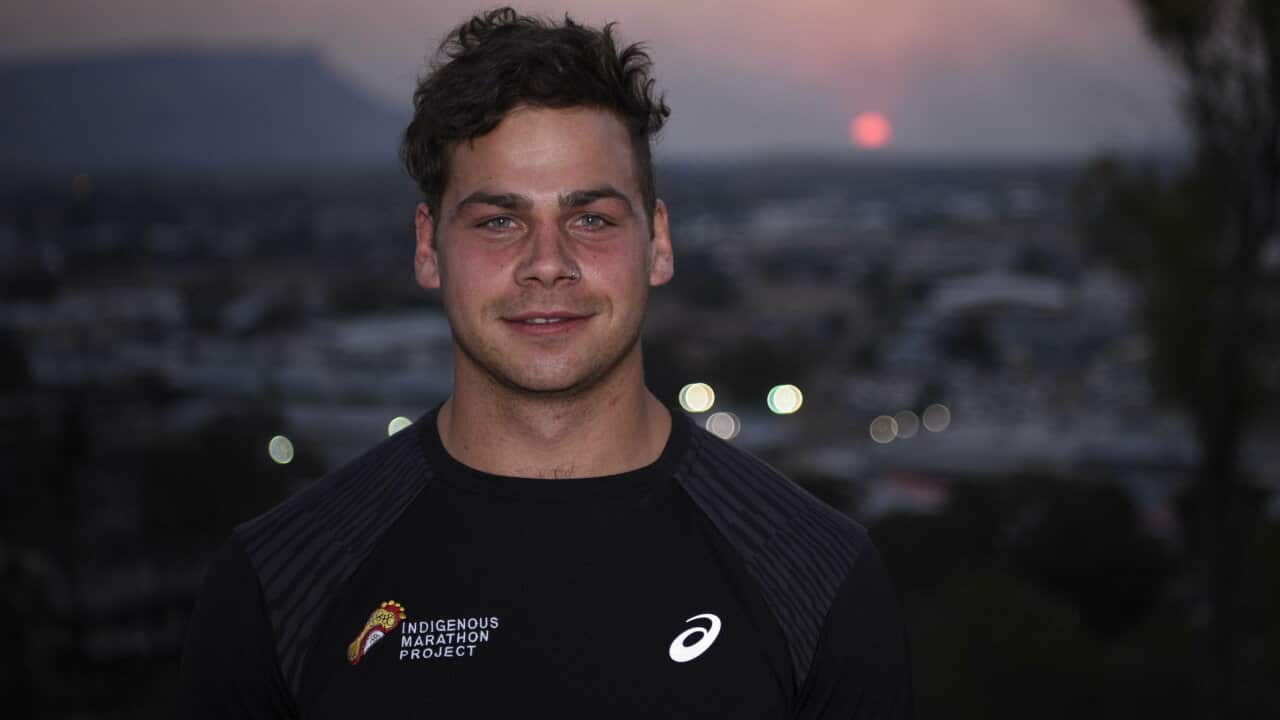

"Celebrating Indigenous resilience and achievement through the biggest marathon run in the world."
Tens of thousands of people are taking part in the 47th annual New York City marathon today. Among them there is a squad of 11 Indigenous runners who have come from some of Australia and the world’s most remote communities, and who aim to go even further in celebrating Indigenous resilience and achievement. In all six men and 5 women, some of whom had never left the country.
Zane Sparke from Port Macquarie and student at Charles Sturt University is part of the Indigenous team. Like the rest of the Indigenous squad, to qualify he went through a six-month rigorous and gruelling preparation that culminated in a 30-kilometre qualifying desert run through Alice Springs, with temperatures sometimes soaring up to 35 degrees.
Though he finished the race in flying colours as the first man to cross the line, and booking his ticket for New York at the same time, before taking off for New York he confided that this run in the desert was the toughest one of his life. However, he also believes that it was a good preparation for today’s big race.
He also believes that he couldn’t have gone through all the training and qualifying process without the support of Charlie Maher, the first Indigenous Australian to run the New York Marathon in 2010.
“Qualifying for the marathon was not just about the physical ability to go the distance. We also had to finish a compulsory health and education program, including first aid training and much more,” Zane Sparke said.
Zane Sparke is currently studying at Charles Sturt University in Port Macquarie and he helps look after two of his younger brothers on weekends. He hopes that his achievement, taking part in the New York marathon, will inspire other young First Nations youth the same way he’s been inspired by Charlie Maher and others through the Indigenous Marathon Project (IMP).
Each year IMP selects a squad of 12 young Indigenous men and women, to train for the New York City Marathon in November, complete a compulsory education component – a Certificate IV in Sport & Rec, media training and coaching accreditation – and through their achievements celebrate Indigenous resilience and success.