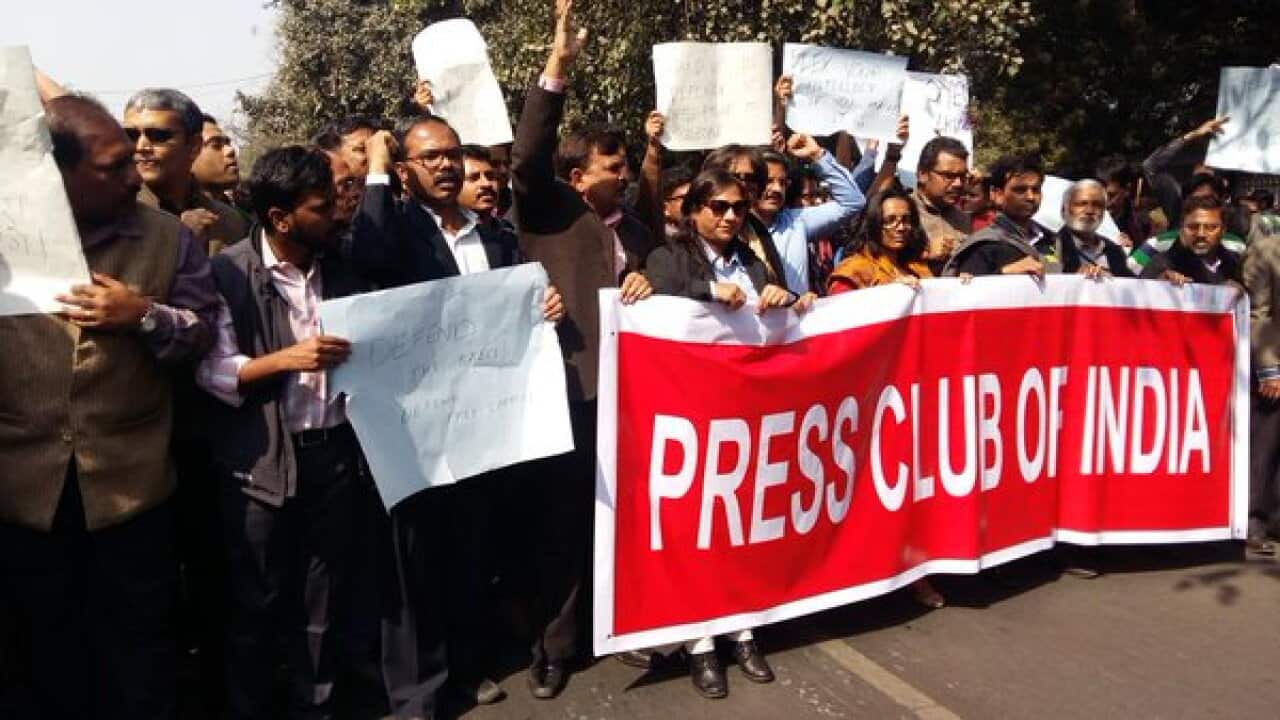

BJP led government in India is facing harsh criticism after police crackdown on University students for raising slogans perceived anti-India.
What began with a handful of students gathering to discus death penalty to Afzal Guru, the man convicted for plotting an attack on India's parliament in 2001, has turned into a massive political storm in India.
On February 9, Democratic Students Union organised a discussion on what they describe as 'judicial killings of Afzal Guru and Maqbool Butt' in Delhi's Jawahar Lal Nehru University. Later some videos began circulating that showed a group of students chanting slogans "The struggle will continue, until India is destroyed" and "We are ashamed that Afzal's killers are alive".
The Delhi police arrested Kanhayia Kumar, JNU Students Union president, who many say, wasn't even involved in that protest.
Opposition parties say that the government in India was crushing the opposing opinions by resorting to such actions.
On Monday, while Kanhayia Kumar appeared before a Delhi court, students and teachers who were there to express their support for the arrested students union president, were roughed up, and media persons reporting the story were also attacked.
On Tuesday, right wing activists belonging to the BJP and Bajrang Dal protested outside JNU to demand immediate action against those who raised 'anti-India' slogans on 9 February in the JNU campus.
Security has been tightened at the university since the protests erupted.
Students and academics of JNU continue to boycott classes to protest against Indian government.
The incident marks another flare-up in an ideological confrontation between Narehdra Modi's nationalist government and left-wing and liberal groups that is prompting critics to compare it with Indira Gandhi's imposition of a state of emergency in the 1970s to crush dissent.