

Australia is proof that a country’s greater wealth is no guarantee of stronger education achievements, says a UNICEF report on education equality.
The Convention on the Rights of the Child says that education should be equally accessible, free and fair for every child, yet inequality in education persists and, as one UNICEF report suggests, is more notable in high-income countries, such as Australia.
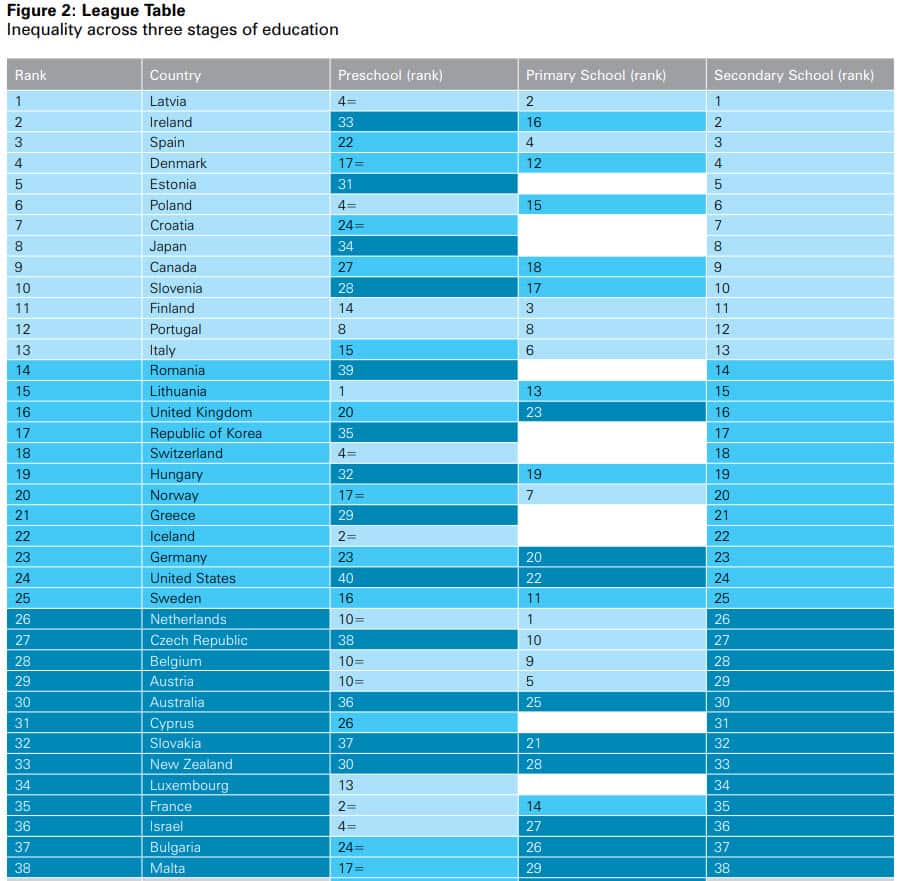
Australia, together with 40 other high-income countries, was the focus of the UNICEF report, An Unfair Start: Inequality in Children’s Education in Rich Countries. The report saw Australia trailing comparable nations across three stages of education: preschool, primary and secondary education.
Early childhood education and care plays out later in life
The report counters the perception that wealthy countries must be doing better than other nations in terms education access and equality.
Some of the poorest of the 41 countries, Lithuania leads the board by equitably providing preschool learning to 99.9 per cent of children. In comparison, in Australia only 90.6 per cent of children attend preschool.
Better academic performance overall is often the result of preschool education, according to the study, which shows that those who attend preschool, score higher in reading at age 15 than those who do not.
Where does Australia score well?
Social policy economic specialist Yekaterina Chzhen is one of the authors of the report. She says that Australia showed a remarkable result in comparing children of immigrant and non–migrant backgrounds.
In almost every studied country, except Australia and Canada, children from migrant families do substantially worse in reading than their peers who are born in the country of the test.
“Australia and Canada managed to ensure that children with an immigrant background do just as well as their native-born peers and, in fact, second-generation immigrant children in Australia do better than their peers with no immigration background”, says Chzhen.
Mind the gap
The gap between better and worse performing students is attributed to several factors, mainly linked to the economic segregation and schooling systems.
In Australia, more than 43 per cent of students attend private schools, which is one of the highest rates among comparable countries.
Education is the right of every child. It should be free and fair, with equal access for girls and boys. - Article 28, Convention on the Rights of the Child, 1989
As Chzhen explains, education systems where children from different backgrounds and economic circumstances are mixed together will see a shift towards breaching the gap in performance.
For instance, compared to Australia, Latvia has only two per cent of students enrolled in private school and less drastic gaps in performance.
Does public education opens doors?
Chzhen says that only discussing better socio-economic conditions fails to give a full picture of how overall educational results are connected, and that equality in education precipitates positive changes.
“A more uniform school system can lead to more equal results and countries with more equal results tend to have high average standard overall.”
A recent Grattan Institute report appears to support the UNICEF claim that there is more inequality within countries than there is between them.
Researchers compared NAPLAN test data across consecutive years and found out that in Australia student progress varies widely between states and territories, as well as within them.
Report author Julie Sonnemann says the study reveals the Australian Capital Territory as the worst performer overall.
"The most concerning pocket is in the ACT, which is quite contrary, because, on most achievement analysis of NAPLAN, they come out at the top," says Sonnemenn. "But once you take into account the students' background, they actually come out as trailing the national average, consistently the worst - far behind other states like Tasmania or even the Northern Territory."