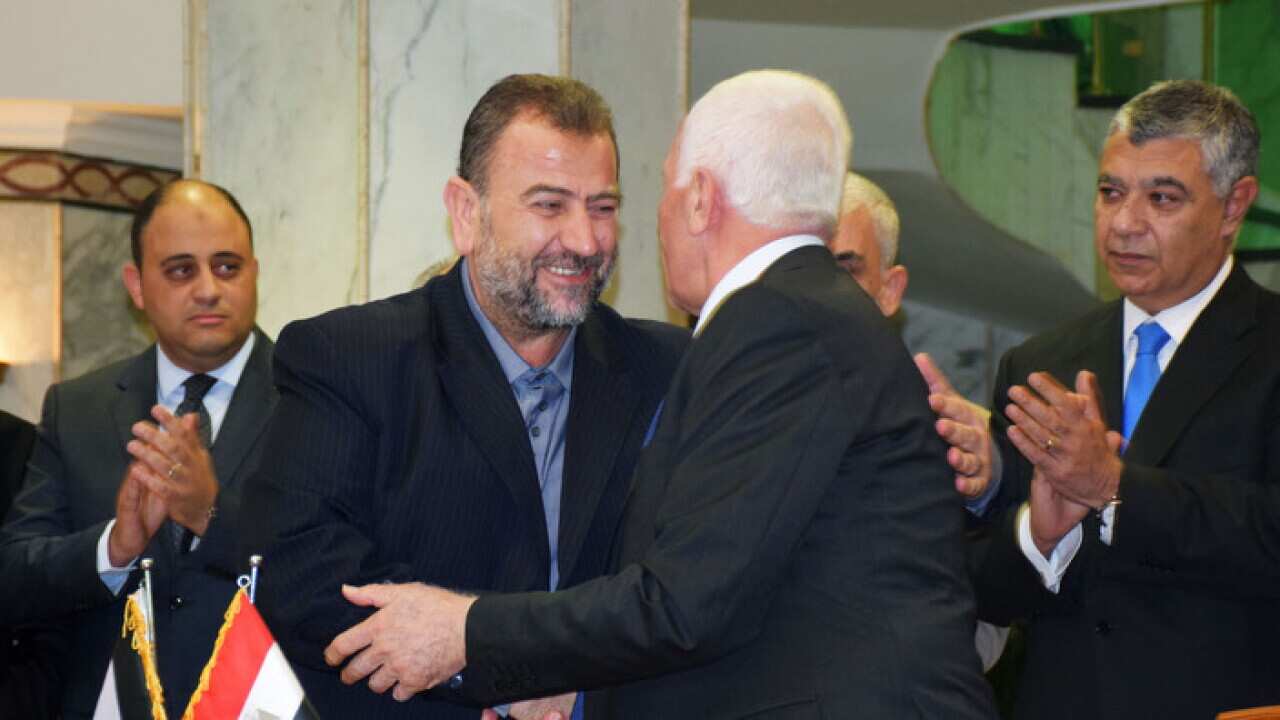

The Palestinian political rivals Fatah and Hamas are meeting over a possible unity agreement to return Gaza to President Mahmoud Abbas's control. The deal, designed to ease the longstanding Israeli-Egyptian blockade of the Gaza Strip, was signed in 2011 but not put into action. If successfully implemented, the dire humanitarian situation in Gaza could drastically improve.
The deal stipulates the main border crossing between Egypt and Gaza would again be operated by Palestinian Authority president Mahmoud Abbas by November the 1st.
A permanent opening of the crossing would reopen free trade and allow Gaza's 2 million people to leave the territory.
Fatah Central Committee member Azzam al-Ahmad (az-AM al akh-MAHD) says Mr Abbas and the Palestinian Authority are ready for reconciliation.
AHMAD
"There has been full agreement on the concept of empowering the government. The legitimate Palestinian government will return to working normally in accordance with its prerogatives and the law."
Hamas has been the de facto ruler of the Gaza Strip since 2007 after beating Mr Abbas's long-dominant Fatah party in parliamentary elections.
Hamas then pushed Fatah out of Gaza in a bloody conflict when Fatah refused to recognise the result of the vote.
The takeover left Fatah in control of only enclaves in the West Bank, and Israel responded by imposing an airtight siege of Gaza still in place today.
Palestinian civilians are welcoming the move towards unity but retain some reservations because past attempts at it have floundered.
Fatah official Hazem Abu Shanab insists the situation is different this time.
SHANAB
"There's a different intention, there are different political circumstances, which encouraged a response to the initiative of President Mahmoud Abbas to regain national unity. The circumstances are different. The government, at the same time, has made preparations. It has the ability to provide many of the public services needed by the Palestinian citizens and to improve the quality of life of the Palestinian citizen. That is for sure."
Hamas declared last month (sept) it would dissolve its administrative committee running the Gaza Strip.
Now, it has announced it will submit responsibilities to Prime Minister Rami Hamdallah (RAH-mee hahm-DUL-uh) under the new deal.
Hamas head delegate Saleh al-Arouri says, at heart, his party shares the same concerns as Fatah.
AL-AROURI
"Despite the fact that we have some different views, we have different political points, we have different disputes, this will never change the fact that we are brothers. We are brothers in religion. We are brothers in nationality. We are brothers in the national interest. We suffer the same. We have the same future. We need to find a way for unity of our people to secure the ambitions of our people."
The emerging deal was brokered under significant Egyptian supervision.
Egypt's increased ability to handle the costs of providing public services in Gaza was also believed to be a key to the agreement.
Hamas official Ahmed Yousef has told Al-Jazeera that, as arbiter, Egypt will have a big role in restoring stability to the Palestinians.
YOUSEF
"Fatah and Hamas, and they both of them, they agreed that, whatever Egypt will decide, they will follow. I think this is important. We trust Egypt to be the mediator."
The Palestinians are set to take on security duties, including deploying 3,000 troops around border territories and the Gaza Strip.
Other issues, including how to run internal security and merge two separate groups of government workers, are being addressed step-by-step.