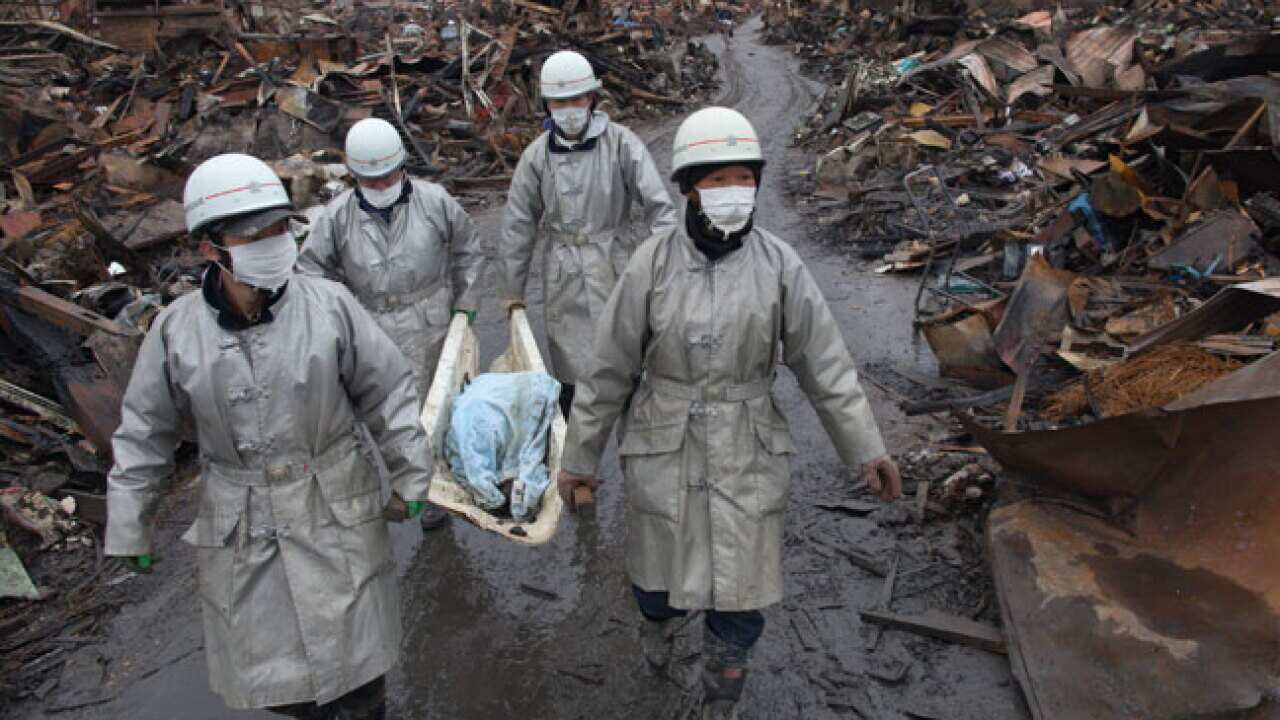
The official number of dead and missing after the devastating Japanese disaster has topped 16,600 as Japanese engineers are fighting a battle against time to restore the nuclear plant's power supply.
The nuclear safety agency said that plant operator Tokyo Electric Power Company (TEPCO) had managed to get a line from a regional power firm into the plant site.
"But the line has yet to reach the reactors' power system and it will take 10 or 15 hours to connect the line to it," an agency spokesman said.
News that makes sense
Your trusted source for staying up-to-date with the world around you. Get free daily news updates and analysis, straight to your inbox.
A TEPCO spokesman earlier told AFP: "If the restoration work is completed, we will be able to activate various electric pumps and pour water into reactors and pools for spent nuclear fuel."
In an update, the International Atomic Energy Agency said "engineers plan to reconnect power to unit two once the spraying of water on the unit three reactor building is completed".
Situation not 'significantly' worse
The UN nuclear watchdog separately said the situation had not worsened "significantly" over the past 24 hours but warned it would be premature to talk about a ray of hope.
As workers battled to avert meltdown, a newspaper reported that Japan had turned down a US offer of assistance in cooling the fuel rods immediately after the damage to the plant.
The government and TEPCO, both having first thought the cooling system could be restored by themselves, rejected the offer as they believed "it was too early to take", the Yomiuri Shimbun said, quoting a senior official of the ruling Democratic Party of Japan.
Some officials had pointed out that Japan could have avoided the crisis if the government had accepted help straight away, the paper said.
Teams of Japanese workers and troops battle to prevent meltdown at a quake-hit nuclear plant as alarm over the disaster grew with more foreign governments advising their citizens to flee.
At the stricken Fukushima No. 1 plant, 250 kilometres (155 miles) from Tokyo, Chinook military helicopters have dumped tonnes of water in a desperate bid to cool reactors crippled by the earthquake to prevent a catastrophic meltdown.
Fire engines were even put into action to douse fuel rods inside reactors and in containment pools to stop them from degrading due to exposure to the air and emitting dangerous radioactive material.
The fuel-rod pools contain used rods that have been withdrawn from reactors yet remain highly radioactive.
They are immersed in cooling water for many years until they shed enough heat to become manageable for storage.
Water in one of the pools was evaporating because of the rods' heat, and temperatures were slowly rising in two other pools because coolant pumps were knocked out by the March 11 quake and tsunami, experts said.
They warned that if the tanks run dry and leave the fuel rods exposed, the rods could melt or catch fire, creating potentially lethal levels of radiation.
US send experts as governments urge citizens to leave Japan
US President Barack Obama offered to give Japan any support that it needs, in a telephone call with Prime Minister Naoto Kan, the Japanese leader's spokesman said.
Paving the way for a more direct role by the US military, the Pentagon said it had sent a team of experts to evaluate what assistance US forces could provide to the plant.
But as crews battled to prevent an atomic disaster, more foreign governments urged their citizens to steer clear of northeast Japan and the capital Tokyo.
Britain, France, Germany, Australia and New Zealand were among the nations advising their nationals to leave Tokyo and shun the northeast region.
The Japanese government has told people living up to 10 kilometres (six miles) beyond a 20-kilometre exclusion zone around the crippled plant to stay indoors. More than 200,000 people have already been cleared from the zone.
The government has said radiation levels from the plant posed no immediate health threat outside the exclusion zone despite slightly elevated levels detected in Tokyo over the past few days.
US officials however warned citizens living within 80 kilometres of the plant to evacuate or seek shelter. The first US charter flight took off for Taiwan carrying almost 100 people, mostly families of US personnel.
Official death toll rising
The official toll of the dead and missing from the twin disasters, which pulverised the northeast coast, now approached 15,000, police said, as aftershocks continued to rattle a jittery nation.
The number of confirmed dead rose to 5,692, with more than 80,000 buildings damaged and 4,798 destroyed.
But as Japanese and international teams mounted a massive search and relief effort, reports from some battered coastal towns suggested the final death toll could be far higher.
Millions of people have been left without water, electricity, fuel or enough food and hundreds of thousands more were homeless, the misery compounded by heavy snowfalls, freezing cold and wet conditions.
A cold snap brought heavy blizzards over the country's northeast overnight, covering the tsunami-razed region in deep snow, all but extinguishing hopes of finding anyone alive in the debris.
"We're already seeing families huddling around gas fires for warmth," said Save the Children's Steve McDonald.
"In these sorts of temperatures, young children are vulnerable to chest infections and flu," he added, estimating that the disaster had left 100,000 children homeless.







