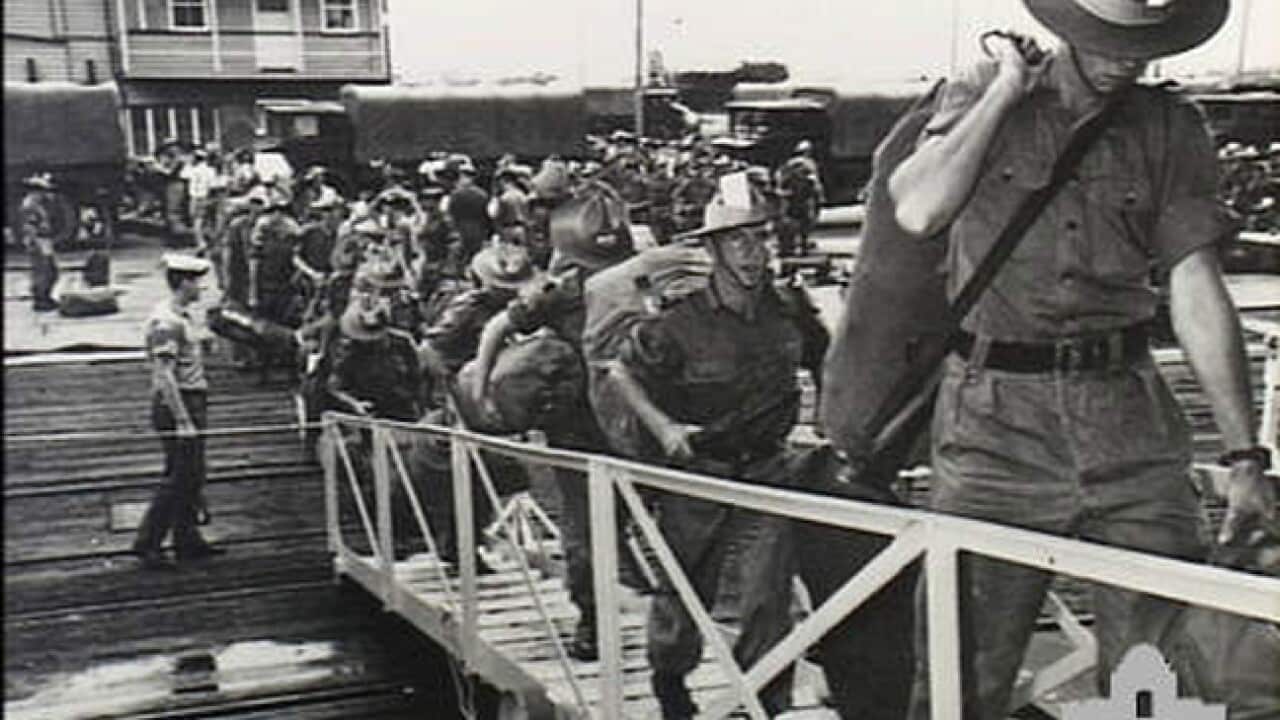
The Vietnam War came to an end in April 1975 when victorious North Vietnamese troops took over the South Vietnamese capital, Saigon.
But Australian involvement in hostilities - in support of the losing side - were formally declared at an end more than two years earlier.
When that occurred 40 years ago on the 11th of January, about 60,000 Australians had served in Vietnam.
LISTEN: Andrew Bolton looks back at the Australian involvement.
News that makes sense
Your trusted source for staying up-to-date with the world around you. Get free daily news updates and analysis, straight to your inbox.
[sbspodcast id="249318"]
The Vietnam War has just been overtaken by Afghanistan as Australia's longest running conflict.
The 40th anniversary of the end of the long and controversial war is not being marked with much ceremony.
But it's certainly stirring up memories for former navy diver, David Williams.
The Vietnam veteran says the trauma of war left its mark, even after all this time.
"At the end of the day we were brainwashed to kill people and that's affected all of us in different ways. Mental health is a major problem, especially with our young veterans I think if you look at Australia's suicide rate for young veterans, per capita, I think we are the highest in the Western world."
At least three-million people died during the Vietnam war, 521 of them Australian servicemen.
Indigenous veteran John Kinsela served as an artillery-man during the Vietnam war.
Four decades since the Australian pull-out, he says attitudes toward soldiers back home have changed a lot.
"I was proud to be an Australian soldier and we just did a job. It's Vietnam veterans that run the RSLs now, whereas before we couldn't get in."
President of the Vietnam Veterans Association of Australia, Ron Coxon, says Australia joined the conflict in 1962 - backing South Vietnam's biggest ally, the United States, in its effort to stop the spread of communism.
He says at first a team of 30 officers were sent to advise South Vietnamese forces.
By 1973, 60,000 troops had been deployed.
"Australia's real commitment up there didn't start until we sent up the advisers in 1962. In 1975 is when the North Vietnamese government moved down and there was a major confrontation and we had Australian troops involved in taking over the embassies and all that in Saigon and so the last Australian troops actually came out after that little bit of combat there in 1975."
Tien Nguyen was a newly graduated doctor and served as a medic in the South Vietnamese army, alongside US and Australian forces.
"We fought and died together during the war. I think it was a great relationship."
Dr Nguyen escaped by boat and arrived in Sydney as a refugee in 1980.
He spends much of his spare time volunteering for the local Vietnamese community and has helped raise funds for the families of fallen Australian Vietnam veterans.
He vividly remembers the last days of the war.
"You sleep in your hammock and because it's so quiet if you put your ear to the ground you can hear the tank engine, your hammock trembling. You know it's not your tank, it's the enemy."
Bob Hall was an infantry platoon commander in Vietnam.
These days, he's a Defence Force Academy researcher and runs a program called -- Operation Wandering Souls.
The project provides information about Vietnam's fallen to their families.
Mr Hall says up to 600,000 local troops remain listed as missing-in-action.
"In Vietnamese culture, those who are killed and lie in unknown graves have their souls trapped -- searching for peace and rest."
At the time, there were huge demonstrations in Australia against Australian involvement in the Vietnam War, and veterans didn't receive the same welcome home that those returning from other wars had received.
Ron Coxon, from the Vietnam Veterans Association of Australia, says through education -- public attitudes have changed for the better over the past 40 years.
"The biggest thing that we notice now is the acceptance we have of veterans of all conflicts and the understanding being demonstrated by the school children. And it's great that they know what our service has been, and they are learning it in the schools."







