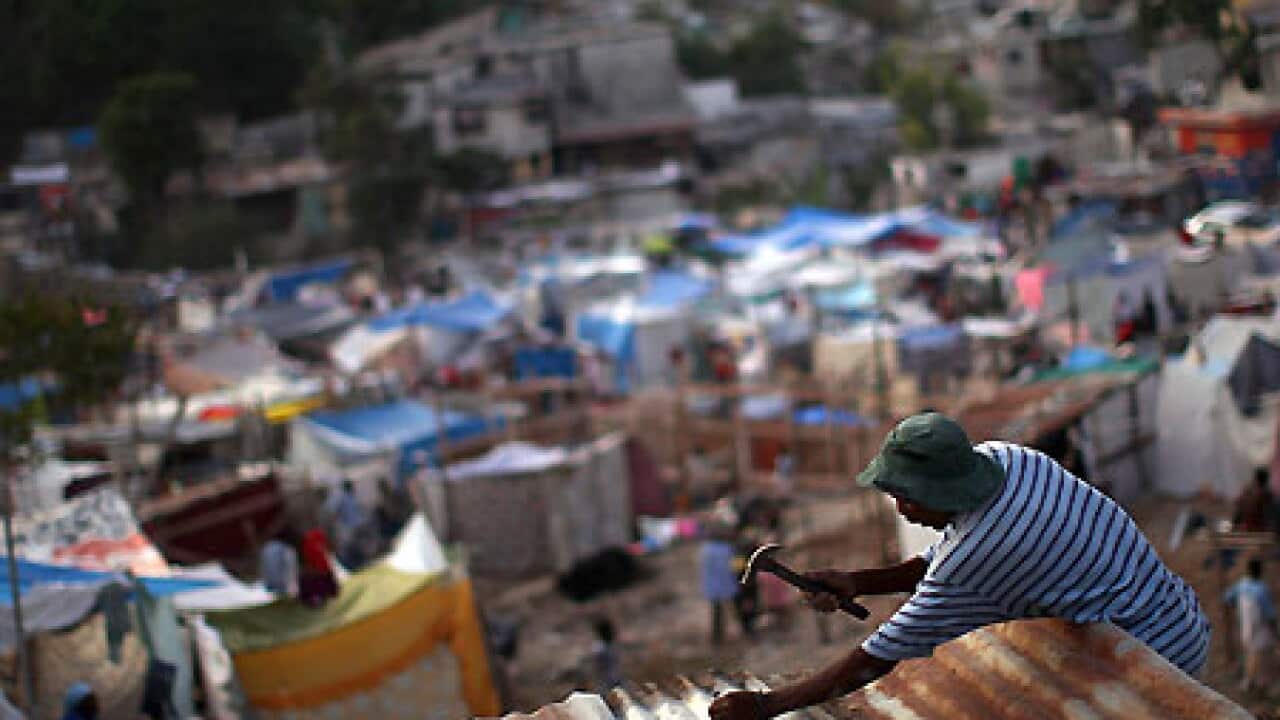
Haitian authorities are set to move 400,000 people made homeless by the country's deadly quake from the squalor of the shattered capital to new displaced persons' camps.
The government is concerned about sanitation and disease outbreaks in makeshift settlements like the one on the city's central Champs de Mars plaza.
"The Champ de Mars is no place for 1,000 or 10,000 people," said Fritz Longchamp, chief of staff to Haitian President Rene Preval.
News that makes sense
Your trusted source for staying up-to-date with the world around you. Get free daily news updates and analysis, straight to your inbox.
Longchamp said buses would start moving the homeless to new camps being built by UN peacekeepers within a week to 10 days.
Brazilian UN workers are already levelling land in the suburb of Croix des Bouquets for a new tent city, the Geneva-based intergovernmental International Organisation for Migration said.
Hundreds of thousands of people whose homes were destroyed in last week's 7.0 magnitude quake have settled in more than 200 open spaces around the city.
Rescue teams leaving
The lucky ones have secured tents for their families, but most are making do under the tropical sun on blankets and plastic sheets or under tarpaulins.
Search-and-rescue teams packed their dogs and gear on Thursday, with hopes almost gone of finding any more people alive in the ruins.
Instead the focus has shifted to keeping injured survivors alive, fending off epidemics and getting help to the hundreds of homeless still suffering.
"We're so, so hungry," said Felicie Colin, 77, lying outside the ruins of her Port-au-Prince nursing home with dozens of other elderly residents who have hardly eaten since the earthquake hit.
Scuffles erupted at one charity's food distribution point as people broke into the storehouse, ran off with food and fought each other over bags.
As aftershocks shook the city, aid workers streamed into Haiti with tonnes of relief supplies.
Aid aircraft waiting to land The international Red Cross called it the greatest deployment of emergency responders in its 91-year history.
But the built-in bottlenecks of this desperately poor, underdeveloped nation and the sheer scale of the catastrophe still left many of the hundreds of thousands of victims without help.
The US military reported a waiting list of 1,400 international relief flights seeking to land on Port-au-Prince's single runway, where 120 to 140 flights were arriving daily.
"They don't see any food and water coming to them, and they are frustrated," said Prime Minister Jean-Max Bellerive, explaining the survivors' frustration.
Four ships have managed to dock at the capital's earthquake-damaged port, holding out the promise of a new avenue for getting aid to the city.
A Danish navy ship was seen unloading crates but only one truck at a time could manoeuvre on the crack-riven pier.
Victims' wounds infected
The picture was especially grim at emergency medical centres, where shortages of surgeons, nurses and supplies have backed up critical cases.
"A large number of those coming here are having to have amputations, since their wounds are so infected," said Brynjulf Ystgaard, a Norwegian surgeon at a Red Cross field hospital.
Perhaps no one was more desperate for food than the 80 or so residents of the damaged Municipal Nursing Home, in a slum near Port-au-Prince's devastated cathedral.
The quake killed six of the elderly, three others have since died of hunger and exhaustion, and several more are barely clinging to life.
"Nobody cares," said Phileas Justin, 78. "Maybe they do just want us to starve to death."
In the first eight days after the quake, they had eaten just a bit of pasta cooked in gutter water and a bowl of rice each.
Survivors homeless, hungry
On Thursday, they had a small bowl of spaghetti and five bags of rice and beans, and cooking oil, were delivered.
A dirty red sheet covered the body of Jean-Marc Luis, who died late Wednesday. "He died of hunger," said security guard Nixon Plantin.
Such deaths were adding to a Haitian government-estimated toll of 200,000 dead, as reported by the European Commission.
It said 250,000 people were injured and two million homeless in the nation of 9 million.
As US troops began patrolling Port-au-Prince to boost security, sporadic looting and violence continued.
At a building in the Carrefour neighbourhood where the multi-faith Eagle Wings Foundation of Florida was to distribute food, quake victims from a nearby tent camp suddenly stormed the stores and made off with what the charity's Reverend Robert Nelson said were 50 tonnes of rice, oil, dried beans and salt.
Disease outbreaks feared
At least 124 people were saved by search-and-rescue teams that worked tirelessly since soon after the quake, the European Commission reported.
But as hopes faded on Thursday, some of the 1,700 specialists, working in four dozen teams with 160 dogs, began demobilising.
Joe Downey, a fire battalion chief from an 80-member New York City police and firefighter unit, said this was the worst destruction his rescue team had ever seen.
"Katrina was bad," he said of the 2005 hurricane. "But this was a magnitude at least 100 times worse."
Doctors have warned of potential outbreaks of diarrhoea, respiratory-tract infections and other communicable diseases among hundreds of thousands living in overcrowded camps with poor sanitation.







