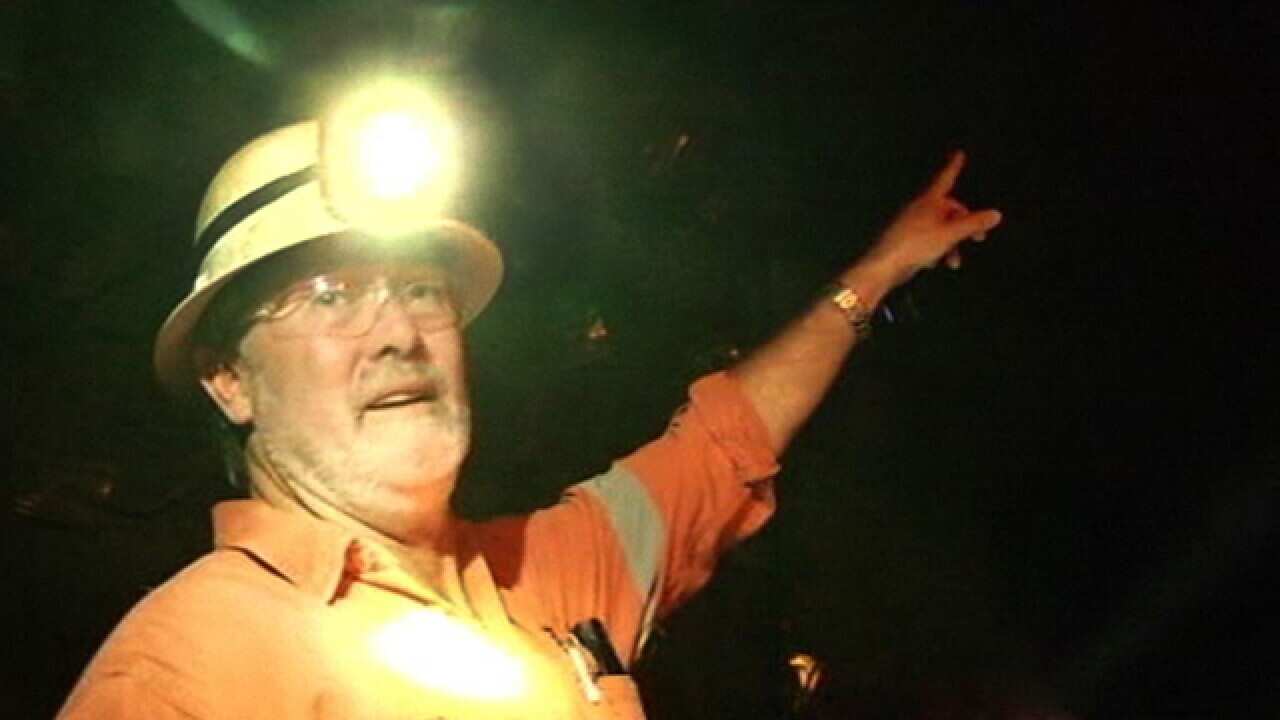
Each day, Rod Verelst drives deep underground.
Originally from WA, he's a supervisor at Cobar's CBH Endeavour mine, where lead, silver and zinc are extracted.
It's almost 40 degrees Celsius on the surface when we hop into his four wheel drive, but Rod doesn't appear to be feeling it.
News that makes sense
Your trusted source for staying up-to-date with the world around you. Get free daily news updates and analysis, straight to your inbox.
He's followed the work for years, and has seen plenty of different mines across Australia.
DIRTY BUSINESS - 'HOW MINING MADE AUSTRALIA' will air Sunday January 6th, 13th and 20th at 8.30pm on SBS ONE.
It's probably instilled in my kids,” he tells me when we sit for a chat in a subterranean mess-hall, carved out of the rock, complete with BBQ.
“I've always had itchy feet and my parents did as well.”
But for outsiders, he says settling in is not always easy - especially when you're the boss.
“When I started the people that report to me asked me 'What, do you just come here for a month or two, and then you go?' They want stability.”
Mining, as anyone passing through this remote NSW outback town soon realises from the parks, lookouts, museums and monuments dedicated to it, has long been buried in Cobar's soul.
After copper was discovered in 1870, a town was founded. It soon prospered, hitting the 10,000 mark in terms of population.
But after the wars, the rollercoaster fortunes of mining saw the town's population dwindle to a thousand.
Now, after a life of up and downs, a handful of new mines could mean a total of six mines in the area.
While there are now less than 5,000 people in town, Cobar is doing the same thing as remote mining communities across Australia to fill the potential jobs - looking further afield, and relying on air travel.
“We've got people coming from Stawell looking for their fly-in fly-outers to come to Cobar,” Mayor Brady tells me as we sit in an improbably green town park. “It's to keep their town going.”
The first flight of that unique scheme to bring former gold mine workers from Stawell in Victoria arrived in the last week of December.
North Grampians Shire Council is keen to share this news because they've worked hard at setting it up with contractors and some of the interested mining firms in Cobar.
Stawell's gold reserves are low - and over 300 jobs could be lost with the closure of the town's mine.
But the men - they are mostly men, after all - are not, on the whole, ready to leave rural Victoria permanently for a hot, dusty town a long way from home. The council thinks doing up its airstrip and flying them out could keep Stawell's community at least partly intact.
Fifty thousand FIFOs
The Reserve Bank of Australia (RBA) says there could be 50,000 fly-in fly-out and drive-in drive-out workers in the country.
Some of the men at the Endeavour mine already make the drive from Dubbo, four hours to the East, as the country greens up ever so slightly, and bends begin to appear on the highway.
But towns within driving distance won't fill the jobs that the mayor says will come with the next 'boom'.
Yet at least one expert is warning of the effects on host towns.
Professor Kerry Carrington is a sociologist and criminologist at Queensland's University of Technology who looked into patterns of violence amongst men in rural communities.
Her team 'stumbled on' the realisation that many of the Queensland towns where high levels of violence and crime were happening had something in common - large numbers of FIFOs.
“It undermines the whole sense of collectivity, the whole sense of social life,” she says, stressing that she's not entirely against the concept, just cautious - she doesn't want the mining lobby on her case again.
“The whole sense of how normal communities operate is turned on its head.”
WATCH full interview with Kerry Carrington, Queensland University of Techology:
She says there's not a lot of research in the field - someone, of course, has to fund it. The biggest submission to a current House of Representatives inquiry has come from her team, she says.
They found violence, a booming sex industry, self-harm and high alcohol and illegal drug use in towns with large numbers of temporary miners.
“When the work camps move in and the families move out they become pretty dysfunctional communities almost overnight.”
She's not keen on talking about Cobar in particular - here, the scheme is only in the early days and the early numbers are small.
Cobar's mayor is pragmatic when I ask if temporary staff get on the nose of some of the locals - after all, most of their earnings aren't even spent in the town - they return home for their days off.
“I don't think we all like fly-in fly-outers,” she laughs.
“But it is the nature of the beast, it's happening, and we've just got to wear it and get on with it.”
WATCH THIS REPORT VIA YOUTUBE:







