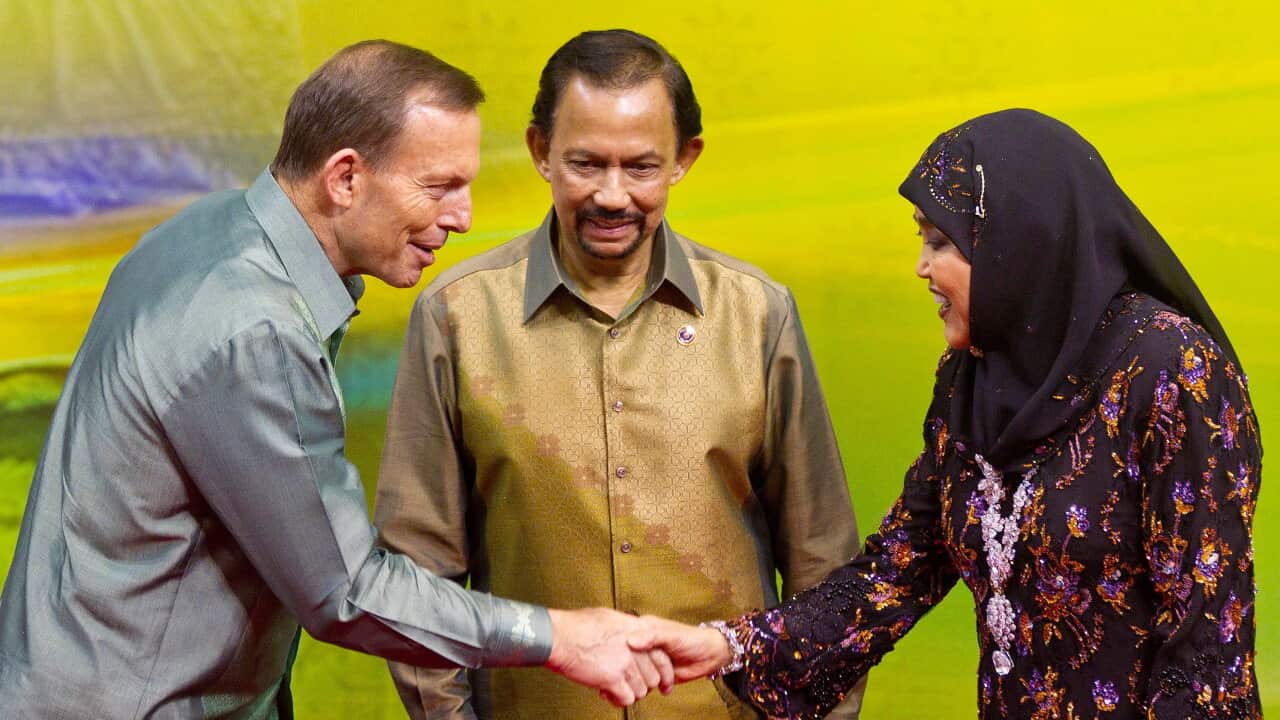
Prime Minister Tony Abbott has been holding talks with leaders of Japan and other countries at the East Asia summit in Brunei.
The summit is the climax of almost a week of top-level meetings in the region which began in Bali at the annual gathering of the Asia-Pacific Economic Cooperation group.
Naomi Selvaratnam has the details.
(Click on audio tab above to listen to this item)
The East Asia meeting brings together members of the Association of South East Asian Nations, ASEAN, and other countries including the United States, New Zealand and Russia.
News that makes sense
Your trusted source for staying up-to-date with the world around you. Get free daily news updates and analysis, straight to your inbox.
One key issue on the agenda in Brunei has been rival territorial claims in the South China Sea, which is believed to hold vast deposits of oil and natural gas and is regarded as a potential military flashpoint.
China claims most of the South China Sea, including waters near the coasts of its neighbours
The Philippines, Vietnam, Malaysia and Brunei -- all ASEAN members -- have competing claims to parts of the sea.
China has struck a friendlier tone of late, agreeing recently to discuss a code of conduct at sea with ASEAN aimed at preventing conflict.
That's an approach being supported by the Australian Prime Minister.
"It's very, very important. It's important for the whole world, not just for the countries which border on the South China Sea. It's important for Australia. Almost 60 per cent of our trade goes through the South China Sea, so strategic stability is very important, and I think everyone realises that. I don't think there is a country represented at this conference that isn't very conscious of the need for continued strategic stability in the South China Sea, and that's why I'm very encouraged by the move towards the establishment of a code of conduct."
Leaders in Brunei have also continued discussions they began in Bali on trade issues.
Tony Abbott says more opportunities are likely to result from meetings he's held with leaders of China, South Korea and Japan.
"All our trading partners are very conscious of the benefits of both of us for freer trade. Look, the universal refrain around the APEC leaders' table was the importance of freer trade for the prosperity of all our peoples, and notwithstanding the differences on other issues that are occasionally apparent, notwithstanding the fact that every country does tend to have a certain self-interest in these negotiations, by the same token, everyone accepts that in the end, everyone is better off, the freer trade can be."
Mr Abbott's talks in Brunei with his Japanese counterpart, Shinzo Abe, covered progress towards a free trade agreement.
After the talks, Mr Abbott described Japan as Australia's "best friend in Asia".
But he's since been quick to state that Australia has close trade relationships with many of its neighbours.
"The phrase that I've used on a number of occasions is that Japan is Australia's best friend in Asia. And that doesn't mean that we don't have other good friends. Obviously China is a good friend of Australia and I hope in the years to come, China becomes an even better friend of Australia."
The Prime Minister says the overall aim of his talks at the East Asia and APEC summits has been to improve employment opportunities in Australia.
"Trade and security issues are very important for our country because in the end, it all comes down to jobs. Jobs for Australians. That's what these meetings are all about. If we have more trade, we have more jobs and if we continue to have strategic stability in our region, we will have more trade."







