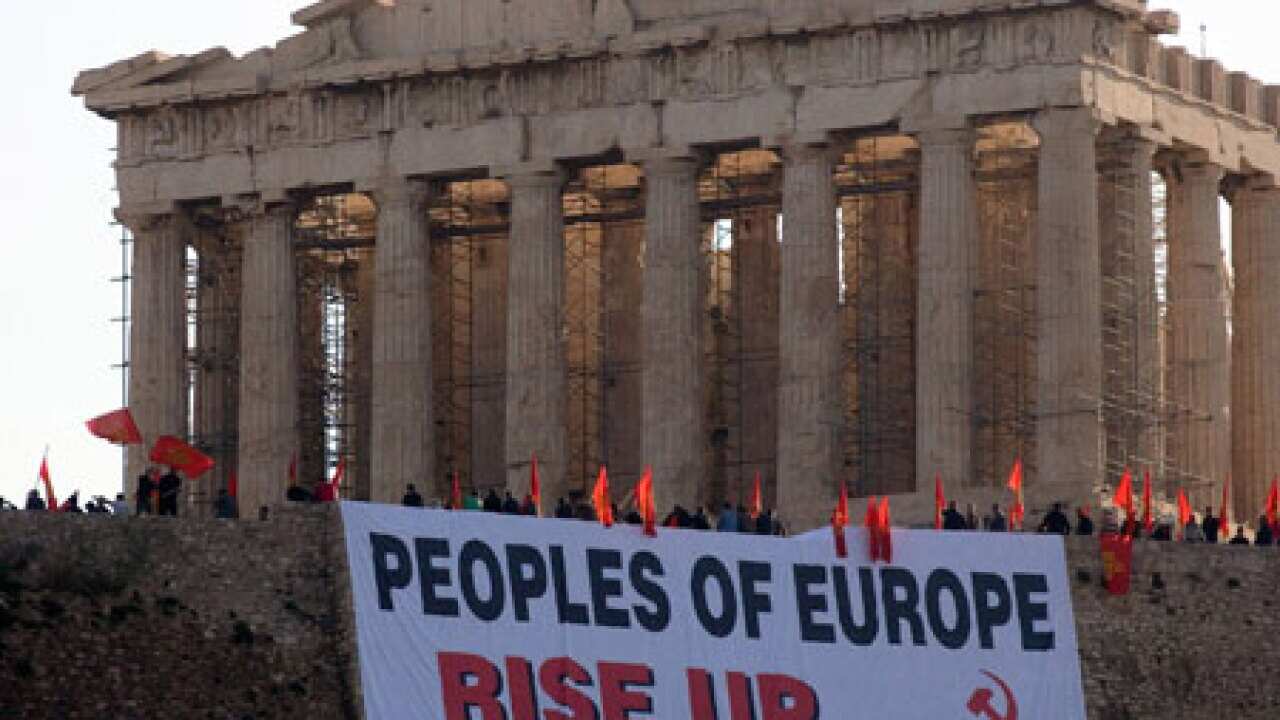
Demonstrators stormed the Acropolis in Athens on Tuesday ahead of a general strike against austerity cuts, as the euro plunged and stock markets tumbled on fears that the Greek debt crisis could spread.
About 200 protesters broke into the ancient citadel overlooking the Greek capital, chanting slogans against the cuts that Greece is being forced to adopt in order to receive a giant bailout aimed at averting a default on its debts.
Around a thousand demonstrators also massed in front of parliament bearing banners reading "We will not give a penny for the crisis."
Summit planned
News that makes sense
Your trusted source for staying up-to-date with the world around you. Get free daily news updates and analysis, straight to your inbox.
Thousands of workers are to join in a nationwide strike on Wednesday, while the Greek parliament is expected to vote on the deeply unpopular measures on Thursday and European leaders hold a summit to approve the bailout on Friday.
"We have only one aim, to save Greece, and we are not going to budge," Greek Labour Minister Andreas Loverdos said as the protests mounted.
The IMF said its board will meet on Sunday "to act" on Greece's plea for a 110-billion-euro (145-billion-dollar) financial lifeline.
Stocks hammered
Financial markets fell sharply on fears the EU-IMF bailout package for Greece may not be enough and that the crisis could spread to other weak eurozone economies like Ireland, Portugal and Spain.
On European stock markets, the losses ranged from 2.56 percent in London to 5.41 percent in Madrid, with Milan giving up 4.70 percent, Lisbon 4.21 percent, Dublin 3.97 percent, Paris 3.64 percent and Frankfurt 2.6 percent.
In New York, the Dow shed 2.02 percent to stand at 10,926.77, while the Nasdaq composite fell 2.98 percent to 2,424.25 and the Standard & Poor's 500 index dropped 2.38 percent to 1,173.60.
"The EU/IMF bailout of Greece provides enough funding for the next 12 months or so," commented VTB Capital economist Neil MacKinnon.
"However, the ability and willingness to bail out another eurozone fiscal miscreant is politically difficult," he added.
Anxiety over the fallout from the Greek mess also hit the euro, which fell to a one-year low against the dollar at 1.3023. The single currency later traded at 1.3035 dollars against 1.3187 on Monday.
Stiglitz: Euro's future at stake
Nobel laureate economist Joseph Stiglitz voiced concern over the terms of the Greek bailout, warning that the severe fiscal austerity measures being adopted in Athens could end up harming the economy.
"If you cut budgets too excessively the economy gets weaker, tax revenues go down and the improvement in the fiscal position of the country is much less that one would have hoped," he said in an interview with BBC radio.
Stiglitz, a one-time economic adviser to US president Bill Clinton and a former chief economist at the World Bank, also warned that "the future of the euro may be limited" if there are no major institutional reforms.
In the first major test of the Greek government's resolve to push through cuts, trade unions have called a general strike with street demonstrations for Wednesday expected to involve hundreds of thousands of people.
Labour stirkes
Civil servants began their two-day strike on Tuesday, with at least several hundred members of the 375,000-strong Adedy union demonstrating in Athens.
"The government is trying to divide the Greek people with lies and giving everything to employers," said Ilias Vrettakos, a senior member of the union, in a speech before the demonstrations got under way.
The public sector walkout paralysed ministries and municipal offices while hospitals were operating on emergency staff.
Civil aviation staff also joined the two-day mobilisation, grounding domestic flights on Tuesday and all flights on Wednesday.
The government aims to cut 30 billion euros from the budget over three years by scrapping annual bonuses for public sector workers and retirees, requiring longer pension contributions and raising sales tax among other measures.
Eager to keep the Greece debt crisis from spreading to other countries, the European Union and International Monetary agreed the rescue package -- an unprecedented bailout for a eurozone member -- on Sunday.
The aid still needs an official go-ahead from EU leaders later this week.
Fears over Spain
Amid market fears that Spain could be the next to face a fiscal crisis, Spanish Prime Minister Luis Rodriguez Zapatero insisted in Brussels that "any speculation on the eurozone is totally unfounded and irresponsible."
Germany, which will foot the biggest share of the bailout and was highly reluctant to extend taxpayer cash to Greece, warned the Greek government on Tuesday that loans could be halted if it did not adhere to the austerity plan.
Austrian Finance Minister Josef Proell also warned Athens that Europe was losing patience with the demonstrations in Greece, urging the government to make protestors understand that there was no alternative to austerity cuts.
"Regarding the protests in Greece, I, along with the rest of Europe, am near the end of my tether," Proell said, insisting that loans "will be dished out step by step, when (austerity) measures have been carried out."







