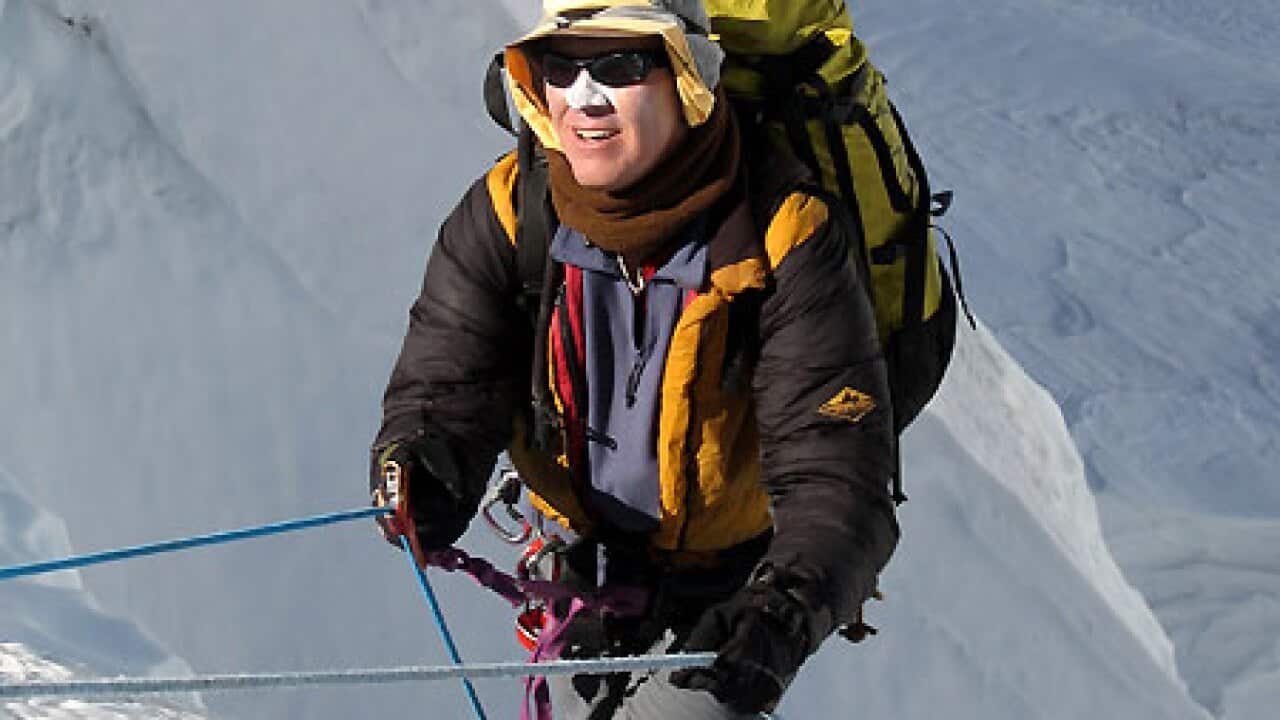
Chessell and seven members of his team reached the peak on Tuesday, the feat confirmed by the team's doctor at Everest base camp.
His successful climb follows his two previous trips to the top of the world in 2001 and 2007.
News that makes sense
Your trusted source for staying up-to-date with the world around you. Get free daily news updates and analysis, straight to your inbox.
It came after more than 200 climbers reached the Everest summit over the weekend, and as another South Australian gave up on her bid to conquer the mountain.
Bad weather forced Lynette Trott, 41, to abandon her push to the summit after she reached camp three at 7,700 metres.
She had spent about 50 days on Everest in a bid to acclimatise to the conditions.
Climbers hampered by heavy snow
Chessell's group took a different route to the top, but had also been hampered in recent days by heavy snowfall.
During the weekend 216 climbers reached the summit and about 30 more were expected to make a bid on Tuesday, the Nepal mountaineering department said.
Among those to reach the top on Saturday was Nepalese mountaineer Apa Sherpa, 50, who broke his own record by climbing Everest for the 20th time.
The figures did not include those climbing from the Tibet side of the mountain, the route chosen by American 13-year-old Jordan Romero, who on Saturday became the youngest person to scale Everest.
About 2,900 people have reached the summit of Mount Everest since Edmund Hillary and Tenzing Norgay became the first people to officially conquer the 8,848-metre peak in 1953.
On his descent, Chessell said he hoped to solve the greatest mystery in mountaineering: the debate over whether two English climbers beat Hillary and Tenzing to the top by almost 30 years.
George Mallory and Andrew Irvine may have reached the summit in June 1924, but died on the way down.
Alternative route down mountain
The pair was last seen on the ascent, just a few hundred metres from their goal.
Mallory's body was found in 1999, but certain pieces of equipment, including cameras, and personal effects were not located.
Irvine's body has never been found.
Chessell thinks Irvine may have survived a fall, but died on his way down while taking a route not often used.
"We know he did not return to high camp - so he perished between the first step and high camp," Chessell said on Monday.
"If Irvine used the normal climbing route, he would have been found.
"We will concentrate our efforts on the alternative descent route where I think he succumbed to his injuries."
Chessell said his team's time in the death zone (above 8,000m) would be limited to just a few hours, but he remained confident of success.







