
In brief
- Russia's full-scale invasion of Ukraine began four years ago and has displaced over 10 million people.
- Ukrainians in Australia remain hopeful for a lasting peace, as the cost to rebuild Ukraine nears one trillion dollars.
Four years into Russia's full-scale invasion of Ukraine, members of Australia's Ukrainian community say they are living in a constant state of "hope and heartbreak" as the war grinds on.
Kateryna Argyrou, chair of the Australian Federation of Ukrainian Organisations, told SBS News that families remain deeply affected by the conflict, whether they arrived recently as refugees or migrated decades ago.
"Our community is carrying a deep mix of grief and determination," she said, describing daily rituals of checking updates from loved ones still under threat in Ukraine.
As the war enters its fifth year, battlefield momentum has slowed, but the human toll continues to mount, with millions displaced and hundreds of thousands of casualties on both sides.
It comes as the cost of rebuilding has been estimated at nearly $1 trillion over a decade.
News that makes sense
Your trusted source for staying up-to-date with the world around you. Get free daily news updates and analysis, straight to your inbox.
For Ukrainians in Australia, the protracted conflict has brought emotional exhaustion, even as diplomatic efforts intensify amid fresh talks involving Russia, the US and Ukraine aimed at forging a pathway to peace.
Fatigued by years of war
In the war's first year, Ukraine forced back the Russian offensive at the gates of Kyiv and reclaimed swathes of occupied land.
But since then, Moscow has made slow but relentless gains in costly battles along a 1,200km front.
The war, which this week enters its fifth year, has triggered the largest refugee crisis in Europe since World War Two, with more than 6 million Ukrainians living as refugees outside the country, and 4.6 million more displaced inside its borders, as of December 2025, a new report from the United Nations and World Bank notes.
According to estimates released in January by the Center for Strategic and International Studies (CSIS), Russian forces have suffered 1.2 million total casualties since 2022.
The CSIS estimated Ukraine had suffered up to 600,000 casualties.
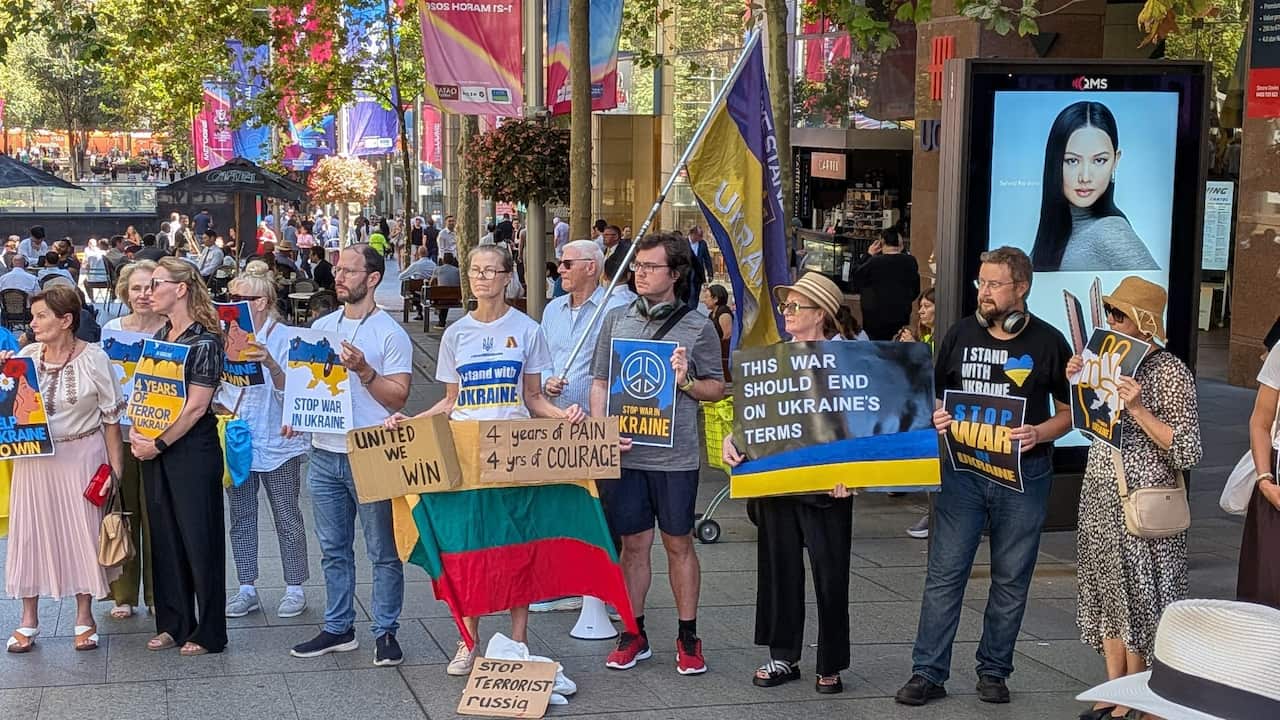
Argyrou described the ongoing war as an "extraordinarily painful" period.
"People are exhausted by the uncertainty and by the knowledge that the war continues to devastate civilian lives," she said.
"So emotionally, we live between hope and heartbreak — committed to Ukraine's survival, yet longing for peace and justice."
SBS News spoke with attendees like Alan Sasha at a rally in Sydney advocating for an end to the war, which included people from Russian and Ukrainian diasporas.
"My wife's sister is still in Odesa, in the centre of the city," Alan said.
"We're on the phone every night, and we know precisely what is happening and when, well ahead of the news. It's a tragedy, just a tragedy."
Sasha said people had gathered to mark the anniversary and acknowledge the loss of innocent civilian life in Ukraine.
"People are dying every night. The Russians are shelling and destroying civilian infrastructure," he told SBS News.
"Hundreds of thousands of Ukrainians are freezing without heat, without running water, without electricity in their homes."
Hopes to rebuild
Rebuilding Ukraine's economy will cost an estimated US$588 billion ($831 billion) over the next decade, the World Bank, UN, European Commission and the Ukrainian government said on Monday.
The latest assessment by the institutions, based on data from 24 February 2022 through to the end of 2025, showed a 12 per cent increase from last year's estimate, based in part on a 21 per cent jump in damaged or destroyed energy infrastructure from a year ago.
The study doesn't include data from Russia's intensified attacks on Ukrainian energy facilities in January and February, which left tens of thousands across Ukraine without heat, power and water during the coldest winter on record in decades.
The estimate — the fifth conducted since the start of the war — found direct damage in Ukraine had reached US$195 billion ($275 billion), up nearly 11 per cent from the previous assessment, with housing, transport and energy sectors most affected, the groups said. That is more than double the damage reported in the first report in 2022.
"The damage is immense and increasing continuously," the report said, noting that damages were concentrated in frontline areas and metropolitan areas, including Ukraine's capital, Kyiv.
What are the sticking points to peace
Another round of peace talks aimed at ending the war in Ukraine could be held at the end of this week, according to the Reuters News Agency.
Ukraine, Russia and the US have held several rounds of talks in Abu Dhabi and Geneva, as the US seeks an end to four years of war since Moscow's 2022 full-scale invasion.
The peace proposal under discussion includes 20 points.
These include the reaffirmation of Ukraine's sovereignty; a full and unquestionable non-aggression agreement between Russia and Ukraine; and the provision of security guarantees by the US, NATO, and European countries.
Russia currently controls large parts of four Ukrainian regions — or 'oblasts' as they are known in Russia — and some post-Soviet states.
These oblasts share their names with their respective administrative capitals — Kherson, Zaporizhzhia, Donetsk and Luhansk — which are along Ukraine's eastern border.
Russia annexed Crimea in 2014.
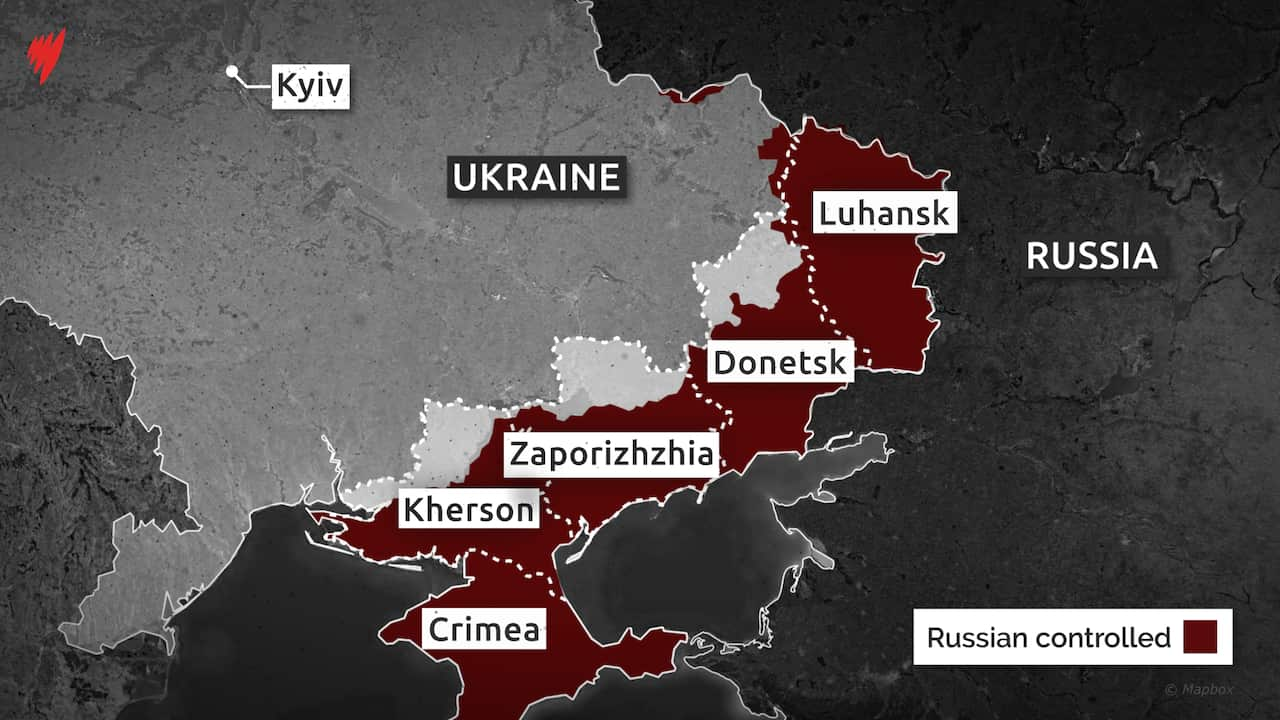
However, the two sides can't agree on the future of the Donetsk region — one of the two regions that comprise Donbas.
Russian forces already control nearly all of Luhansk, the other Donbas region.
Russian President Vladimir Putin wants Ukraine to withdraw from the roughly 5,000 square kilometres of Donetsk, which Russian forces have so far not managed to take on the battlefield in the face of fierce Ukrainian resistance.
Ukrainian President Volodymyr Zelenskyy has said he sees no reason to gift Putin the land.
Argyrou said Ukrainians in Australia follow these negotiations closely.
"Ukrainians have paid an immense price to defend their country and democratic future," she said.
Any negotiation must recognise that sacrifice and uphold international law.
Australia's support
Australia's "meaningful support" of Ukraine's defence gives people hope, according to Argyrou.
"Australia may be geographically distant, but morally it has stood close. That solidarity gives our community strength and hope," she said.
However, "continued" assistance for Ukraine's military and energy sector is vital.
Argyrou would also like to see Australia strengthen sanctions enforcement, "particularly by closing loopholes that allow blood oil of Russian origin to enter Australian markets indirectly".
Australia remains the single biggest buyer of oil products refined from Russian crude in third countries, according to several submissions to the inquiry and experts who appeared at the hearing.
SBS News first reported on this loophole in July 2024. The issue was also mentioned in two separate Senate inquiries.
In October 2025, SBS News also revealed that sanctioned shadow fleet tankers were still appearing in the supply chains of Australian companies.
Pressure from experts and community members on the government to close the so-called "blood oil" loophole grew significantly in 2025, with Foreign Minister Penny Wong saying the government expected the industry "to prevent their supply chains from inadvertently funding Russia's illegal and immoral invasion of Ukraine".
"Our greatest hope is for a just and lasting peace," Argyrou said.
"One that restores Ukraine's sovereignty and territorial integrity and guarantees real security for the people of Ukraine."
— With additional reporting from the Reuters News Agency.
For the latest from SBS News, download our app and subscribe to our newsletter.







