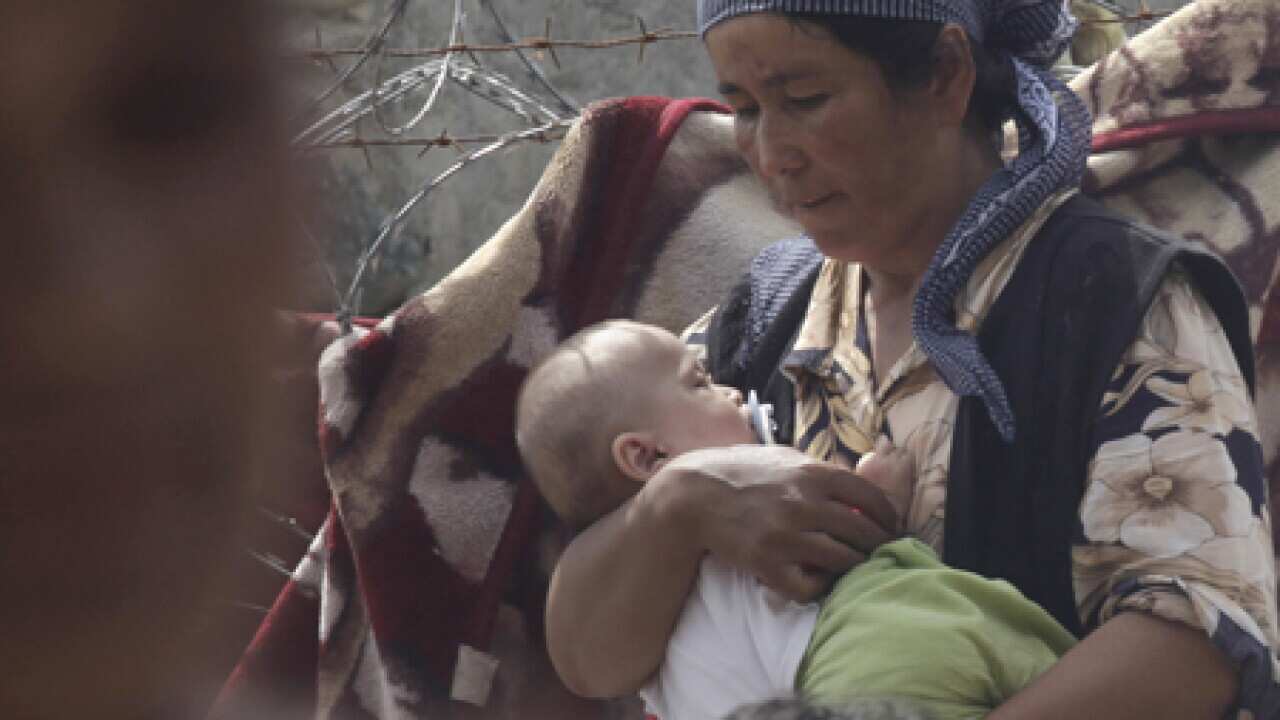
Foreign aid started Thursday reaching desperate refugees who fled a wave of ethnic bloodshed in Kyrgyzstan, as the UN revealed that 400,000 people had been uprooted by the clashes.
Amid estimates of several hundred dead from the unrest, victims told AFP the violence was a brutal and orchestrated campaign by armed militias of ethnic Kyrgyz targeting their Uzbek neighbours.
Up to 100,000 people had taken refuge in Uzbekistan, not counting children, while about 300,000 are thought to be internally displaced, UN Office for the Coordination of Humanitarian Affairs spokeswoman Elisabeth Byrs told AFP.
News that makes sense
Your trusted source for staying up-to-date with the world around you. Get free daily news updates and analysis, straight to your inbox.
'An immense crisis'
"It's an immense crisis," said Severine Chappaz, the International Committee of the Red Cross (ICRC) deputy head in Kyrgyzstan.
Just inside the Uzbekistan border, refugees trickled into a camp where the UNHCR refugee agency and UNICEF erected hundreds of white and green tents overnight, an AFP correspondent said.
Fewer than 1,000 refugees were at the camp, where aid workers were handing out clothing and blankets, but thousands more were expected to be brought from temporary centres for the displaced set up by the Uzbek government.
Refugees said they were in dire need of supplies after fleeing from the five days of clashes that killed at least 191 people and wounded 1,971 according to the latest Kyrgyz government toll, though witnesses said far more died.
"First of all we need clothes and medical supplies, especially for the children, because when we fled our homes we just ran away and couldn't take anything with us," Halima Otajonova, a 41-year-old mother of two, said at a refugee centre at a stadium in the Uzbekistan town of Khanabad.
"Some of us even ran away in bare feet, without shoes."
An ICRC cargo plane carrying relief supplies arrived in southern Kyrygzstan Thursday and another loaded with 40 tonnes of biscuits landed in Uzbekistan.
Two Russian cargo planes carrying humanitarian aid were due to land in Uzbekistan Friday and a third on Saturday, Russian authorities said.
Political and criminal agends blamed
Victims interviewed by AFP on both sides of the border gave harrowing testimony of militias ravaging Uzbek districts in southern Kyrgyzstan in coordinated pogroms.
"An armoured vehicle followed by regular cars with armed men arrived from the main road. They started shooting and screaming 'we will kill all the Uzbeks! Kyrgyzstan for the Kyrgyz!," said Davran Badalov, 35, who runs an Uzbek bakery in the village of Shark in the Osh region.
Political and even "criminal agendas" may have sparked the violence, added Rupert Colville, a spokesman for the office of the UN High Commissioner for Human Rights, without elaborating.
Attacks have died down in recent days in Osh and Jalalabad, the Kyrgyz cities at the centre of the fighting, with interim deputy prime minister Azimbek Beknazarov saying that "life is slowly returning to normal" in Osh.
But the mayor of Osh, Melisbek Myrzakmatov, told AFP the death toll "will be two or three times the official number. Time will tell if it is more on one side or the other. But it will not be in the thousands."
The ICRC said, citing its workers, "several hundred people" had been killed.
A Russian-led security group, the Collective Security Treaty Organisation, said there was "no question" of deploying peacekeepers to Kyrgyzstan, though it may send specialists in dealing with "mass disorders".
With the violence easing, focus was turning to the humanitarian catastrophe facing the region.
The insecurity and fear and shortages of basic necessities such as food, water, shelter and medicine were putting a "tremendous strain" on efforts to help the displaced in both Kyrgyzstan and Uzbekistan, the ICRC said.
Knut Vollebaek, high commissioner for minorities at the Organisation for Security and Cooperation in Europe, called on the group's members to help stabilise the situation in Kyrgyzstan and help refugees in Uzbekistan.
Kyrgyzstan's leaders have blamed the violence on ex-president Kurmanbek Bakiyev, who was ousted in protests in April. Bakiyev, who took refuge in Belarus, has denied the charges.
Officials have insisted the country will go ahead with plans to hold a June 27 referendum on a new constitution.
The riots were the worst inter-ethnic clashes to hit the impoverished Central Asian state since the collapse of the Soviet Union. Uzbeks make up 14 percent of Kyrgyzstan's population of 5.3 million.







