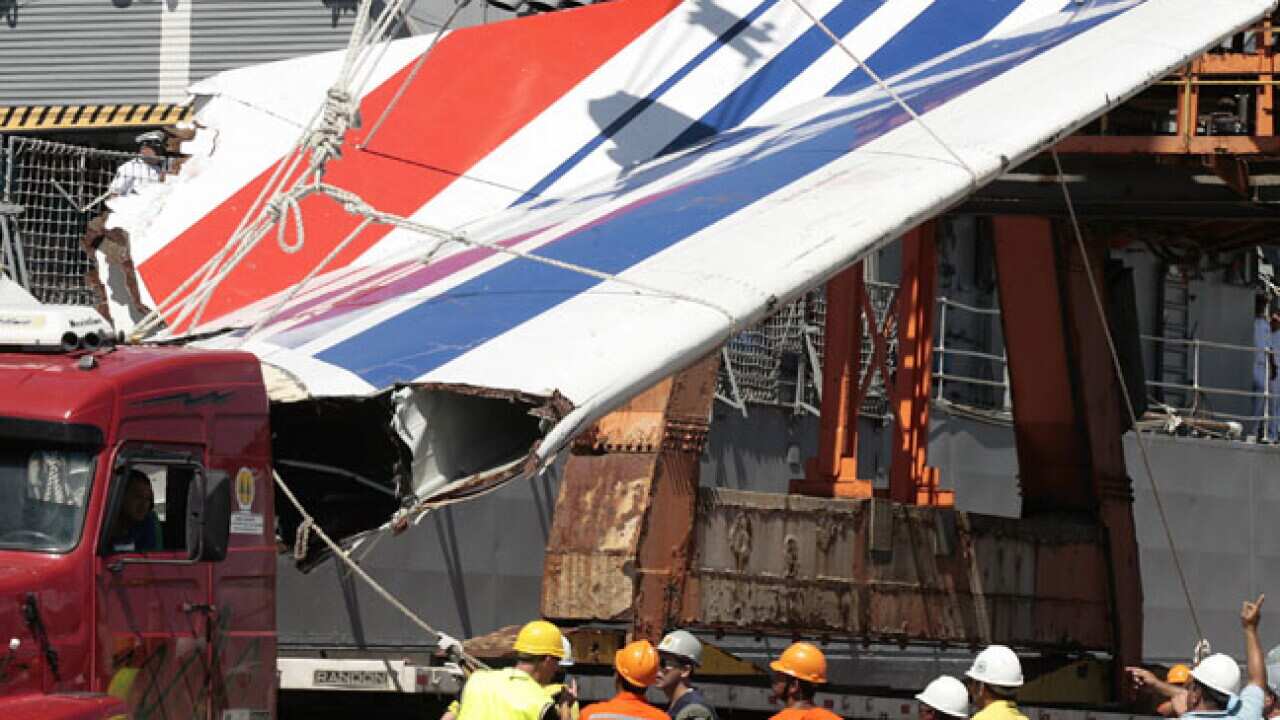
Air France pilots lost vital speed data and their Airbus A330 stalled, beginning a fatal three-minute plunge into the Atlantic in June 2009 with 228 people aboard, the BEA aviation safety agency says.
"We have no valid indications," one of the pilots of flight AF447 from Rio to Paris said, according to information from the flight data recorders released by the French Bureau of Inquiry and Analysis (BEA).
The aircraft had entered a zone of turbulence two hours into the flight when the autopilot suddenly disengaged.
News that makes sense
Your trusted source for staying up-to-date with the world around you. Get free daily news updates and analysis, straight to your inbox.
Shortly thereafter one instrument showed "a sharp fall" in airspeed and a stall warning sounded, indicating the plane was no longer being lifted by the air pushing under the wings.
As the two co-pilots struggled to understand what had happened the captain, who had left the cockpit to take a rest, returned but did not retake control of the plane.
The agency said the plane's engines were working normally and responded to commands.
An interim inquiry, conducted prior to the raising of the data recorders from the ocean floor earlier this month, had pointed to an icing problem with the probes measuring air speed but there was no definitive conclusion as to the cause of the crash.
According to several experts, the deactivation of the autopilot could have caused by the icing up of the air speed probes, known as pitots.
Low airspeed data can cause the aeroplane's computer system to reject as invalid other readings, according to the BEA.
Pilot's unions and some of the victims' families have accused the airline of reacting too slowly to safety warnings but both Airbus and Air France insist they reacted properly.
Since the accident, Air France has replaced the pitots on its Airbus fleet with a newer model.
Both companies are being probed for alleged manslaughter in connection with the crash.
Airbus said the information released on Friday was consistent with the BEA's preliminary and interim reports and "constitutes a significant step towards the identification of the complete chain of events" that led to the crash.
Air France called for the BEA's further analysis of the data to determine the precise cause of the crash, although it said it appears "that the initial problem was the failure of the speed probes".
It praised the "three skilled pilots" who "demonstrated a totally professional attitude and were committed to carrying out their task to the very end".
However a source familiar with the investigation was puzzled by the reaction of the pilots.
"Why, when getting the stall signal, did the pilots pull the (aircraft nose) up and not push it down?"
A retired pilot, Jack Krine, told AFP that in a stall the normal procedure would be to push the plane's nose down to regain speed and lift, adding that they may not have had enough time to analyse the situation properly.
According to the chronology provided by the BEA, the responses by the co-pilot flying the aircraft "were mainly nose-up" and the aircraft initially gained altitude.
"The trimmable horizontal stabiliser (THS) passed from 3 to 13 degrees nose-up in about 1 minute and remained in the latter position until the end of the flight," said the BEA report said.
The last data on the recorder showed the plane's nose was up at a sharp angle as it plunged into the sea at 3300 metres per minute.







