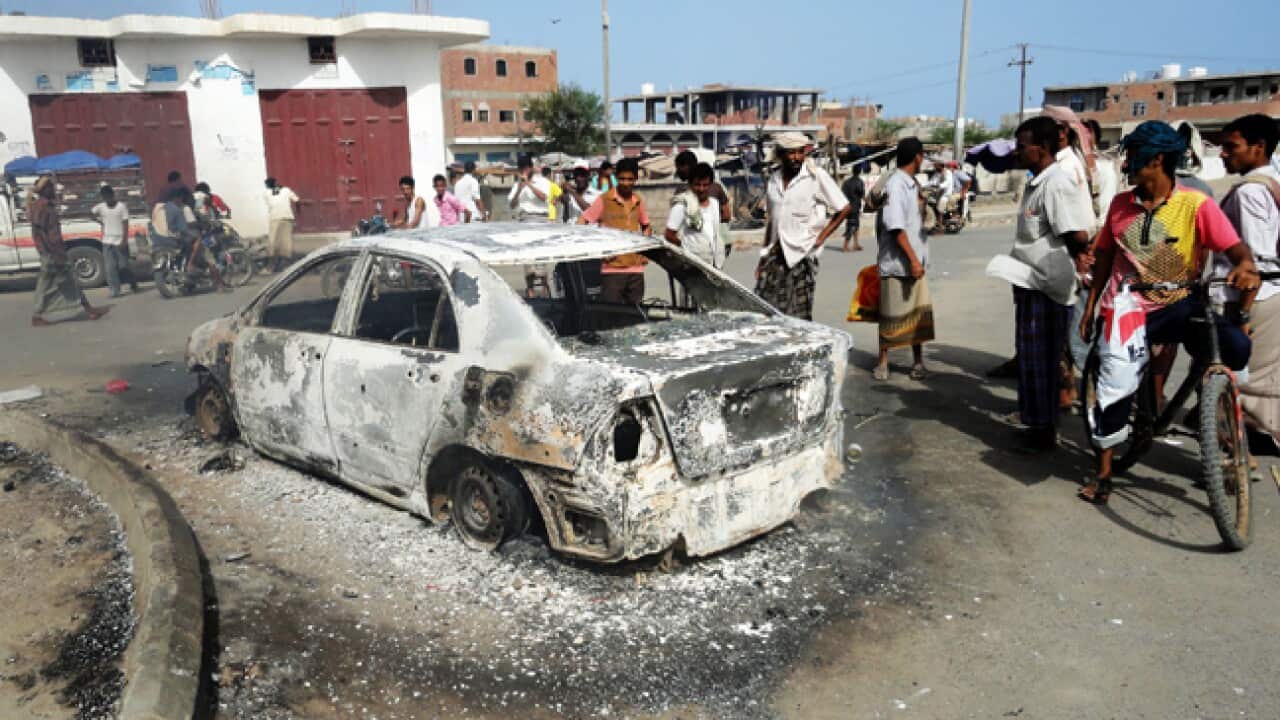
The news came as police shot dead four anti-government protesters and wounded dozens more on Sunday in Yemen's second largest city of Taez, south of Sanaa, hospital officials said.
A security official said that more than 200 suspected Al-Qaeda gunmen seized control of the southern city of Zinjibar, Abyan's capital, in fighting that has left 21 dead.
News that makes sense
Your trusted source for staying up-to-date with the world around you. Get free daily news updates and analysis, straight to your inbox.
In "Statement Number One," the generals led by General Ali Mohsen al-Ahmar accused President Ali Abdullah Saleh of "surrendering Abyan to an armed terrorist group" and urged army forces "to join the peaceful popular revolution."
They also called on the army to fight the "terrorists" in Abyan.
PRESIDENT HOLDS ON
Several generals, including Ahmar who commands troops that control part of Sanaa, have pledged support for protesters calling for Saleh to quit.
But the Republican Guards and other elite units commanded by Saleh family members have remained loyal.
Police on Sunday shot dead four anti-regime protesters and wounded dozens more in Yemen's second largest city of Taez, south of Sanaa, medics said.
The "Youth of the Revolution" group said about 3,000 people gathered outside a police station to demand the release of a detained protester and that police fired into the crowd when they refused to leave, killing three.
A fourth demonstrator was shot dead in the city's nearby Tahrir Square.
POSSIBLE 'AL QAEDA' CONNECTION
The security official and witnesses said Zinjibar had fallen to militants who may be Al-Qaeda fighters.
The fighters "were able to gain control of the city of Zinjibar... and took over all government facilities," except for the 25th mechanised brigade headquarters which is besieged by militants, the security official said.
Witnesses said gunmen were still battling members of the besieged brigade.
"We will fight until the last bullet, and we will not surrender to the gunmen who killed our colleagues," a brigade officer reached by telephone said.
A medic said five civilians were killed and 15 wounded in shelling between the brigade and suspected Al-Qaeda fighters on Sunday.
Residents reported heavy fighting in Zinjibar on Friday and Saturday, and said the attackers had freed dozens of prisoners from the main jail.
RESIDENTS FLEE
One witness said on condition of anonymity that the gunmen executed soldiers who surrendered, and that residents were not able to bury them.
"Most of the residents of Zinjibar have left," another said.
Nazir Ahmed Said, who fled to the south's main city Aden, told AFP he left because Zinjibar "is under the control of gunmen who say they are from Al-Qaeda."
The security official, who said he was among the last security officials to quit Zinjibar, estimated that more than 200 militants had attacked the city.
"The lack of concern from the authorities is unfortunate," he said, adding that "the leadership in Abyan province left the area before it exploded."
Five soldiers and a civilian were killed on Friday, two other security officials said, and Zinjibar residents said they found the bodies of 10 soldiers, bringing the toll from the fighting there to at least 21.
One official said that another two soldiers were killed on Friday in clashes with suspected Al-Qaeda militants in Loder, also in Abyan province.
In a statement, the Common Forum parliamentary opposition coalition blamed Saleh for the situation in Zinjibar, but said he had "delivered Zinjibar to groups that he has formed and armed, to continue to utilise the spectre of Al-Qaeda to frighten regional and international parties."
Since January, Saleh has faced protests calling for him to stand down after 33 years in office.
On May 22, he refused to sign a Gulf Cooperation Council-sponsored accord that would have seen him cede power within 30 days in exchange for immunity from prosecution.
The following day, fighting erupted in Sanaa between security forces and followers of opposition tribal chief Sheikh Sadiq al-Ahmar, who heads the powerful Hashid federation.
Ahmar's fighters seized various government buildings between May 23 and 26, but on Sunday began vacating them following tribal mediation mediator Sheikh Abdullah Badr al-Din told AFP.
Several buildings were heavily damaged in Al-Hasaba area where the fighting was centred, including Ahmar's residence, the interior ministry, the official news agency Saba and the offices of the Yemenia national airline, an AFP correspondent said.
In other areas of Sanaa, roadblocks were set up by forces loyal to the president and by dissident army units, with both deploying heavy armour and machine guns.







