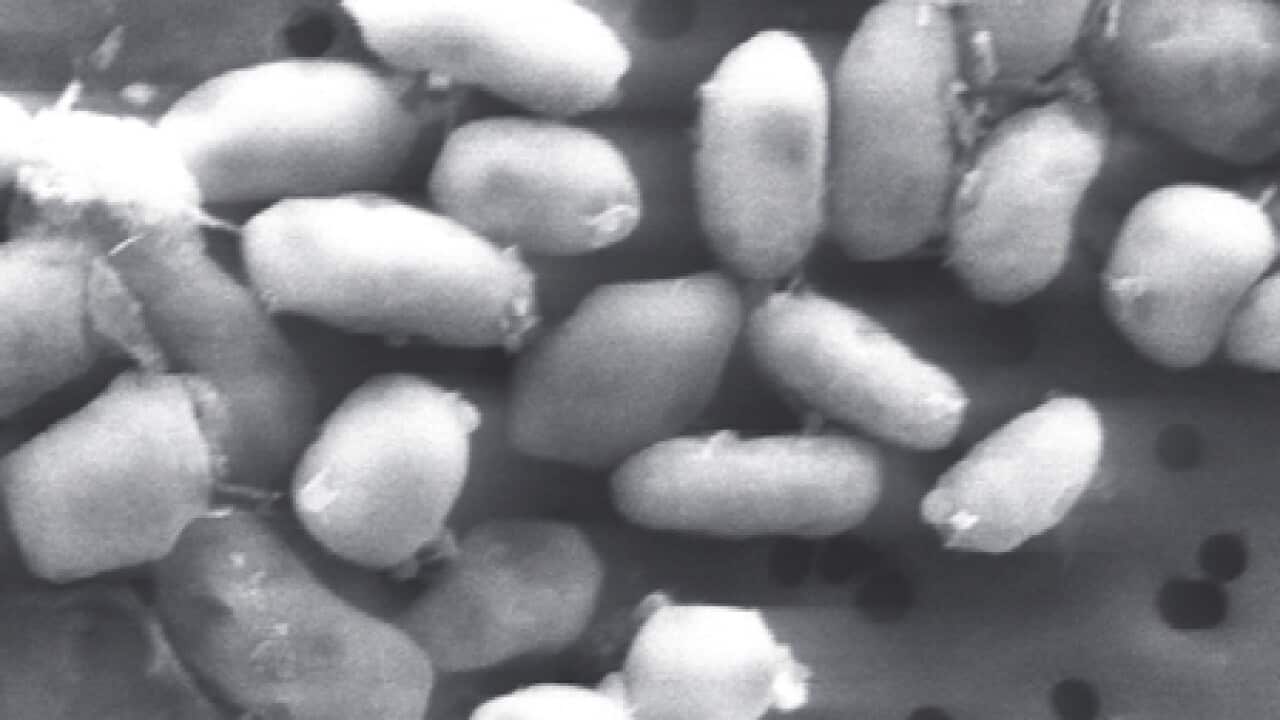
Lurking in the depths of a California lake is a bacteria that can thrive on arsenic, an explosive discovery that could expand the search for other life on earth and beyond, researchers have found.
The NASA-funded study released on Thursday and published in the journal, Science, redefines what biologists consider the necessary elements for life, currently viewed as carbon, hydrogen, nitrogen, oxygen, phosphorus and sulfur.
Not only does the bacteria survive on arsenic, it also grows by incorporating the element into its DNA and cell membranes.
News that makes sense
Your trusted source for staying up-to-date with the world around you. Get free daily news updates and analysis, straight to your inbox.
"What is new here is arsenic is being used as a building block for the organism," Ariel Anbar, co-author of the study, said.
"We have had this idea that life requires these six elements with no exceptions and here it turns out, well maybe there is an exception," he said.
The discovery was made by Felisa Wolfe-Simon, a former postdoctoral scientist in Anbar's research group at Arizona State University's School of Earth and Space Exploration.
NASA's vague announcement earlier this week of a press conference on "an astrobiology finding that will impact the search for evidence of extraterrestrial life" set the internet abuzz with speculation.
Astrobiology relates to the study of life in the universe, including its origin and evolution, where it is located and how it might survive in the future.
But Anbar acknowledged it would be quite a leap to presume the next step is discovering alien life.
"It is more the principle of the thing," he said. "We are very influenced by life as we know it and it gets very difficult to know, how far can we push that? How different can life be and still work?"
'Weird life'
A few years ago, Wolfe-Simon, Anbar and colleague Paul Davies began discussing the idea that different life forms could exist on Earth but by biological rules unlike ours, a notion known
informally by scientists as "weird life".
The trio published their 2009 hypothesis that arsenic, which is directly below phosphorus on the periodic table, could substitute for phosphorus in earth life forms.
"We not only hypothesised that biochemical systems analogous to those known today could utilise arsenate in the equivalent biological role as phosphate," said Wolfe-Simon.
"But also that such organisms could have evolved on the ancient earth and might persist in unusual environments today."
Wolfe-Simon then went out into the field to test the theory, collaborating with Ronald Oremland, known as a world expert in arsenic microbiology, of the US Geological Survey.
She scooped sediment from Mono Lake, known for its high levels of salt and arsenic, in eastern California and brought the material back to the lab.
"She takes this sediment, puts it in a bottle essentially where there is lots of arsenic and very little phosphorus, and she does it over and over so only organisms that are going to be happy in that environment survive," said Anbar.
Wolfe-Simon was able to get a bacteria known as strain GFAJ-1 of the Halomonadaceae family of Gamoproteobacteria to grow in the lab.
"The organism came from nature," said Anbar.
"It is a known bacteria. It is not a brand new bug but nobody realised it could do this."
The discovery could open new avenues in disease research, and possibly new chapters in biology books, researchers said. For more on this discovery, click here.







