IN BRIEF
- Gonorrhoea and syphilis notifications have surged by more than half in the past decade.
- Indigenous health experts have warned of a serious need for investment in community-led health projects.
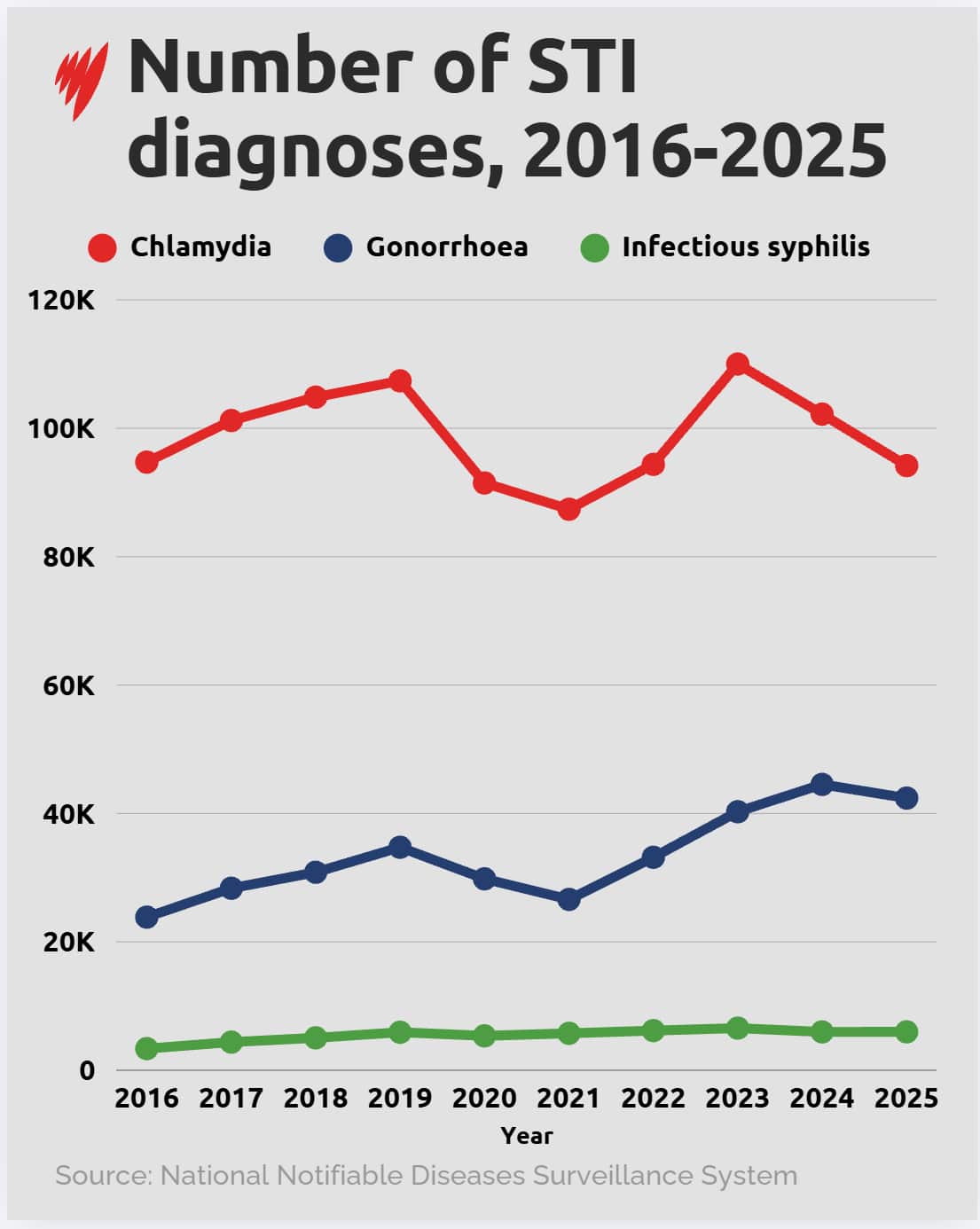
Reported cases of infectious syphilis and gonorrhoea have surged by more than half over the past decade in Australia, as experts warn education and testing urgently needs to improve.
In 2025, there were 42,393 gonorrhoea notifications and 5,986 infectious syphilis notifications — a 10-year increase of 57 per cent for gonorrhoea and 56 per cent for syphilis, analysis from the University of New South Wales' Kirby Institute has shown.
Syphilis was declared a communicable disease of national significance in late 2025, in response to "ongoing and concerning" rises in Australian case numbers.
Chief medical officer Professor Michael Kidd declared that awareness was necessary among all Australians, including healthcare professionals, and urged everyone to get tested.
News that makes sense
Your trusted source for staying up-to-date with the world around you. Get free daily news updates and analysis, straight to your inbox.
Syphilis and gonorrhoea are common bacterial infections with ancient origins, now easily treated with antibiotics.
But both infections can present with either mild or non-existent symptoms.
If left untreated, syphilis progresses through stages and can spread to the brain, heart, eyes, and other organs. It can cause neurological problems including paralysis, and dementia, and cause soft, tumour-like growths to appear on the skin, bones or internal organs. Tertiary syphilis can eventually lead to death.
Notification rates for infectious syphilis among women increased 170 per cent in the past decade from 2016 to 2025. In contrast, rates increased just 39 per cent among males.
Syphilis during pregnancy can lead to congenital syphilis, which can result in miscarriage or stillbirth, or severe lifelong health impacts in babies that are born, including prematurity, low birthweight and other physical developmental abnormalities.
Kirby Institute epidemiologist Dr Skye McGregor said congenital syphilis is a persistent issue in Australia, with more than half of deaths in the last decade among First Nations infants. There were 14 cases of congenital syphilis in 2025, and 113 from 2016 to 2025, with 40 resulting in the death of an infant.
"This is an entirely preventable outcome with early diagnosis, testing and treatment of pregnant people," McGregor said.
Better approaches for at-risk populations
First Nations peoples were disproportionately affected by STIs, diagnosed with gonorrhoea at more than four times the rate of non-Indigenous people and syphilis at more than six times.
Kim Gates, community relations lead in the Kirby Institute's First Nations Point-Of-Care Program, said the disparities in diagnoses between First Nations and non-Indigenous Australians were an indication of broader inequities in healthcare.
Australian services needed to be designed better to reflect the experiences of First Nations communities, Gates told SBS News, adding that many First Nations peoples have a complex relationship with the Australian health system and "have good reasons to be sceptical of top-down services and approaches".
"This is why Aboriginal-led services are so important," she said.
Gates said that while the 149 Aboriginal Controlled Community Health Services in Australia provide comprehensive and culturally safe healthcare, "there are areas these don't reach".
For Gates, sustained investment in community-led initiatives, like the First Nations Molecular Point-of-Care Testing Program, was the solution to bringing down STI rates among Indigenous populations.
Improving community awareness is key
Dr Arthur Wong, sexual health physician and conjoint lecturer at the Kirby Institute, said that timely testing, treatment and retesting were "crucial", and that post-diagnosis care was also "essential" to avoid repeat infections.
Wong told SBS News that awareness was already affecting syphilis rates, where evidence shows a decline in incidence among gay and bisexual men.
"We do know that testing has increased in certain populations," Wong said. "Gay and bisexual men who are taking HIV pre-exposure prophylaxis (PReP) are tested more frequently for STIs."
But the data leaves out an often-overlooked section of the population — for homosexual, bisexual and transgender women, rates of syphilis and gonorrhoea remain largely unknown.
LGBTIQ+ Women's Project Lead at ACON (formerly AIDS Council of NSW), Lee Wang, says queer and trans women aren't routinely reported in surveillance data, which has adverse health outcomes.
"When queer and trans women are overlooked, it can create the false impression that STI prevention and testing are not relevant to them," Wang told SBS News.
"This can contribute to lower testing and missed opportunities for prevention and early diagnosis, with recent surveys highlighting substantial gaps in STI testing when compared with gay and bisexual men."
There was a need for targeted sexual health education resources, Wang said, like ACON's Word on the Sheets, a digital sexual and reproductive health resource for LGBTQ+ women, trans and gender diverse people.
"We shouldn't confuse a lack of data with a lack of priority," Wang said. "We need healthcare providers who are equipped to discuss sexual practices without making assumptions about sexuality or gender identity."
Wong said preliminary data from the most recent Australian Study of Health and Relationships show that just 17 per cent of people aged 16 to 49 reported having an STI test in the last 12 months.
Rates of chlamydia and gonorrhoea were highest among young people aged 15 to 29 years.
Studies in recent years have pointed to a waning use of condoms among school-aged people in Australia, with findings from a Secondary Students and Sexual Health (SSASH) survey analysis by Victoria University in 2024 stating that condom use in Australia was low and has declined over a decade.
Overall, Wong said, Australia needed a "sustained and enhanced" response to sexual health, "to ensure any gains are experienced equally across all populations."
For the latest from SBS News, download our app and subscribe to our newsletter.







