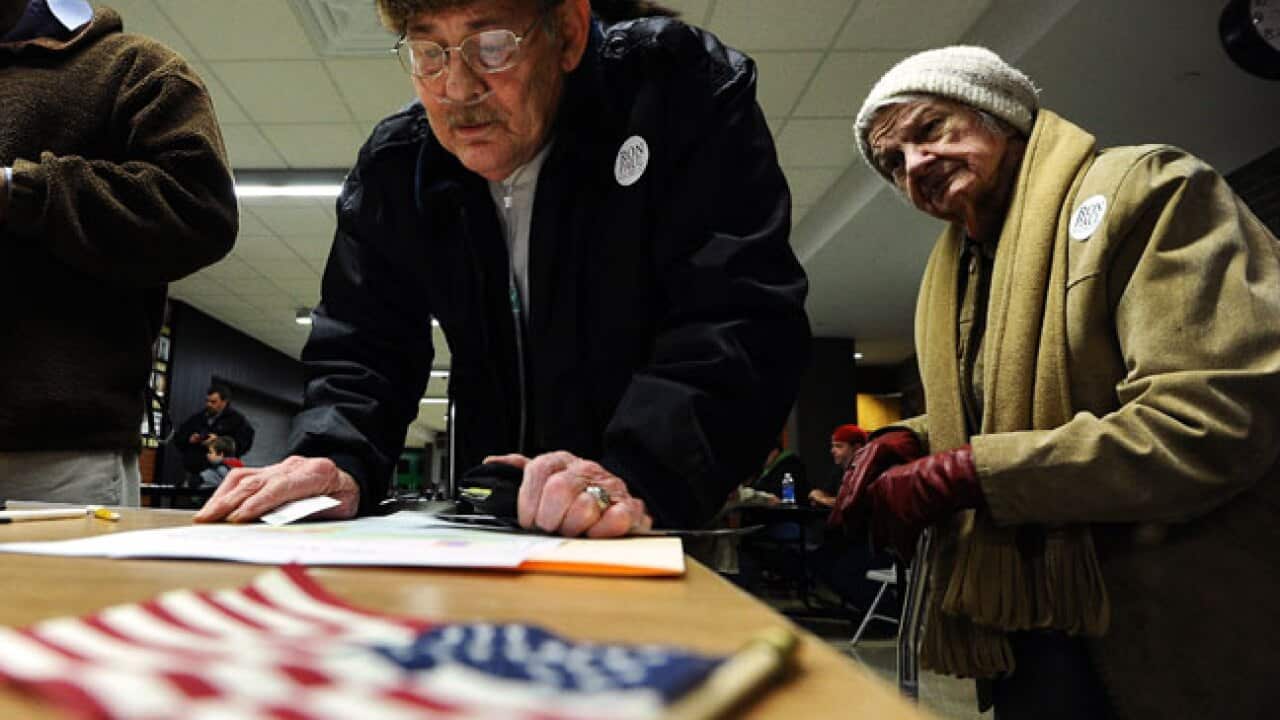
In US politics there is nothing quite like the caucus meeting -- especially the famous Iowa caucuses, the contest held every four years that kicks off voting in the US presidential campaign.
With the exception of the general election in November, the Iowa vote may be one of the most important dates on the US election calendar.
A win in Iowa doesn't yield much in the way of delegates to the party's nominating convention when its candidate will be crowned, and the winner here is far from being assured of capturing the Republican nomination.
News that makes sense
Your trusted source for staying up-to-date with the world around you. Get free daily news updates and analysis, straight to your inbox.
But victory could lift a flagging campaign or help solidify a frontrunner's air of invincibility on the way to locking up the nomination.
Iowa Republicans gathered at neighborhood schools, firehouses, and recreation centers to vote for their choice for their party's nomination to oppose Democratic President Barack Obama this fall.
There are 1,774 precincts in this year's caucuses. Many are rural outposts that will draw just a handful of participants, while more heavily populated counties may see thousands of caucus-goers converge at a single location.
While only registered Republicans can vote, non-Republicans are permitted to take part if they register onsite -- provided they change their party affiliation to the GOP.
Participants must be at least 18 years old by the November 6 general election.
Refreshments are typically provided, as friends and neighbors mingle and chat before a volunteer precinct captain calls the session to order.
After a few minutes of procedural business, precinct captains quickly get to the "presidential preference poll."
At that point, each campaign can have one surrogate deliver a speech on its behalf.
The short speeches afford a campaign one final chance to sway undecided voters -- who this year, according to polls, comprise about half of Iowa's Republican electorate.
After the speeches, voting promptly begins. Methods may vary from precinct to precinct, but often each caucus-goer is handed a blank piece of paper to write down the name of their choice and post in a box.
Votes are then tallied, monitored by an observer from each campaign, and the results announced to the entire gathering. The count is then relayed to the Iowa Republican Party.
Pundits say the main value of Iowa is that it helps to shape the unwieldy field of candidates, pruning away those unlikely to have a real shot.
But the entire process -- while long on political theater -- has very little predictive power.
Since the modern Iowa GOP caucus began in 1976 only three Republican caucus winners have actually gone on to win the nomination: Gerald Ford in 1976, Bob Dole in 1996 and George W. Bush in 2000.







