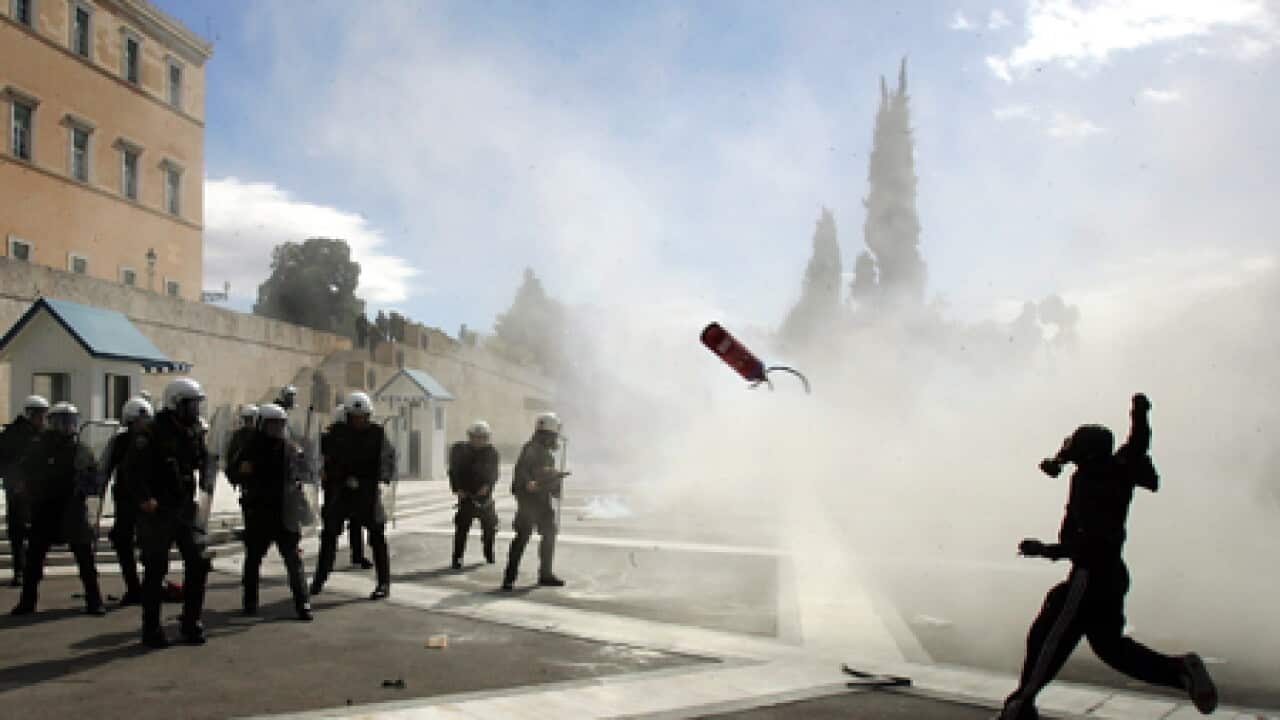
Greek police on Friday fought protesters angered by tough new financial measures, as European heavyweight Germany rebuffed suggestions cash-strapped Athens needed a financial bailout.
Strikes disrupted air and ground transport, as well as schools and hospitals, hitting economic activity hard two days after the government unveiled sweeping tax hikes and spending cuts that parliament approved Friday.
A demonstration by several thousand protesters was marred by clashes after the head of Greece's main union, Yiannis Panagopoulos, was beaten by unknown assailants as he delivered a speech.
News that makes sense
Your trusted source for staying up-to-date with the world around you. Get free daily news updates and analysis, straight to your inbox.
Panagopoulos' union, the General Confederation of Greek Workers (GSEE), later said it was an "organised" attack and that some of the assailants carried the flags of a small leftist group.
Another prominent protester, 87-year-old war resistance hero and former deputy Manolis Glezos, was hospitalised with breathing problems after a riot policeman sprayed tear gas in his face.
Five people were arrested in Athens and a handful of shops and banks along with a ministry building had their front windows smashed, police said. Around a dozen protesters and police were injured, according to reports.
Several dozen interior ministry staff occupied the Greek National Printing House to prevent the latest austerity measures from being published in the government gazette, police said.
Parliament meanwhile approved a third round of austerity measures aimed at reining in the country's gaping budget deficit and restoring trust in its solvency on financial markets.
But government hopes to secure more tangible European backing for its 4.8-billion-euro (AU$7.2bn) belt-tightening package were dashed by German Chancellor Angela Merkel.
"Greece has not asked for financial assistance," she said after talks in Berlin with Greek Prime Minister George Papandreou.
Tension with Germany increases
"The stability of the eurozone is assured today. As a result, the question (of aid to Greece) is not being asked ... I am even optimistic that it will not be asked," Merkel added.
While praising the latest austerity measures, she said Greece "must do more than rein in its budget deficit," such as modernising its economy.
Europe's biggest economy, Germany is widely seen as the most likely candidate to help prevent a Greek default, which would be disastrous for the eurozone.
But there is huge opposition in Germany against such a move, with angry editorials slamming alleged Greek corruption and wasteful spending.
Papandreou earlier told Germany's Frankfurter Allgemeine newspaper he was "not asking for money" but other forms of solidarity, warning he might otherwise go to the International Monetary Fund.
"We need support from the European Union and our partners to obtain credit on the markets at better conditions. If we do not receive this aid, we will not be able to enact the changes we
foresee," he said.
Credit ratings lowered
Greece's credit ratings have been lowered and it must now borrow money at rates far above those of other eurozone members.
Luxembourg's Jean-Claude Juncker, the formal head in finance matters for the 16 nations that share the euro, said Greek measures taken so far meant that Athens would not need EU aid.
"The commitments taken by the Greek government are clearly paving the way towards an exit" from its debt and deficit crisis, Juncker said.
There is however consternation in European Union circles that Greece managed to amass a debt of nearly 300 billion euros despite having received major funding from Brussels for decades.
Papandreou was to travel to Paris to meet French President Nicolas Sarkozy on Sunday. He will then fly to Washington next week to meet US President Barack Obama.







