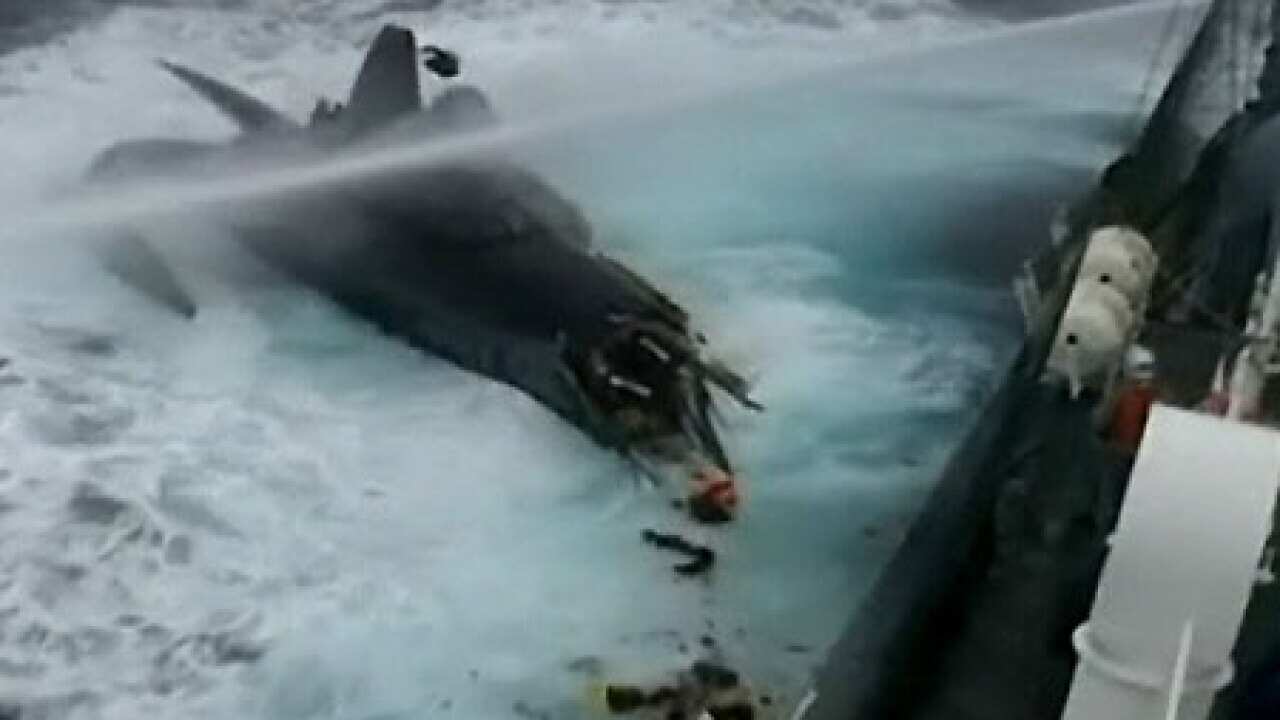
Defiant anti-whaling activists have vowed to fight on after their high-tech superboat sank in Antarctic seas following a collision with a Japanese ship.
Peter Hammarstedt, first officer of the Sea Shepherd group's "Bob Barker" ship, said the celebrated "Ady Gil" was abandoned in the Southern Ocean after a tow line snapped.
"At this point unfortunately the Ady Gil is on the bottom of the Southern Ocean," he said.
News that makes sense
Your trusted source for staying up-to-date with the world around you. Get free daily news updates and analysis, straight to your inbox.
"It leaves us with no other option but to re-take up the pursuit of the whaling fleet," Hammarstedt said. "We have no intention of backing down. We will never surrender."
The futuristic trimaran, which held the round-the-world record, had several metres of its front end sheared off in the collision with a Japanese security vessel on Wednesday.
Footage of the incident showed the "Shonan Maru 2" ploughing across the New Zealand-registered Ady Gil's bow and firing water cannons while its crew dived for safety.
Hammarstedt said the powerboat, bankrolled by Hollywood businessman Ady Gil, was being towed to an Antarctic port when the line broke overnight.
"Last time we saw the Ady Gil, the entire engine room was fully submerged in water as well as the fuel tanks," he said.
"It was going down pretty quickly. Captain Pete Bethune estimated two to three hours before being fully submerged. At that point we decided to take up the hunt for the whaling fleet again."
Distress signals 'ignored'
Captain Paul Watson, of the Sea Shepherd Conservation Society, said Japanese whalers remained close by as the crew of the Bob Barker anti-whaling ship worked to remove all oil and fuel from the boat to avoid pollution.
But he said they ignored all of the activists' calls for help.
"The Japanese harpoon vessels stayed close by but offered no assistance at any time," he said.
"They were responsible, they destroyed the vessel and the effort to try and keep it from polluting the ocean, I think, they should have offered some sort of assistance but they didn't.
Political reaction
New Zealand and Australian authorities are investigating the incident, while Japan lodged a strong protest with the Wellington government. Both the whalers and the protesters blame each other for the crash.
Australia is also investigating claims that the whalers chartered flights to spy on the Sea Shepherd ships and harass them using the Shonan Maru 2 security vessel.
Acting Prime Minister Julia Gillard told reporters in Brisbane the Australian Embassy in
Japan had told the Japanese government its "very strong concerns", including those about sending chartered flights to monitor anti-whaling activists.
"Our embassy in Tokyo is making high-level representations to the Japanese government," she said.
"They have passed to the Japanese government our very strong concerns about the question of flights being chartered, potentially in Australia, to monitor the activity of protest vessels.
"They have passed on our very strong concerns about conduct on the high seas and of course we continue to make it very clear, our view about whaling."
Legal action
Meanwhile, the Australian Greens have backed international law experts who argue the Rudd government could stop whaling in the Southern Ocean "within weeks" by launching international legal action.
Greens leader Bob Brown says federal Labor "should get off its backside and take action.”
"The government should be seeking such an injunction in the court," Senator Brown told reporters in Hobart.
"Canberra's handed control of Antarctic waters to Tokyo - it needs to take it back."
Australian National University law expert Don Rothwell believes Australia could successfully win an injunction in the International Tribunal for the Law of the Sea "within three to four weeks".
Canberra could argue Japan's so-called scientific whaling program was actually commercial whaling in disguise, Prof Rothwell told ABC TV.
"All commercial whaling is currently prohibited under the whaling convention.
"(And) the number of whales that it (Japan) takes is far in excess of what in any way could be legitimate scientific whaling."







