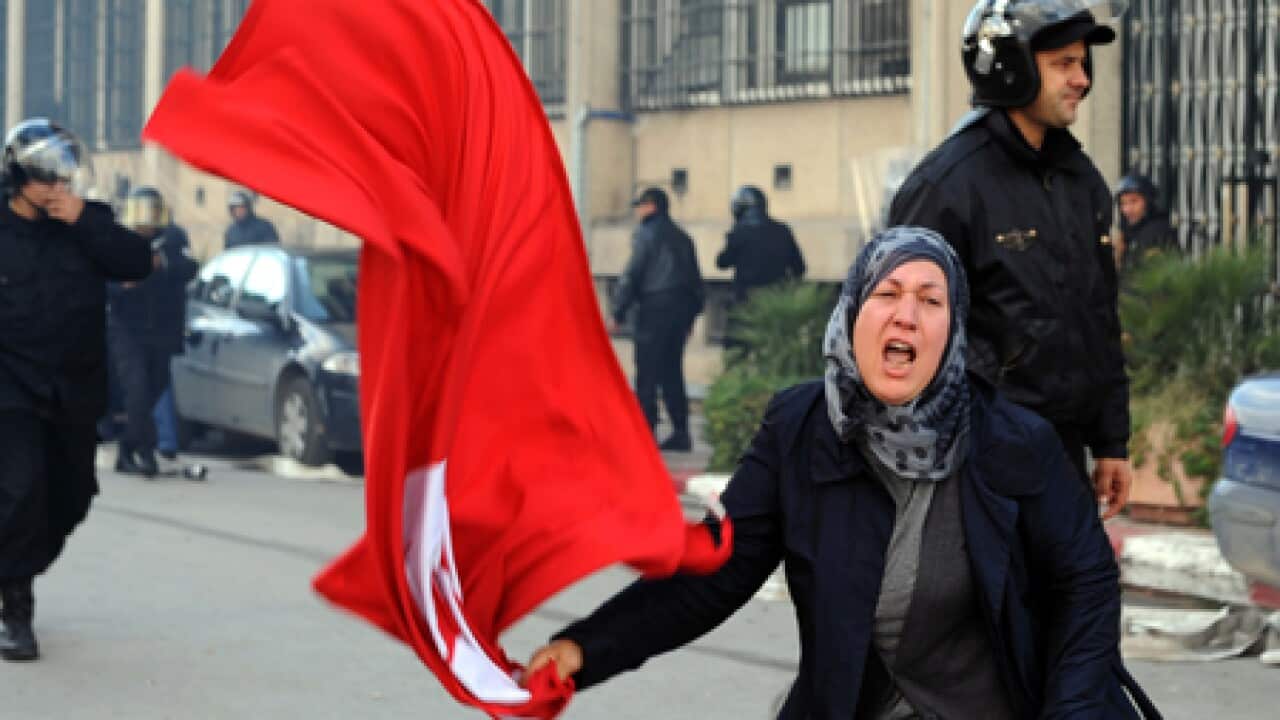
Arab League chief Amr Mussa has warned Arab leaders that the hardships of ordinary Tunisians that sparked a popular uprising were linked to "unprecedented anger" in the region.
Mussa was addressing an economic summit of Arab leaders in Egypt's resort of Sharm el-Sheikh that closed with a vow to "move forward in the development of our societies in terms of human development, technology, economy and society."
"The developmental challenges are no less important than the political challenges facing the region," the leaders said in a final statement after their one-day summit on Wednesday.
News that makes sense
Your trusted source for staying up-to-date with the world around you. Get free daily news updates and analysis, straight to your inbox.
It was the first gathering of Arab leaders since Tunisian president Zine El Abidine Ben Ali was forced to step down and fled his country on Friday after 23 years in power.
"The revolution that happened in Tunisia is not far from the subject of this summit," Mussa said, amid fears of a spillover.
"The Arab soul is broken by poverty, unemployment and general recession ... The political problems, the majority of which have not been fixed ... have driven the Arab citizen to a state of unprecedented anger and frustration."
The self-immolation of 26-year-old Mohammed Bouazizi that unleashed a wave of deadly street riots across Tunisia has set off a rash of copycat attempts in Algeria, Egypt and Mauritania.
Arab leaders, many of whom rule over populations with similar economic and political grievances as those of protesters in Tunisia, have denied any similarity with the North African country.
Leaders shy away from comparisons
At a post-summit press conference, Egyptian Foreign Minister Ahmed Abul Gheit criticised drawing comparisons between Tunisia and other countries, saying there was progress in the Arab world.
"We always criticise ourselves and say there is failure but there is also success and progress. For example, in Egypt there are 60 million cell phone users. We can't say a society is failed and incapable and there are 60 million cell phone users," he said.
President Hosni Mubarak, who has ruled Egypt for three decades, made no reference to the Tunisian revolt in his Sharm el-Sheikh speech but acknowledged economic development and cooperation had become a national security priority.
"We have realised that the priority of economic cooperation and development is no longer just about progress for our people ... but a basic demand of Arab national security," he said.
At the last summit, held in Kuwait in 2009, the leaders agreed to set up a $2 billion fund to finance small- and medium-sized businesses.
Mussa told reporters after the summit that there were roughly $1.4 billion "in committed funds" for that project.
Sudan on the table
Wednesday's summit also came as partial preliminary results collated by AFP showed that south Sudan has achieved the simple majority needed to secede in its independence referendum, splitting Africa's largest nation.
Sudanese President Omar al-Bashir, who faces strident criticism from the opposition at home, saluted the Tunisians in his own address and urged them "and the government to work together to restore stability."
In a region where rulers often assume power through coups or inheritance, the Tunisian uprising was unprecedented in that a highly autocratic ruler was forced out by popular protests.
Tunisian Foreign Minister Kamel Morjane, who briefed his counterparts in Sharm el-Sheikh on developments in his country, told reporters on Tuesday that the protests were fuelled by political and economic grievances.
Morjane left the country on Wednesday without attending the summit, leaving Tunisia to be represented by its ambassador to Egypt.
One summit delegate, on condition of anonymity, said it was expected to produce empty pledges like previous gatherings of heads of state of the 22-member Arab League.
But the economic roots of the Tunisian uprising have added urgency to the adoption of measures to alleviate poverty in the Arab world, he said.







