
Key Points
- New national data shows Australia is close to eliminating cervical cancer, with rates among young women dropping drastically.
- But the same figures show cancer arriving earlier in life for some Australians, and falling far more slowly for First Nations people.
Cervical cancer is vanishing from a generation of Australian women, with a new national data report revealing it's happening one age bracket at a time.
Among women aged 25 to 29, cervical cancer has almost disappeared. Incidence in that group has fallen from 9.3 cases per 100,000 in 2013 to a projected 0.5 in 2025 — a decline of roughly 95 per cent. The figures were released by the Australian Institute of Health and Welfare (AIHW), the federal government's health statistics agency, on Tuesday.
The same generation, though, is on the wrong side of a second finding.
Bowel cancer, a disease in retreat across every older age group in the country, has roughly tripled among Australians in their 30s over the past twenty-five years, the report shows — and alone among cancers in that age group, extra diagnoses are showing up as extra deaths.
What has not changed significantly, however, is that nearly 9 in 10 cancers diagnosed in 2025 are estimated to occur in people aged 50 or older.
News that makes sense
Your trusted source for staying up-to-date with the world around you. Get free daily news updates and analysis, straight to your inbox.
The vaccine generation
Australia started vaccinating girls aged 12 to 13 against human papillomavirus, the main risk factor for cervical cancer, in 2007, and ran a catch-up program for those aged 14 to 26 until 2009.
The school-based initiative made Australia the first in the world to add HPV vaccination to a national immunisation schedule. It was extended to boys aged 12 to 13 in 2013.
Cervical cancer typically takes 15 to 20 years to develop after HPV infection, so a lag between vaccination and falling incidence was expected — and data shows it has arrived precisely where the arithmetic predicted. Incidence among 25-to-29-year-olds began falling in 2014; among 30-to-34-year-olds, around 2020.
Once the second most commonly diagnosed cancer among Australian women aged 15 to 29, cervical cancer had fallen to ninth by 2021, and on current trends will drop out of the leading 20 cancers for that age group entirely by 2025.
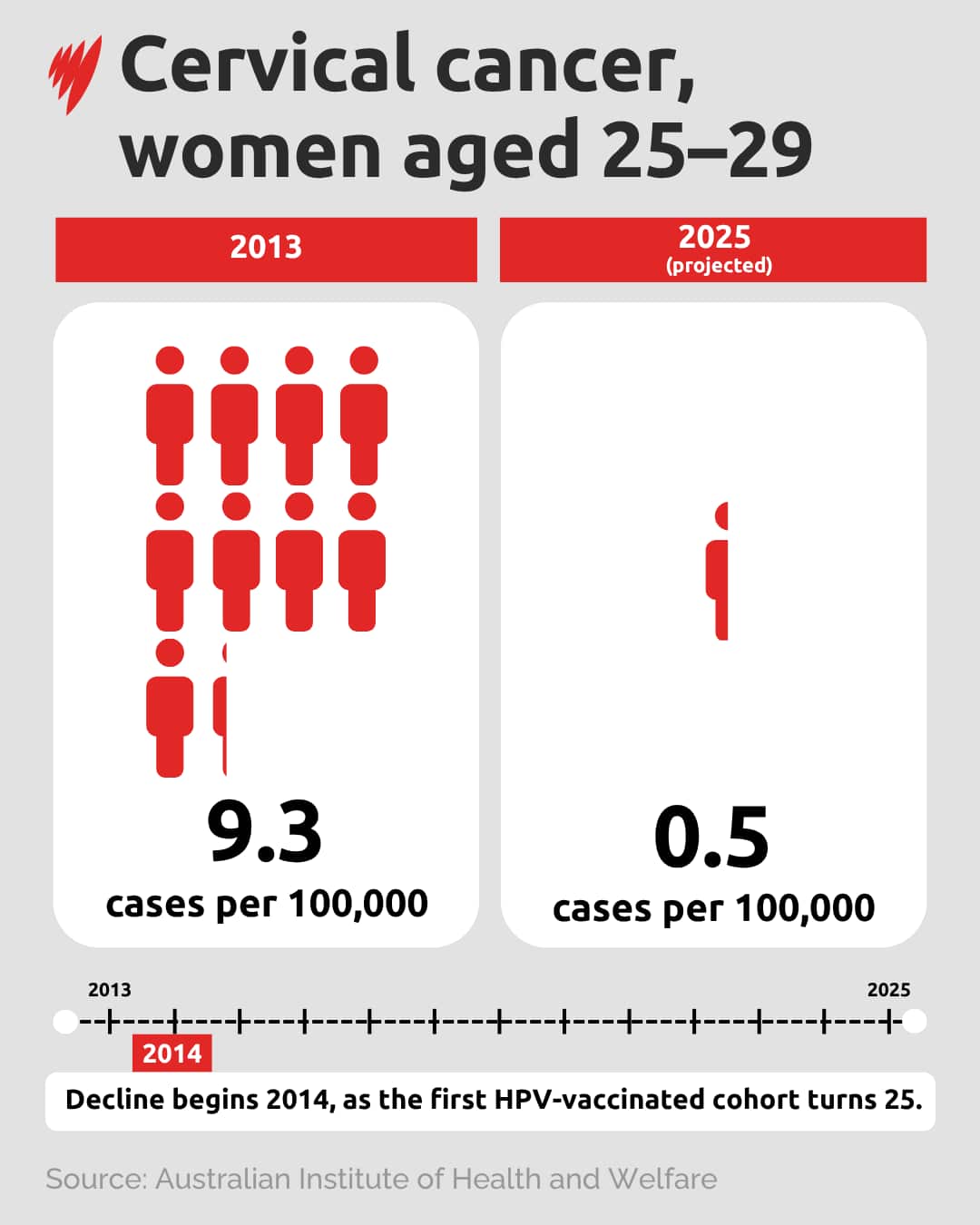
Complete national incidence data currently runs only to 2021, so the AIHW projects the remaining years forward from the previous decade's trends — a method that applies to almost every 2025 figure in the report.
Vaccination arrived on top of a screening program that had already been driving the disease down for a generation. Incidence halved between 1994 and 2003, falling from 14 to 7.7 cases per 100,000 women after the National Cervical Cancer Screening Program was introduced in 1991 and began detecting pre-cancerous abnormalities before they progressed.
Mortality has dropped from 3.2 deaths per 100,000 women in 2000 to a projected 1.8 in 2025.
Elimination is a statistical threshold rather than the disappearance of the disease. The World Health Organization defines it as fewer than four new cases per 100,000 women a year.
A 2019 modelling study in The Lancet Public Health projected Australia would clear that threshold by around 2028, with a sensitivity range spanning 2021 to 2035; Australia's national strategy, published in 2023, targets elimination by 2035. On that timeline, Australia would be the first country in the world to get there.
Bowel cancer being diagnosed in more young people
Colorectal cancer, which starts in the colon or rectum, has fallen further than any other cancer in Australia this century.
Age-standardised incidence peaked at 86 cases per 100,000 in 2001 and is projected to reach 53 by 2025. Among Australians aged 50 and over, where the disease remains overwhelmingly concentrated, rates fell from 201 per 100,000 in 2005 to a projected 131 in 2025.
Five-year survival has climbed from 56 per cent in 1992–96 to 72 per cent in 2017–21, and mortality has almost halved, from 35 deaths per 100,000 in 2000 to a projected 19.
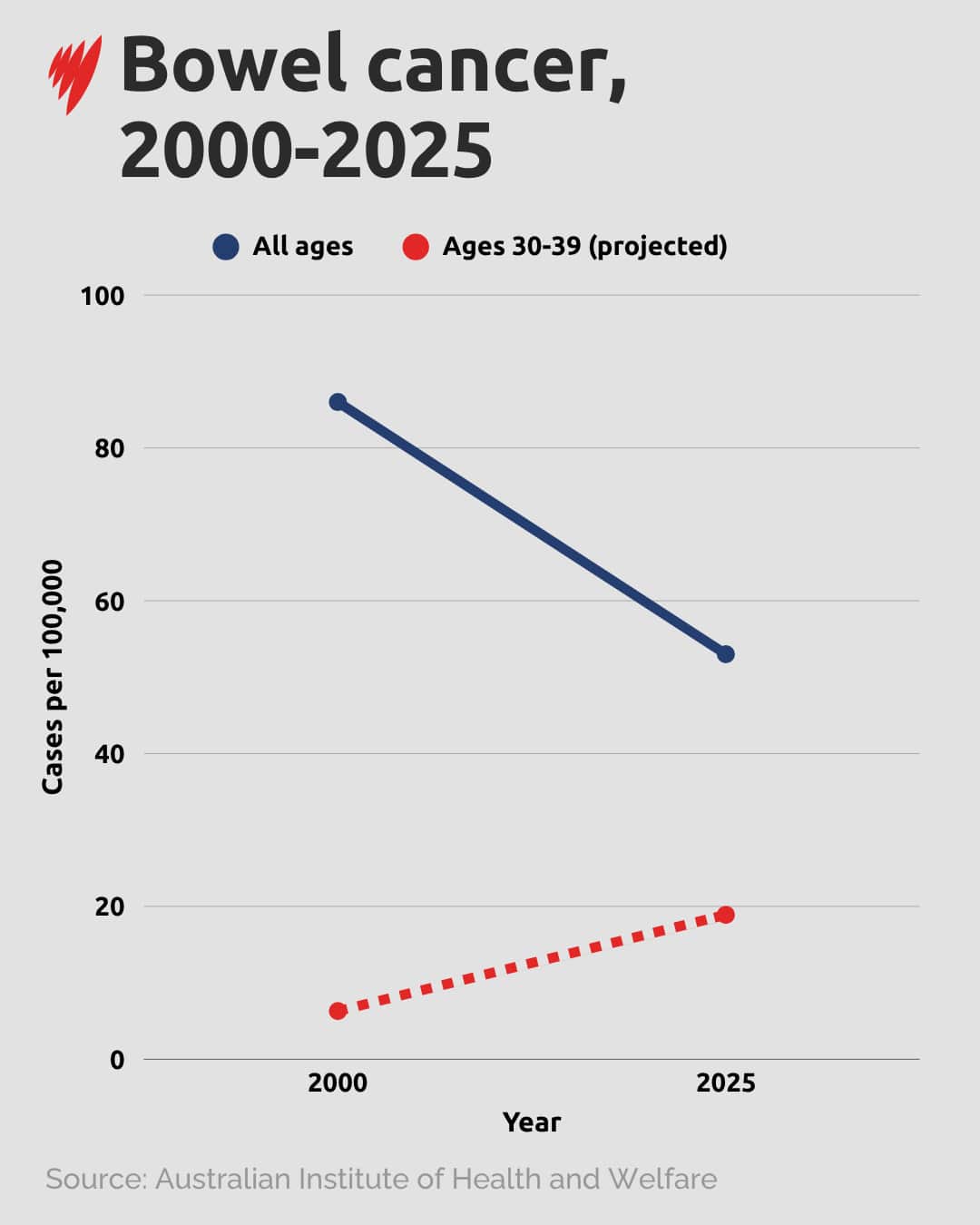
Among people in their 30s, however, every one of those trends reverses. Incidence in the 30–39 bracket rose from 6.3 cases per 100,000 in 2000 to a projected 18.9 in 2025, roughly a tripling, and the share of all colorectal cancers diagnosed in Australians under 40 has grown from 2.2 to an estimated 7.2 per cent.
Mortality has risen with it, from 1.8 to a projected 2.8 deaths per 100,000 — the only cancer among people in their 30s where more diagnoses have brought more deaths.
The AIHW is careful not to attribute all of that rise to the disease itself. Improved imaging, greater use of colonoscopy and endoscopy, heightened clinical awareness and a 2010 change to how the World Health Organization classifies the tumours could all be contributing, alongside a genuine rise in cases.
Colorectal cancer is among the cancers whose estimates the AIHW says have changed more than usual, now that data from the years 2020 and 2021 during the COVID-19 pandemic — when diagnoses dipped as people stayed away from doctors — have been folded into its projections for the first time.
Detection, not disease
Cancer incidence is rising across younger age brackets, but it could be that more of it is being found; not necessarily that more of it is occurring.
Rates among Australians in their 30s rose from 121 to a projected 135 cases per 100,000 between 2000 and 2025, and among those in their 40s from 280 to 313. In both, the single largest contributor is thyroid cancer — up 8.8 and 10.5 points respectively, ahead of bowel, breast, prostate and kidney cancer.
The AIHW attributes that increase to greater medical surveillance and new diagnostic techniques such as neck ultrasonography, rather than to a growing burden of disease.
Thyroid cancer was the only cancer in Australia to move from "rare" to "common" between 2000 and 2025, yet its mortality rate has held broadly stable throughout, between 0.5 and 0.7 deaths per 100,000.
Deaths across both age groups point the same way. Cancer mortality among Australians in their 30s fell from 18 to a projected 11 per 100,000 between 2000 and 2025, and among those in their 40s from 60 to 37.
With the single exception of bowel cancer in the 30s, rising incidence has not brought rising deaths.
First Nations cancer deaths falling faster
The report contains the AIHW's first comprehensive national dataset on cancer among Aboriginal and Torres Strait Islander people, built using new methods designed to work around data historically too incomplete to report on.
An estimated 3,600 First Nations people were diagnosed with cancer in 2025, and around 1,200 died of it.
"Overall cancer incidence and mortality rates for First Nations people have been declining over time," AIHW spokesperson Justin Harvey said.
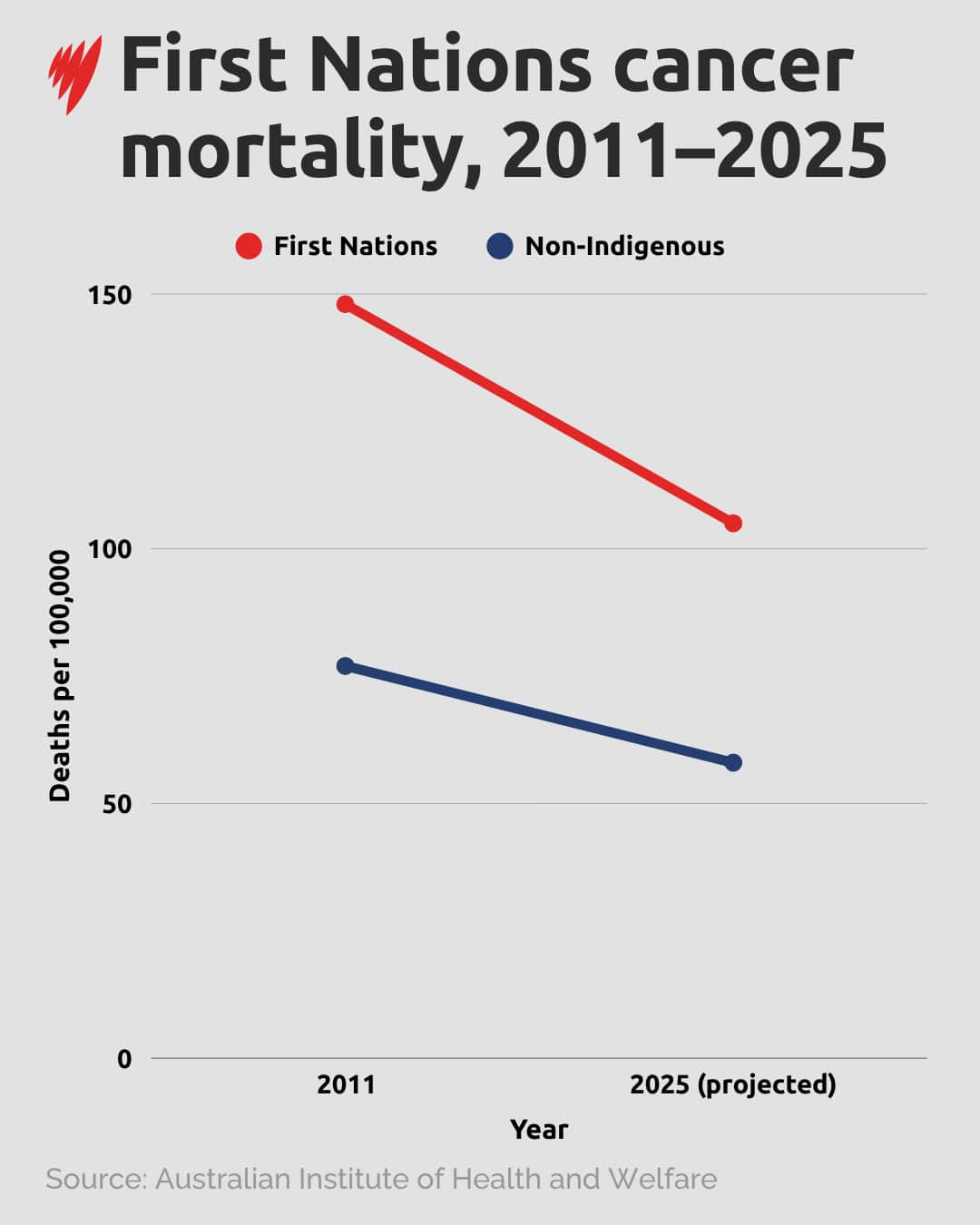
Age-standardised cancer incidence among First Nations Australians fell from 342 cases per 100,000 in 2011 to a projected 315 in 2025, and mortality from 148 deaths per 100,000 to a projected 105. Over the same period, the non-Indigenous mortality rate fell from 77 to 58. First Nations cancer rates are declining faster and the gap is narrowing, but mortality remains close to double.
The disparity lies in which cancers are being diagnosed. "First Nations people are twice as likely as non-Indigenous Australians to be diagnosed with cancers that have a lower chance of survival," Harvey said — cancers such as lung, liver and pancreatic, where fewer than 30 per cent of Australians live beyond five years.
Between 2017 and 2021, five-year relative survival was 58 per cent for First Nations people against about 76 per cent for non-Indigenous Australians. For pancreatic cancer, it was 8.8 per cent against 19 per cent.
Lung cancer is both the most frequently diagnosed cancer among First Nations people and the leading cause of cancer death, accounting for around a quarter of all First Nations cancer deaths against roughly 17 per cent nationally.
Liver cancer incidence and mortality run at three times the non-Indigenous rate.
Modelling published in The Lancet Public Health this year found cervical cancer incidence among Aboriginal and Torres Strait Islander women runs at around twice the national rate, driven by long-standing inequity in screening. Australia's elimination target will not be met on the strength of the vaccine alone.
The AIHW dataset excludes South Australia and Tasmania, where Indigenous status is not recorded completely enough to report, and apparent increases in First Nations cancer rates may partly reflect more people identifying as Aboriginal or Torres Strait Islander in successive censuses rather than any real change in the disease.
"This is the most comprehensive cancer data available for First Nations people to date," Harvey said.
"With a more complete picture of cancer outcomes, alongside more detailed information about geography and socioeconomic status, it becomes possible to identify where disparities are greatest and where targeted action can make the biggest difference."
An estimated 969,000 Australians — about 3.5 per cent of the population — will be alive at the end of 2025 having been diagnosed with cancer in the previous decade.
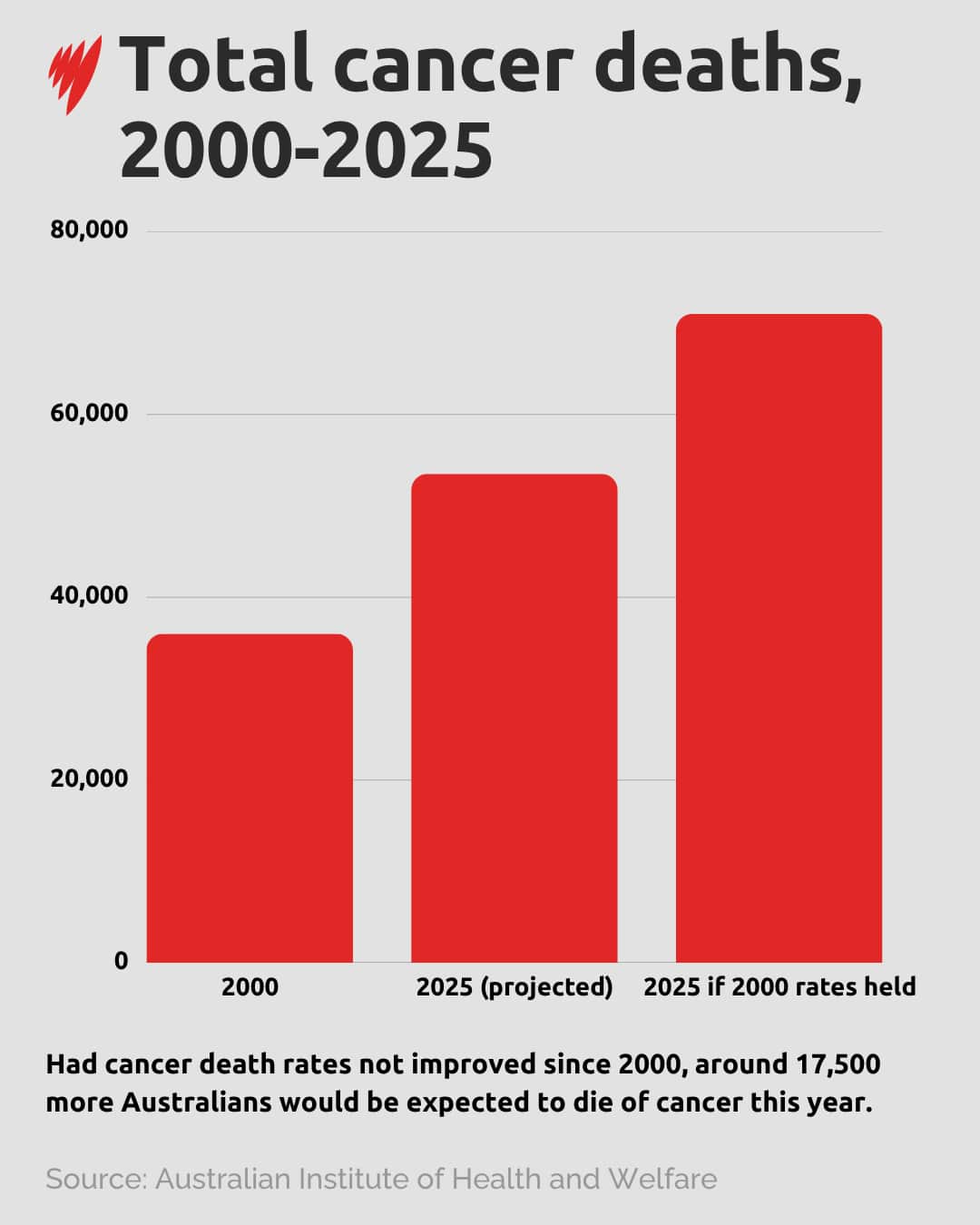
An estimated 53,500 Australians will die of cancer this year. Had the mortality rates of 2000 not improved, the figure would have been around 71,000.
For the latest from SBS News, download our app and subscribe to our newsletter.







