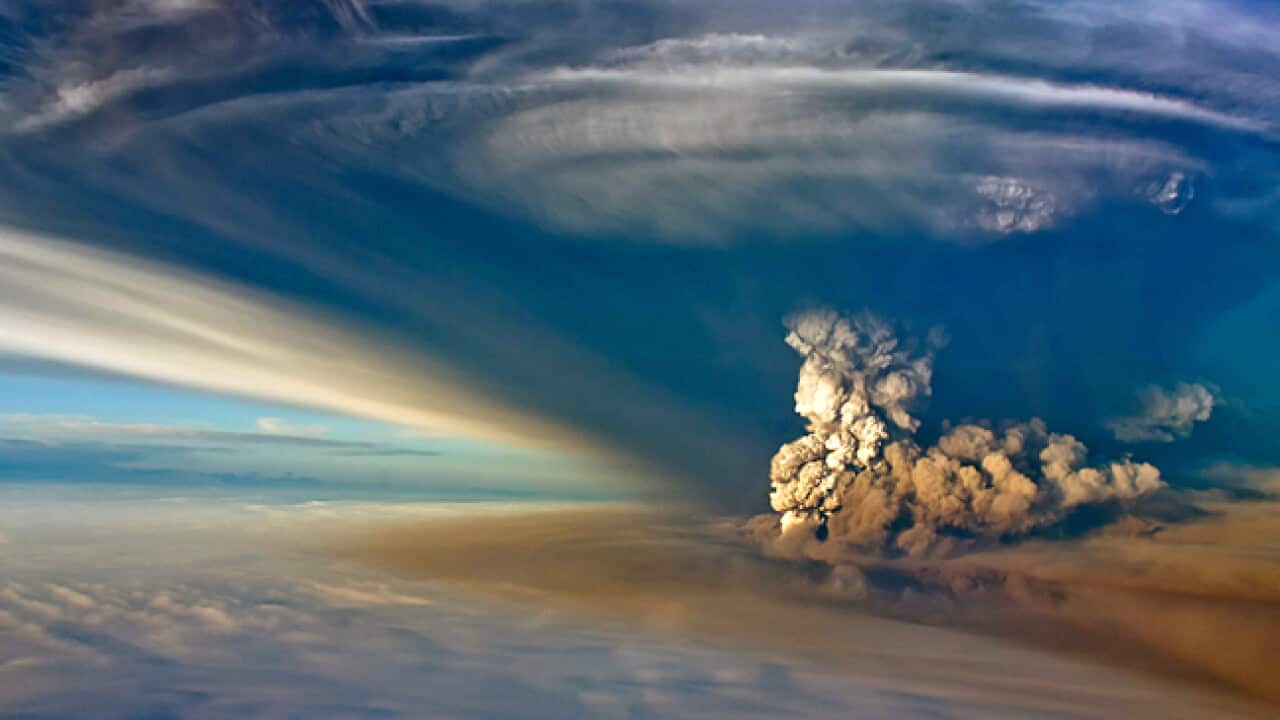
Safety experts have warned that ash from an erupting Icelandic volcano that closed the country's airspace may blow across large swathes of western Europe, raising fears of new flight chaos.
Air safety officials said ash from the Grimsvotn eruption may reach north Scotland by Tuesday before sweeping across Britain to hit France and Spain two days later, as experts said the impact should not be as far-reaching as 2010 when a similar event caused widespread flight cancellations.
Ash deposits were sprinkled over the capital Reykjavik on Sunday, some 400 kilometres to the west of the volcano which spewed a cloud about 20 kilometres into the sky.
News that makes sense
Your trusted source for staying up-to-date with the world around you. Get free daily news updates and analysis, straight to your inbox.
Residents living near to Grimsvotn said the skies had turned black in an eerie echo of last year's eruption of the smaller Eyjafjoell volcano which led to the biggest global airspace shutdown since World War II.
"It's just black outside, and you can hardly tell it is supposed to be bright daylight," Bjorgvin Hardarsson, a farmer at Hunbakkar Farm in the nearby village of Kirkjubaejarklaustur said by phone.
"It's been very dark. You'd think it was night," agreed Vilhelm Tunnarsson, a photographer for local Icelandic media staying at a nearby hotel, adding at times he had been unable to see 30 centimetres in front of him.
"I went out a little this morning, and had ash in my eyes and mouth and nose. And I just went five metres to my car and back ... I was covered," he said, describing how he and others at the hotel had tried to cover doors and windows with mattresses and towels to block the ash.
Rescue workers have been hard at work handing out masks and helping local farmers with their animals since Grimsvotn, Iceland's most active volcano located at the heart of its biggest glacier Vatnajoekull, began erupting late on Saturday.
Ash soon covered nearby villages and farms and by Sunday morning invisible deposits had reached the capital, prompting Iceland's airport authority, Isavia, to announce the main airport Keflavik was shutting.
The airspace closure "affects pretty much all of Iceland right now ... Flights to and from Iceland are shutting down," Isavia spokeswoman Hjordis Gudmundsdottir said, adding that flight routes to the north of the North Atlantic island might also eventually be affected.
Gudmundsdottir said the closure would remain in force until at least 6pm (0400 AEST) .
However, she stressed, the fact that winds were blowing the ash to the north were far better than last year's eruption of Eyjafjoell, when a massive cloud of ash was blown to the south and southeast over mainland Europe.
Saturday's eruption was the most powerful in over a century at Grimsvotn, which has erupted nine times between 1922 and 2004, a spokeswoman for the Icelandic Meteorological Office said.
The eruption, which was far more powerful than the Eyjafjoell blast and its plume peak of nine kilometres, was meanwhile already showing signs of tapering off,spokeswoman Bergthora Njala Gudmundsdottir said.
"It seems like the activity is declining quite rapidly at the moment," she said, pointing out that Grimsvotn's plume now stood at between 10 and 15 kilometres.
"That is still a quite powerful eruption, but the history of the volcano area shows that it is usually quite powerful for one or two days and then less powerful," she said, stressing though that "how it will be a day from now is impossible to say, but we are hoping it will calm down".
The plume of smoke and ash meanwhile still reaches "above the tropopause (the atmospheric boundary between the troposphere and the stratosphere) where most of weather happens, so there is still a danger that the ash can travel," Elin Jonasdottir, an aviation expert at the Meteorological Office, said.
By Sunday evening, no other European countries had closed their airspace, although aviation authorities in Britain and Scandinavia,
among the hardest hit last year, said they were keeping a close eye on developments.
The European air safety organisation Eurocontrol said no impact was expected on European airspace outside Iceland or on transatlantic flights for at least 24 hours.
When the Eyjafjoell eruption began in April 2010, orders were given to close vast swathes of European airspace for fear the ash could wreak havoc on aircraft engines.
But experts said the ash generated by the latest eruption might be of a different nature, although an official analysis has not been completed.
"I don't expect this will have the same effect as Eyjafjoell volcano because the ash is not as fine," geologist Gunnar Gudmundsson said.
"The eruption is still going strong, but because the ash is basalt it is rougher and falls back down to earth much quicker."
When it last erupted in November 2004, volcanic ash fell as far away as mainland Europe and caused minor disruptions in flights to and from Iceland.







